Understanding the Basics of EMI
What Does EMI Actually Mean?
When people hear the term EMI (Equated Monthly Installment), it often sounds simple just a fixed monthly payment you make toward a loan. But beneath that simplicity lies a structure that quietly shapes your financial future. EMI is essentially a combination of two components: the principal amount (the money you borrowed) and the interest charged by the lender. Each month, you pay a portion of both, gradually reducing your loan balance over time.
Here’s where it gets interesting. In the early months of your EMI schedule, a larger chunk of your payment goes toward interest rather than the principal. This means that even though you’re consistently paying every month, your actual loan amount doesn’t shrink as quickly as you might expect. It’s like running on a treadmill you’re moving, but not covering much ground initially.
Think about buying a smartphone or a car on EMI. The low monthly payment makes it feel accessible, almost harmless. But that feeling can be deceptive. The structure of EMI is designed to make borrowing appear manageable, even attractive. This is why so many people end up committing to loans without fully understanding the long-term impact.
Another overlooked aspect is how EMI normalizes debt. When everyone around you is paying EMIs friends, coworkers, even influencers it starts to feel like a standard way of life. But normalization doesn’t equal safety. It just means the system is widely accepted.
So, while EMI is a useful financial tool, it’s not just a payment method it’s a commitment. And like any commitment, it deserves a deeper look before you jump in.
The Core Components of an EMI
To truly understand how EMI works, you need to break it down into its core elements. At its heart, every EMI consists of three critical factors: principal, interest rate, and tenure. These three variables interact in ways that can either work in your favor or quietly drain your finances over time.
The principal is straightforward it’s the amount you borrow. But the moment you take a loan, the lender adds an interest rate, which is essentially the cost of borrowing that money. This rate can vary depending on the type of loan, your credit score, and market conditions. Even a small difference in interest rates can significantly affect how much you end up paying in total.
Then comes the tenure, or the duration of the loan. This is where things get tricky. A longer tenure reduces your monthly EMI, making it feel more affordable. But at the same time, it increases the total interest you pay over the life of the loan. It’s like choosing between a light backpack for a long hike or a heavy one for a short sprint both have trade-offs, but one may leave you more exhausted in the end.
Here’s a simple way to visualize it:
| Component | What It Does | Impact |
| Principal | Amount borrowed | Higher = Higher EMI |
| Interest Rate | Cost of borrowing | Higher = More total payment |
| Tenure | Loan duration | Longer = Lower EMI but higher interest |
What many borrowers don’t realize is how these components interact dynamically. For instance, extending your tenure might reduce your monthly burden, but it could add thousands or even lakhs to your total repayment.
Understanding these components isn’t just about numbers. It’s about control. When you grasp how principal, interest, and tenure work together, you stop being a passive borrower and start making intentional financial decisions.
The Math Behind EMI Calculations
How Interest Rates Shape Your Payments
Interest rates are the silent force steering your EMI journey, and most people underestimate just how powerful they are. At a glance, a difference between 10% and 12% might seem trivial almost negligible. But stretch that across a multi-year loan, and suddenly that “small” gap transforms into a significant financial burden. This is because EMI calculations follow a reducing balance method, meaning interest is charged on the outstanding loan amount each month. Early on, since your principal is still large, the interest portion dominates your EMI.
Picture it like this: you’re chipping away at a block of ice. In the beginning, every strike barely makes a dent because the block is massive. Over time, as it shrinks, each effort becomes more effective. Similarly, in EMI payments, your early installments mostly cover interest, while later payments finally start reducing the principal meaningfully.
Banks and financial institutions often highlight attractive EMI figures without emphasizing the total cost of borrowing. For example, a ₹500,000 loan at 12% over five years might feel manageable monthly, but you could end up paying over ₹660,000 in total. That extra ₹160,000? That’s the price of convenience and time.
Another important factor is whether the rate is fixed or floating. Fixed rates keep your EMI stable, which feels predictable, but they’re often slightly higher. Floating rates can fluctuate with market conditions, potentially reducing or increasing your EMI over time. It’s a gamble sometimes rewarding, sometimes risky.
Understanding interest rates isn’t just about knowing the percentage; it’s about recognizing their long-term impact. Even a slight reduction in rate, negotiated or researched, can save you a surprising amount of money.
Loan Tenure and Its Hidden Impact
Loan tenure is often marketed as your flexibility lever stretch it out, and your EMI shrinks. Sounds like a win, right? Not quite. While a longer tenure lowers your monthly burden, it quietly inflates the total amount you repay. This is where many borrowers fall into a subtle but costly trap.
Let’s imagine two scenarios. In the first, you take a loan for three years with a higher EMI. In the second, you stretch it to seven years with a lower EMI. The second option feels lighter on your monthly budget, almost like a financial relief. But here’s the catch: over those extra years, interest keeps accumulating. You’re essentially paying for the privilege of time.
Think of tenure as a subscription. The longer you stay subscribed, the more you pay even if each individual payment feels small. This is why lenders often nudge borrowers toward longer tenures. It increases their profit while making the deal look more attractive to you.
There’s also a psychological angle. A lower EMI can create a false sense of affordability, encouraging you to borrow more than you actually need. It’s like choosing a bigger house just because the monthly payment seems manageable, ignoring the long-term commitment attached to it.
A balanced approach is crucial. Shorter tenures save money but demand discipline. Longer tenures offer breathing room but cost more. The trick is to find a middle ground where your EMI is comfortable without turning your loan into a long-term financial drain.
Why EMI Feels Affordable (But Isn’t Always)
The Psychology of Small Monthly Payments
There’s a reason EMI-based purchases feel so easy to say yes to it taps directly into human psychology. Our brains are wired to focus on immediate affordability rather than long-term cost. When you see a product priced at ₹60,000, you hesitate. But present it as ₹2,500 per month, and suddenly it feels manageable, almost trivial.
This mental shortcut is called “payment framing.” Businesses and lenders use it to shift your attention away from the total price and toward the monthly commitment. It’s the same reason streaming services, gym memberships, and subscriptions thrive small recurring payments don’t trigger the same resistance as a large upfront cost.
Another psychological element involved is the presence of bias towards immediate rewards.. We tend to prioritize immediate gratification over future consequences. That new phone, appliance, or vacation feels valuable today, while the burden of future EMIs feels distant and abstract. By the time the reality of multiple payments sets in, you’re already locked in.
There exists a mindset that can be summarized as “it’s merely one EMI.”. Individually, each EMI seems harmless. But stack a few together a phone, a bike, a credit card conversion and suddenly a significant portion of your income is tied up in monthly obligations. It’s like carrying small weights in your backpack; each one feels light, but together they slow you down.
Understanding this psychological pull is powerful. It helps you pause and ask a critical question: Would I still buy this if I had to pay the full amount upfront? If the answer is no, the EMI might be masking a decision you wouldn’t otherwise make.
The Illusion of Affordability
EMIs create a carefully crafted illusion: that you can afford more than you actually can. It’s not that the math is wrong it’s that the perspective is incomplete. When you focus only on the monthly payment, you ignore the cumulative effect of multiple financial commitments.
Let’s say your monthly income comfortably supports a ₹10,000 EMI. That seems reasonable. But what happens when you add another ₹5,000 for a gadget, ₹7,000 for a vehicle, and ₹3,000 for a credit card conversion? Individually, each decision felt justified. Collectively, they start to squeeze your financial flexibility.
This is where the illusion breaks. Your fixed obligations grow, leaving less room for savings, emergencies, or even lifestyle choices. You’re earning, but a large chunk of your income is already spoken for. It’s like booking every seat in your financial “theater” before the show even begins there’s no room left for surprises.
Another hidden layer is opportunity cost. The money you commit to EMIs could have been invested, saved, or used to build assets. Instead, it’s tied up in depreciating items or interest payments. Over time, this can significantly impact your wealth-building potential.
The illusion of affordability isn’t about deception it’s about perspective. When you change your perspective from “Is it possible for me to make this payment monthly?” to “What is this costing me in total, and what am I giving up?”, your decisions become sharper and more intentional.
The Hidden Costs Inside EMI Plans
Processing Fees and Extra Charges
When you sign up for an EMI plan, the monthly payment is only part of the story. What often slips under the radar are the extra charges that quietly inflate the overall cost of your purchase or loan. These include processing fees, documentation charges, prepayment penalties, late payment fees, and even GST on financial services. Individually, they may seem minor, but together they can add a surprising amount to your financial commitment.
Let’s take a simple example. Suppose you take a personal loan of ₹300,000. A processing fee of 2% instantly deducts ₹6,000 from the amount you receive, yet you still repay the full loan with interest. That means you’re effectively paying interest on money you never even used. It’s like buying a full tank of fuel but starting your journey with less in the tank.
Late payment charges are another hidden landmine. Missing even a single EMI can trigger penalties and negatively impact your credit score, which in turn affects your ability to borrow in the future. Some lenders also charge foreclosure fees if you try to repay the loan early, discouraging you from escaping the interest cycle sooner.
Then there are add-on costs like insurance bundled with loans. While sometimes useful, these are often included without much clarity, increasing your EMI or total repayment amount. The lack of transparency can make it difficult to calculate the true cost of borrowing.
To get a clearer picture, always look beyond the EMI figure and ask for the Annual Percentage Rate (APR). This includes most additional charges and gives a more realistic view of what you’re actually paying. Because in the world of EMIs, the real expense isn’t always visible upfront it’s layered beneath the surface.
Compounding Interest Over Time
Interest isn’t just a static number it grows, evolves, and compounds in ways that can either work for you or against you. In the case of EMIs, it often works against you, especially when loans are stretched over longer tenures. The longer the duration, the more time interest has to accumulate, turning a manageable loan into a costly obligation.
Here’s the tricky part: even though EMI loans typically use a reducing balance method, the early-stage interest dominance means you’re paying a significant portion of the total interest upfront. This creates a situation where, even after paying EMIs for months or years, your outstanding principal doesn’t drop as quickly as expected.
Think of it like watering a plant that grows in reverse your payments are steady, but the visible reduction takes time. This can be frustrating if you decide to close the loan early, only to realize that a large portion of your payments has already gone toward interest.
Let’s look at a simplified comparison:
| Loan Tenure | Monthly EMI | Total Interest Paid |
| 3 Years | Higher | Lower |
| 7 Years | Lower | Much Higher |
The difference in total interest can be substantial, sometimes even doubling depending on the loan amount and rate. This is why longer tenures, while appealing, can quietly erode your financial health over time.
Understanding compounding in EMIs flips your perspective. Instead of seeing time as a relief, you start seeing it as a cost factor. The longer you take, the more you pay not just in money, but in lost financial opportunities.
EMI Traps That Most People Overlook
Zero-Cost EMI—Is It Really Free?
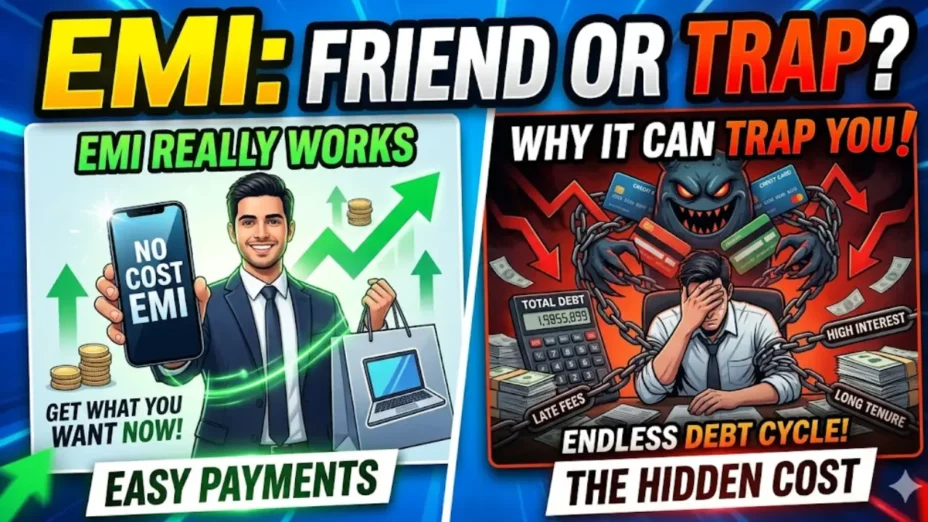
“Zero-cost EMI” sounds like a dream deal. No interest, easy payments, and instant gratification it’s hard to resist. But here’s the uncomfortable truth: zero-cost EMI is rarely truly free. The cost is simply hidden or shifted in ways that aren’t immediately obvious.
In many cases, the interest is already baked into the product’s price. Retailers may remove upfront discounts or inflate the base price to compensate for the “zero interest” offer. So while you’re not paying explicit interest, you’re still paying more than you would in a standard purchase.
Another common tactic involves merchant-lender partnerships, where the brand absorbs the interest cost but passes it on indirectly through pricing strategies. Some offers also include processing fees or mandatory credit card usage, which can carry their own costs if not managed properly.
There’s also the issue of missed payments. Even a single delay can convert your zero-cost EMI into a high-interest liability, often at steep credit card rates. What started as a “free” option can quickly become expensive if not handled carefully.
The key is to compare the EMI offer with the full upfront price, including discounts. If you’re paying more through EMI than you would in a one-time payment, the “zero-cost” label is just clever marketing.
Credit Card EMI Pitfalls
Credit card EMIs are incredibly convenient. With just a few clicks, you can convert a large purchase into manageable monthly payments. But convenience often comes at a price sometimes a steep one.
Unlike traditional loans, credit card EMIs typically carry higher interest rates, often ranging between 13% to 24% annually. On top of that, there may be conversion fees and taxes that increase the effective cost. Because these charges are spread out, they don’t always feel significant but they add up.
Another risk is the impact on your credit utilization ratio. When you convert a purchase into EMI, it reduces your available credit limit. If a large portion of your limit is tied up in EMIs, it can negatively affect your credit score and limit your financial flexibility.
Then there’s the temptation factor. Credit cards make it easy to stack multiple EMIs without feeling the immediate impact. Before you realize it, a significant part of your monthly income is committed to repayments, leaving little room for savings or emergencies.
A subtle but important point: missing a credit card EMI can lead to very high penalty interest rates, often much higher than regular loan penalties. This situation can rapidly develop into a cycle of debt that is difficult to break free from.
Credit card EMIs aren’t inherently bad but they require discipline and awareness. Without that, they can quietly become one of the most expensive forms of borrowing.
Real-Life Examples of EMI Debt Cycles
When One EMI Turns Into Many
Typically, it does not begin with a significant error. It starts with something small, almost harmless—a smartphone on EMI, maybe a laptop for work, or a quick upgrade to a better appliance. The monthly payment feels manageable, so there’s no real hesitation. Then, a few months later, another need or want pops up. Another EMI gets added. Before long, what began as a single commitment quietly multiplies into several parallel obligations.
This is how EMI stacking happens. Each new installment feels justified in isolation, but collectively they begin to consume a significant portion of your income. Imagine earning ₹50,000 a month and committing ₹5,000 here, ₹3,000 there, ₹7,000 somewhere else. Individually, none of these seem alarming. Together, they start eating into your flexibility, leaving less room for savings or unexpected expenses.
A common real-life scenario involves young professionals. With steady income and access to easy credit, they build a lifestyle supported by EMIs phone, bike, furniture, vacations. Everything is under control until an unexpected event hits: a medical expense, a job change, or even a delay in salary. Suddenly, the fixed nature of EMIs becomes a burden. Unlike optional spending, these payments don’t pause.
There’s also a subtle emotional trap. Once you’re used to paying EMIs, it starts to feel normal—even necessary. The idea of saving up and paying upfront begins to feel outdated or restrictive. But that shift in mindset is exactly what keeps the cycle going.
Breaking this pattern requires awareness. Not just of how much you owe, but how many commitments you’ve layered onto your income. Because the real danger isn’t a single EMI it’s the quiet accumulation of many.
The Snowball Effect of Monthly Obligations
Debt rarely explodes overnight it builds momentum. The snowball effect in EMIs is a perfect example of this slow escalation. At first, your obligations seem stable. You’re managing your payments, staying on track, and everything feels under control. But then, life happens.
Maybe your expenses increase, or your income doesn’t grow as expected. Perhaps inflation pushes up your daily costs. Suddenly, the margin between your income and expenses shrinks. With multiple EMIs in play, even a small disruption can tip the balance.
Here’s where the snowball starts rolling. If you miss one payment, penalties kick in. That increases your financial burden, making it harder to keep up with other EMIs. In some cases, people take new loans to pay off existing ones, hoping to buy time. But this often leads to a deeper cycle of debt, where you’re constantly juggling obligations rather than reducing them.
It’s similar to pushing a snowball downhill. At first, it’s small and manageable. But as it rolls, it gathers more snow, growing larger and harder to control. In financial terms, that “snow” is interest, penalties, and new borrowing.
Another overlooked aspect is stress. Managing multiple EMIs can create constant mental pressure. You’re always aware of upcoming due dates, always calculating your balance, always trying to stay ahead. Over time, this can affect not just your finances, but your overall well-being.
Recognizing the snowball effect early is crucial. It’s not just about avoiding debt it’s about maintaining control before things accelerate beyond your comfort zone.
Smart Strategies to Avoid EMI Traps
Choosing the Right Tenure
Selecting the right loan tenure is less about finding the lowest EMI and more about striking a balance between affordability and total cost. Many borrowers instinctively choose longer tenures because they reduce the monthly burden. But as you’ve seen, this often leads to significantly higher interest payments over time.
A smarter approach is to choose the shortest tenure you can comfortably afford. This reduces the total interest and helps you become debt-free sooner. Think of it as ripping off a bandage quickly instead of dragging it out. Yes, it might feel slightly uncomfortable in the short term, but it’s far less painful overall.
That said, “comfortably afford” is the key phrase here. Stretching yourself too thin with high EMIs can backfire if your income fluctuates or unexpected expenses arise. A good rule of thumb is to keep your total EMIs within 30–40% of your monthly income. This leaves enough room for savings and emergencies.
Another effective tactic is to prepay whenever possible. Even small additional payments toward your principal can reduce your interest burden and shorten your loan tenure. Over time, these extra contributions can make a noticeable difference.
Choosing the right tenure isn’t just a financial decision it’s a strategic one. It determines how long you stay tied to a loan and how much you ultimately pay for it.
Budgeting Before Committing
Before saying yes to any EMI, it’s essential to step back and look at your overall financial picture. Budgeting isn’t about restricting yourself it’s about understanding your limits and making informed decisions.
Start by mapping out your monthly income and fixed expenses. Then factor in your existing EMIs, savings goals, and variable spending. This gives you a clear view of how much room you actually have for a new commitment. Without this clarity, it’s easy to overestimate your capacity and take on more than you can handle.
One useful exercise is to simulate the EMI for a few months before committing. Set aside the amount you’d be paying as EMI and see how it affects your lifestyle. Does it feel manageable? Does it limit your flexibility? This real-world test can reveal insights that numbers alone might not.
It’s also important to consider future uncertainties. Income changes, emergencies, and unexpected expenses are part of life. Building a buffer into your budget ensures that your EMIs don’t become a source of stress when circumstances shift.
Budgeting transforms EMI from a reactive decision into a proactive one. Instead of adjusting your life around your payments, you ensure your payments fit into your life.
When EMI Actually Makes Sense
Good Debt vs Bad Debt
Not all EMIs are created equal, and treating them as universally harmful misses an important nuance. Some EMIs can actually support your long-term financial growth, while others quietly drain your resources without adding real value. The difference lies in understanding good debt versus bad debt.
Good debt typically involves borrowing for something that either appreciates in value or generates income over time. Think of a home loan, an education loan, or even a business investment. In these cases, the EMI isn’t just a payment it’s a step toward building an asset or increasing your earning potential. For example, paying EMI on a course that boosts your career prospects can lead to higher income, making the cost worthwhile.
Bad debt, on the other hand, is usually tied to depreciating assets or lifestyle upgrades—things that lose value quickly and don’t generate returns. A high-end smartphone, luxury items, or impulse purchases on EMI fall into this category. While they may provide short-term satisfaction, they don’t contribute to your financial growth.
Here’s a quick comparison:
| Type of Debt | Example | Long-Term Impact |
| Good Debt | Education, Home Loan | Builds wealth or income |
| Bad Debt | Gadgets, Luxury items | Drains finances |
The tricky part is that bad debt often feels harmless because of low EMIs. But over time, multiple such commitments can limit your ability to invest, save, or take advantage of better opportunities.
A useful question to ask before taking any EMI is: Will this improve my financial position in the future, or just my present comfort? The answer can help you distinguish between a smart decision and a costly habit.
Strategic Use of EMI for Wealth Building
EMIs aren’t inherently negative they’re tools. And like any tool, their impact depends on how you use them. When applied strategically, EMIs can actually help you leverage opportunities without draining your savings.
For instance, consider a scenario where you have enough cash to buy an asset outright but choose an EMI instead. If the interest rate on the EMI is lower than the returns you can earn by investing that cash, you come out ahead. This is a classic example of financial leverage—using borrowed money to potentially increase your overall returns.
Another strategic use of EMI is maintaining liquidity. Instead of locking all your funds into a single purchase, you spread the cost over time while keeping cash available for emergencies or investments. This flexibility can be invaluable, especially in uncertain financial environments.
However, this strategy requires discipline. It only works if you actually invest or utilize the saved cash wisely. Otherwise, you end up paying interest without gaining any real advantage.
Timing also plays a role. Taking an EMI during a stable income phase, when you have predictable cash flow, is far safer than committing during uncertain periods. Aligning your EMI decisions with your financial stability ensures that they remain tools not traps.
Used wisely, EMIs can support growth and flexibility. Used carelessly, they can become long-term burdens. The difference lies in intention and planning.
Expert Tips to Stay Financially Safe
Financial experts often emphasize that the key to managing EMIs isn’t avoidance it’s awareness and discipline. One widely recommended guideline is the 50/30/20 rule, where 50% of your income goes toward needs, 30% toward wants, and 20% toward savings. EMIs should ideally fit within the “needs” category and not crowd out your ability to save.
Another important tip is to maintain an emergency fund covering at least 3–6 months of expenses. This acts as a safety net, ensuring that unexpected events don’t disrupt your EMI commitments. Without this buffer, even a minor financial shock can lead to missed payments and penalties.
Experts also advise regularly reviewing your loans. Interest rates change, and better options may become available. Refinancing or balance transfers can help reduce your interest burden if done at the right time. It’s a bit like switching to a better deal on a subscription you get the same service at a lower cost.
Automation can also be your ally. Setting up auto-debit for EMIs ensures timely payments and helps maintain a healthy credit score. But it’s equally important to monitor your accounts to avoid overdrafts or unexpected deductions.
Finally, there’s a simple but powerful habit: pause before committing. Give yourself 24–48 hours before agreeing to any EMI. This short delay can help you separate impulse from necessity and make a more rational decision.
Conclusion
EMIs are designed to make life easier, and in many ways, they do. They allow you to access opportunities, manage large expenses, and spread costs over time. But beneath that convenience lies a structure that can quietly shape your financial future for better or worse.
The real challenge isn’t understanding how EMIs work on paper; it’s recognizing how they influence your behavior. The low monthly payments, the easy approvals, the normalization of debt all of these factors can nudge you toward decisions that feel right in the moment but carry long-term consequences.
When you shift your perspective from monthly affordability to total cost and long-term impact, everything changes. You start asking better questions, making more intentional choices, and using EMIs as tools rather than crutches.
Financial freedom isn’t about avoiding EMIs altogether it’s about using them wisely, with clarity and control.
FAQs
1. Is EMI always a bad financial choice?
No, EMIs are not inherently bad. They can be useful for acquiring assets or opportunities that improve your financial position, such as education or property. The key is to evaluate whether the EMI contributes to long-term value or just short-term satisfaction.
2. What portion of my salary should be allocated to EMIs?
A commonly recommended limit is 30–40% of your monthly income. Staying within this range helps maintain financial stability and ensures you still have room for savings and unexpected expenses.
3. What is the biggest risk of taking multiple EMIs?
The main risk is reduced financial flexibility. Multiple EMIs can consume a large portion of your income, making it harder to handle emergencies, save money, or adapt to changes in your financial situation.
4. Are zero-cost EMIs really free?
Not always. The cost is often hidden in the product price, reduced discounts, or additional fees. It’s important to compare the total cost with and without the EMI to understand the real impact.
5. Can I reduce my EMI burden after taking a loan?
Yes, options include prepayment, refinancing, or balance transfer to a lower interest rate. Even small additional payments toward the principal can significantly reduce your overall interest.