
Why YouTube Is Still the Best Platform for Creators.
The digital world has changed dramatically over the past decade. Social media platforms appear and disappear, algorithms change frequently, and audience preferences evolve rapidly. Yet one platform has remained a powerful and reliable space for creators: YouTube.
Unlike short-form social platforms where content disappears quickly, YouTube allows creators to build a long-term library of videos that can continue generating views, subscribers, and income for years.
A single well-optimized video can bring thousands of viewers every month, even if it was uploaded several years ago.
That is why YouTube is often described as the most sustainable content platform for creators, educators, businesses, and influencers.
However, success on YouTube does not happen randomly. It requires a deep understanding of how the platform works.
The most successful creators understand three important principles:
- The YouTube algorithm favors viewer satisfaction.
- Content strategy matters more than equipment.
- Long-term consistency creates exponential growth.
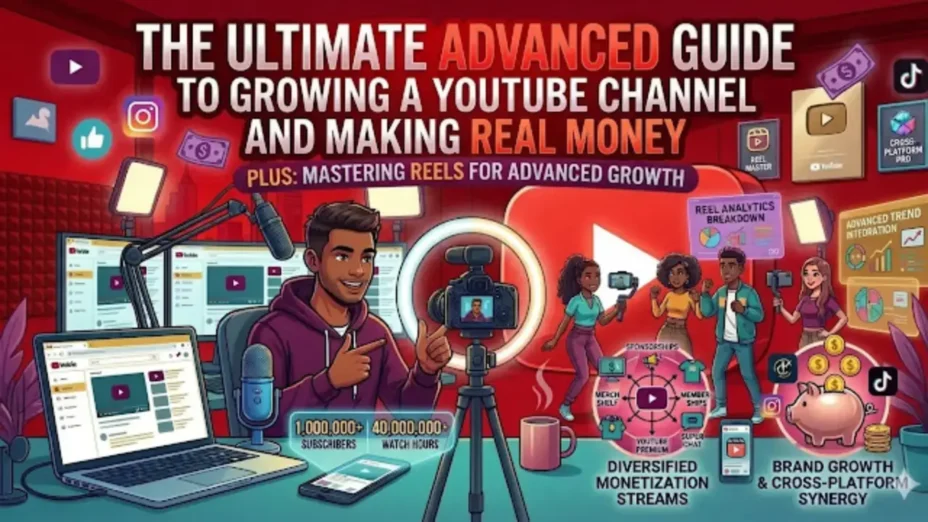
This article- Ultimate Advanced Guide to Growing a YouTube Channel and Making Money will walk you through advanced YouTube growth strategies used by professional creators.
By the end, you will understand how to build a scalable channel, grow an audience, and turn your videos into a sustainable source of income.
Chapter 1: Understanding the YouTube Algorithm.
Before creating content, it is essential to understand how YouTube recommends videos.
The platform uses a sophisticated algorithm to decide which videos appear in search results, home pages, and suggested videos.
The algorithm analyzes several viewer behaviors, including:
• Click-through rate (CTR)
• Watch time
• Audience retention
• Engagement (likes, comments, shares)
• Session duration
The goal of YouTube is simple: keep viewers on the platform for as long as possible.
If your videos help YouTube achieve that goal, the algorithm will recommend them to more people.
Click-Through Rate (CTR).
Click-through rate measures how many people click your video after seeing the thumbnail and title.
If 1000 people see your video thumbnail and 80 click on it, your CTR is 8%.
A strong CTR usually falls between 5% and 12%.
Low CTR means viewers are not interested in your title or thumbnail.
Audience Retention.
Audience retention measures how long viewers stay on your video.
If people leave within the first 20 seconds, the algorithm assumes the content is not engaging.
High-performing videos often maintain 50–70% retention.
Improving retention is one of the fastest ways to grow on YouTube.
Watch Time.
Watch time is the total number of minutes people spend watching your content.
Videos that generate longer watch sessions are more likely to be recommended.
This is why longer videos often perform better than very short ones.
Chapter 2: Choosing a Profitable YouTube Niche.
One of the biggest mistakes beginners make is creating random videos about unrelated topics.
Channels grow faster when they focus on a specific niche.
A niche helps the algorithm understand what your channel is about.
It also helps viewers decide whether they want to subscribe.
High-Growth YouTube Niches.
Some niches consistently perform well due to large audience demand.
Popular niches include:
Education
Technology reviews
Personal finance
Health and fitness
Travel
Cooking
Gaming
Motivation and self-development
For example, creators who explain financial topics often attract advertisers from banks, investment companies, and fintech startups.
This increases the value of their advertising revenue.
Passion vs Profit.
Choosing a niche should balance two factors:
Interest and market demand.
If you choose a niche only because it is profitable but you dislike the topic, you will struggle to stay consistent.
On the other hand, if you choose a niche with no audience demand, growth will be extremely slow.
The best strategy is to combine passion with market opportunity.
Chapter 3: Building a Strong Channel Identity.
A professional channel identity builds trust with viewers.
Your brand includes several elements:
Channel name
Logo
Banner design
Channel description
Content style
A recognizable brand makes your videos easier to remember.
Creating a Memorable Channel Name.
Your channel name should be:
Short
Easy to spell
Related to your niche
For example, a technology channel may include words like “tech,” “review,” or “lab”.
Avoid long complicated names.
Simple names are easier to search and remember.
Designing Your Channel Banner.
The banner is the first visual element viewers see.
A professional banner usually includes:
Your channel name
Upload schedule
Topic categories
You can create banners easily using Canva.
Chapter 4: Advanced Content Strategy.
Content strategy determines whether your channel grows quickly or remains stagnant.
Professional creators categorize their videos into three types:
- Search-based videos
- Recommended videos
- Viral videos
Search-Based Videos.
These videos answer specific questions that people search for.
Examples include:
How to repair a smartphone
How to start investing in mutual funds
How to learn coding
Search videos generate long-term traffic.
They may continue attracting viewers for years.
Recommended Videos.
These videos appear in YouTube’s suggested video section.
They usually include:
Tutorials
Storytelling
Entertainment content
These videos help increase watch time and channel growth.
Viral Videos.
Viral videos attract sudden massive views.
However, viral success is unpredictable.
Smart creators focus more on consistent useful content rather than chasing viral trends.
Chapter 5: Creating High-Quality Videos.
Many beginners believe they need expensive equipment.
In reality, content quality matters more than equipment.
Even a smartphone can produce excellent videos if used correctly.
Basic Equipment Setup.
Essential beginner tools include:
Smartphone camera
Tripod
External microphone
Lighting
Audio quality is extremely important.
Viewers tolerate average video quality but rarely tolerate poor sound.
Video Structure for Maximum Retention.
High-retention videos follow a specific structure:
Hook (first 10 seconds)
Introduction
Main content
Summary
Call-to-action
The hook should immediately explain why the viewer should continue watching.
For example:
“Today I will show you the exact strategy that helped my channel gain 100,000 subscribers in six months.”
This creates curiosity.
Chapter 6: Professional Video Editing.
Editing improves the viewing experience.
Common editing techniques include:
Removing long pauses
Adding background music
Using transitions
Adding subtitles
Popular editing tools include:
DaVinci Resolve
CapCut
These tools allow creators to produce professional-quality videos without expensive software.
Chapter 7: Mastering YouTube SEO.
Search engine optimization (SEO) helps your videos appear in search results.
YouTube is actually the second largest search engine in the world, owned by Google.
SEO involves optimizing:
Titles
Descriptions
Tags
Thumbnails
Keyword Research.
Keyword research helps you understand what viewers are searching for.
One useful tool is Google Ads Keyword Planner.
It reveals search volume and keyword trends.
Another powerful tool used by creators is TubeBuddy, which helps analyze keyword competition.
Writing SEO Titles.
Good titles combine curiosity with clear information.
Example:
“Beginner’s Guide to Investing in Mutual Funds (Step-by-Step Strategy)”
Avoid misleading titles that do not match the video content.
Clickbait reduces viewer trust and retention.
Chapter 8: Designing High-CTR Thumbnails.
Thumbnails play a major role in attracting viewers.
A compelling thumbnail can increase video clicks dramatically.
Effective thumbnails usually include:
Bright colors
Minimal text
Human facial expressions
Clear subject focus
Many creators design thumbnails using Adobe Photoshop or Canva.
Chapter 9: Uploading and Managing Videos.
All videos are uploaded through YouTube Studio.
This dashboard allows creators to manage:
Videos
Analytics
Comments
Monetization settings
Creators can also schedule videos to publish automatically.
Consistent upload schedules help build viewer loyalty.
Chapter 10: Understanding YouTube Analytics.
Analytics provide detailed information about viewer behavior.
Key metrics include:
Views
Watch time
Subscriber growth
Traffic sources
Audience demographics
Analyzing these metrics helps creators identify which videos perform best.
They can then create similar content to grow faster.
Chapter 11: Monetizing Your YouTube Channel.
The primary monetization system is the YouTube Partner Program.
To qualify, a channel must achieve:
1000 subscribers
4000 watch hours in the last 12 months
Once approved, creators can earn advertising revenue.
Payments are processed through Google AdSense.
Chapter 12: Multiple Income Streams from YouTube.
Successful creators rarely rely on a single income source.
They generate revenue through several methods.
Ad Revenue.
Ads appear before or during videos.
Creators receive a share of advertising income.
Brand Sponsorships.
Brands pay creators to promote products.
Technology channels often receive sponsorships from gadget companies.
Affiliate Marketing.
Creators share affiliate links to products.
When viewers purchase through these links, the creator receives a commission.
Platforms like Amazon offer affiliate programs.
Merchandise.
Large channels often sell branded merchandise such as clothing or accessories.
This strengthens community engagement while generating additional income.
Chapter 13: Growing Faster Using YouTube Shorts.
Short-form videos have become extremely popular.
YouTube Shorts allows creators to upload vertical videos under 60 seconds.
Shorts can reach millions of viewers quickly.
They are an excellent way to attract new subscribers.
However, long-form videos usually generate higher revenue.
The best strategy is to combine both formats.
Chapter 14: Building a Loyal Community.
Audience connection is one of the most powerful growth factors.
Creators should respond to comments and interact with viewers regularly.
Engaged audiences are more likely to share videos and recommend the channel to others.
Community posts, polls, and live streams help strengthen this relationship.
Chapter 15: Avoiding Common YouTube Mistakes.
Many beginners fail because they repeat common mistakes.
These include:
Uploading inconsistently
Ignoring thumbnails
Choosing overly competitive niches
Using copyrighted music
Giving up too early
Growth on YouTube takes time.
Channels often take several months before experiencing significant growth.
Chapter 16: Protecting Your Channel.
As your channel grows, security becomes important.
Creators should enable two-factor authentication for their Google accounts.
They should also avoid suspicious emails and unknown links.
Protecting your account prevents hackers from stealing your channel and revenue.
Chapter 17: Long-Term Growth Strategy.
Successful creators think long term.
Instead of focusing only on quick views, they build content libraries.
Each video becomes part of a larger ecosystem.
Over time, hundreds of videos work together to generate consistent traffic.
Turning YouTube into a Digital Business.
YouTube is no longer just a video platform.
It has become a global economy where creators build careers, businesses, and communities.
Many creators start with nothing more than a smartphone and a passion for sharing knowledge.
Through dedication, strategy, and creativity, they build audiences that reach millions of viewers around the world.
If you approach YouTube with patience and a long-term mindset, the platform can become an incredible opportunity.
Your videos can educate, inspire, entertain, and create real financial freedom.
The journey may begin with a single video, but with the right strategy, that small step can grow into a powerful digital empire.