
What Are Gut Feelings?
Defining Intuition in Everyday Life
You’ve probably experienced it that sudden, unexplainable feeling nudging you toward a decision without any logical reasoning to back it up. That’s what we casually call a gut feeling, and while it might sound mystical or even irrational, there’s actually a fascinating scientific foundation behind it. Intuition is essentially your brain’s way of making quick judgments based on patterns it has recognized over time, even if you’re not consciously aware of those patterns. It’s like your mind is running a background process, quietly analyzing information and delivering a conclusion without showing its work.
Think about the last time you met someone and instantly felt uneasy or, on the flip side, completely at ease. You didn’t sit down and logically list reasons for your reaction it just happened. That’s intuition at play. It draws from your accumulated experiences, memories, and subconscious observations, compressing them into a single emotional signal. While it may feel like magic, it’s actually a highly efficient mental shortcut.
Interestingly, intuition isn’t limited to big, life-changing decisions. It shows up in small, everyday choices too like picking the fastest route home, choosing what to eat, or deciding whether to trust a piece of advice. In a world overloaded with information, intuition acts like a filter, helping you cut through the noise. But here’s the big question: if gut feelings are so powerful and ever-present, can they really be trusted?
Common Examples of Gut Instincts
Gut feelings often show up when you least expect them, and they tend to be strongest in situations involving uncertainty or risk. Imagine walking down a dimly lit street and suddenly feeling like something isn’t right, even though you can’t pinpoint why. That subtle internal alarm might prompt you to change direction or stay alert. In many cases, this kind of instinct has evolutionary roots it’s your brain’s way of keeping you safe.
Another common example is in decision-making under pressure. Athletes, for instance, rely heavily on intuition during games. A basketball player doesn’t calculate angles and probabilities before making a split-second pass; they just “know” what to do. Similarly, experienced professionals like doctors or firefighters often make rapid decisions based on gut feelings shaped by years of experience. These instincts aren’t random; they’re built on a deep well of knowledge that has become automatic.
Even in relationships, gut feelings play a huge role. You might instantly trust someone or feel suspicious without any clear evidence. While this can sometimes lead to misjudgments, it often reflects subtle cues your brain has picked up, such as body language, tone of voice, or inconsistencies in behavior.
What makes gut instincts so intriguing is their speed and confidence. They don’t come with hesitation or doubt they just appear. But speed doesn’t always equal accuracy, and that’s where understanding the science behind them becomes essential.
The Brain-Gut Connection Explained
What Is the Enteric Nervous System?
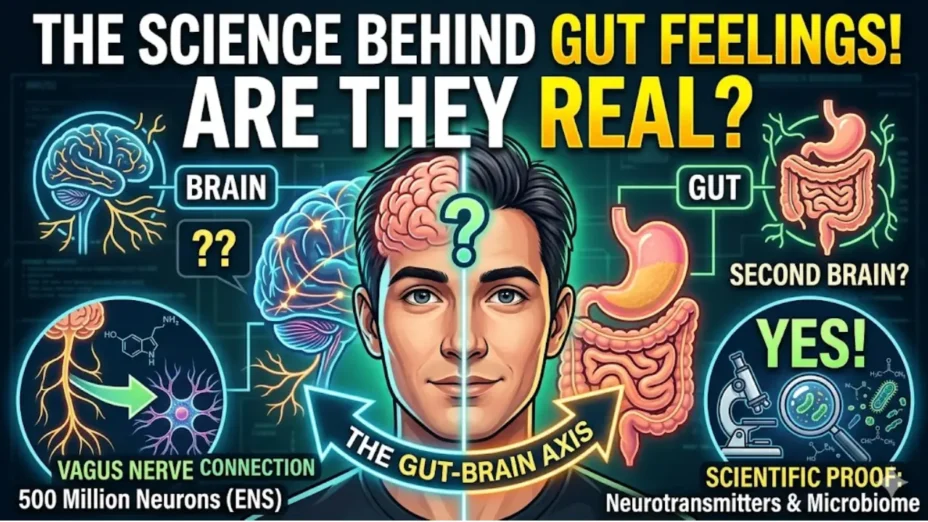
When people talk about gut feelings, they’re not just speaking metaphorically. There’s an actual biological system in your body that plays a key role in this phenomenon, known as the enteric nervous system (ENS). This complex network of neurons is embedded in the walls of your gastrointestinal tract and contains over 100 million nerve cells more than your spinal cord. That’s a staggering number, and it’s one of the reasons scientists often refer to it as a “second brain.”
The ENS operates semi-independently from your central nervous system, meaning it can function without direct input from your brain. It regulates digestion, controls the movement of food through your intestines, and even communicates with your brain through the vagus nerve, a major communication highway linking the gut and the brain. This constant back-and-forth exchange is what forms the basis of the brain-gut connection.
What’s even more fascinating is that your gut produces a significant amount of neurotransmitters, including serotonin, often called the “feel-good” chemical. In fact, around 90% of the body’s serotonin is found in the gut. This explains why your digestive system can influence your mood, emotions, and even decision-making processes. Ever noticed how stress can cause stomach discomfort? That’s the brain-gut connection in action.
Scientists are increasingly discovering that this connection plays a crucial role in mental health, immunity, and overall well-being. It’s not just about digestion it’s about communication. Your gut is constantly sending signals to your brain, shaping how you feel and sometimes how you think.
Why It’s Called the “Second Brain”
The term “second brain” isn’t just a catchy phrase it reflects the remarkable autonomy and complexity of the enteric nervous system. Unlike other systems in your body, the ENS doesn’t rely entirely on instructions from your brain. It can make decisions, process information, and even learn from experience, all on its own. That level of independence is what sets it apart.
One of the key reasons it earns this title is its ability to influence emotions and behavior. When your gut senses something off whether it’s spoiled food or a stressful situation it sends signals to your brain that can trigger emotional responses like anxiety or discomfort. This is why people often describe feeling “butterflies” in their stomach before a big event or a “knot” when they’re nervous.
Research has shown that the gut microbiome the trillions of bacteria living in your digestive tract also plays a significant role in this process. These microbes produce chemicals that can affect brain function, further strengthening the link between gut and mind. It’s like having a tiny ecosystem inside you that actively participates in your thoughts and feelings.
So when you say you have a gut feeling, you’re not just being poetic. You’re tapping into a sophisticated biological system that’s constantly working behind the scenes. The real question isn’t whether gut feelings are real they clearly are. The deeper question is how much we should rely on them, and that’s where things get even more interesting.
How Gut Feelings Work Scientifically
Role of Neurotransmitters
To really understand gut feelings, you have to zoom in on the microscopic level where neurotransmitters are constantly firing signals between your gut and brain. These chemical messengers are the backbone of your nervous system, and they play a surprisingly large role in shaping what you perceive as intuition. One of the most important players here is serotonin, a neurotransmitter often associated with mood regulation. What catches many people off guard is that about 90% of serotonin is produced in the gut, not the brain. That alone should make you rethink the idea that thinking and feeling are purely “brain-based” activities.
But serotonin isn’t the only chemical involved. Dopamine, gamma-aminobutyric acid (GABA), and other neurotransmitters are also influenced by gut activity and your microbiome. These chemicals help regulate not just mood, but also decision-making, motivation, and risk assessment. When your gut senses something whether it’s a physical sensation or a subtle environmental cue it sends chemical signals through the vagus nerve to your brain. Your brain then interprets these signals, often translating them into a feeling: comfort, unease, excitement, or caution.
Here’s where things get even more interesting. The gut doesn’t “think” in words or logic, but it processes patterns based on past inputs. If you’ve repeatedly experienced certain situations—say, being around untrustworthy people your gut may recognize similar cues in the future and trigger a warning signal before your conscious mind catches up. It’s like having a silent partner that’s constantly scanning for patterns and nudging you when something feels familiar.
This biochemical conversation between gut and brain happens incredibly fast, often in milliseconds. That’s why gut feelings feel so immediate and certain. You’re not aware of the layers of processing happening beneath the surface you just feel the outcome. And while this system is efficient, it’s not foolproof, which is why understanding its limits is just as important as appreciating its strengths.
The Influence of Past Experiences
Gut feelings don’t come out of nowhere they are deeply rooted in your past experiences, even the ones you don’t consciously remember. Your brain is constantly storing information, from major life events to tiny, seemingly insignificant details like facial expressions, tones of voice, and environmental cues. Over time, these experiences form a vast internal database that your subconscious mind uses to make quick judgments.
Imagine your brain as a high-speed pattern recognition machine. When you encounter a new situation, it instantly compares it to similar scenarios you’ve faced before. If it finds a match even a partial one it sends a signal that manifests as a gut feeling. For example, if you once had a negative experience in a certain type of environment, your gut might warn you when you find yourself in a similar setting again, even if you can’t pinpoint why.
This is why experts in various fields often rely heavily on intuition. A seasoned firefighter, for instance, might sense that a building is about to collapse without seeing obvious signs. In reality, their brain has picked up on subtle cues heat patterns, sounds, structural behavior that they’ve learned to associate with danger over years of experience. Psychologist Gary Klein, who studied decision-making in high-stakes environments, found that experienced professionals often make better intuitive decisions than novices, precisely because their internal database is richer and more refined.
However, there’s a flip side. If your past experiences are limited or biased, your gut feelings can lead you astray. For example, if you’ve had a few bad interactions with a certain group of people, your intuition might generalize that negativity unfairly. This is where intuition overlaps with cognitive bias, and it’s why gut feelings should be examined rather than blindly trusted.
Are Gut Feelings Reliable?
When Intuition Is Accurate
Gut feelings can be incredibly accurate but only under certain conditions. The key factor is experience. When you’ve spent years in a particular field or repeatedly encountered similar situations, your intuition becomes finely tuned. It’s no longer just a vague feeling; it’s a rapid, unconscious analysis based on a wealth of data. This is why chess grandmasters can instantly recognize strong moves, or why an experienced nurse might detect subtle signs of a patient’s decline before any tests confirm it.
Research supports this idea. Studies in cognitive psychology suggest that intuition works best in environments that are predictable and structured, where patterns repeat over time. In these settings, your brain has the opportunity to learn from feedback and refine its internal models. For instance, a stock trader who has studied market trends for years may develop an intuitive sense of when something is off. While they might not be able to articulate every detail, their gut feeling is grounded in real knowledge.
Another scenario where intuition shines is under time pressure. When you don’t have the luxury of analyzing every option, your brain defaults to its fastest decision-making system—your gut. In many cases, this can lead to surprisingly effective outcomes, especially if you’ve been in similar situations before.
That said, accurate intuition often feels calm and clear rather than frantic or emotional. It’s more like a quiet nudge than a loud alarm. Learning to distinguish this kind of intuition from anxiety or fear is crucial, because not every strong feeling is a reliable signal.
When It Can Mislead You
For all its strengths, intuition has a tendency to misfire, especially in unfamiliar or complex situations. When you lack experience in a particular area, your brain doesn’t have enough data to form reliable patterns. In these cases, your gut feeling may be based on incomplete or irrelevant information, leading to poor decisions.
One of the biggest pitfalls of intuition is its susceptibility to cognitive biases. These are mental shortcuts that can distort your perception of reality. For example, the confirmation bias makes you favor information that supports your existing beliefs, while the availability heuristic causes you to overestimate the importance of recent or vivid experiences. These biases can easily masquerade as gut feelings, giving you a false sense of certainty.
Emotions also play a significant role in misleading intuition. Fear, anxiety, and stress can amplify gut reactions, making them feel more urgent and convincing than they actually are. Imagine making a decision while you’re extremely nervous you might interpret that anxiety as a warning sign, even if there’s no real danger.
Another limitation is that intuition struggles with long-term, data-heavy decisions. Choosing a career path, making financial investments, or planning for the future often requires careful analysis rather than instinct. In these situations, relying solely on your gut can lead to oversimplified thinking.
The takeaway here isn’t to ignore your gut feelings, but to treat them as one piece of the puzzle rather than the whole picture. They can guide you, but they shouldn’t replace critical thinking.
Psychology Behind Intuition
System 1 vs System 2 Thinking
To make sense of intuition, psychologists often refer to the dual-process theory of thinking, popularized by Nobel laureate Daniel Kahneman. This theory divides human thought into two systems: System 1 and System 2. Understanding these systems can completely change how you view your gut feelings.
System 1 is fast, automatic, and intuitive. It operates in the background, constantly scanning your environment and making quick judgments. This is the system responsible for gut feelings. It’s efficient and requires little effort, which is why it’s so dominant in everyday life. When you instantly recognize a friend’s face or react to a sudden noise, that’s System 1 in action.
System 2, conversely, operates in a slow, methodical, and analytical manner. It kicks in when you’re solving a complex problem, weighing pros and cons, or making a decision that requires careful thought. This system is more reliable for tasks that involve logic and reasoning, but it’s also more mentally demanding.
The interplay between these two systems is what shapes your decisions. In many cases, System 1 generates a quick answer, and System 2 either accepts or challenges it. The problem is that System 2 is often lazy it tends to go along with System 1 unless there’s a clear reason not to. This is why gut feelings can sometimes dominate even when they shouldn’t.
Learning to balance these systems is key. Instead of viewing intuition and logic as opposing forces, it’s more helpful to see them as complementary tools. Each has its strengths, and the best decisions often come from using both together.
Cognitive Biases and Their Role
Cognitive biases are like hidden filters that shape how you interpret the world, and they have a powerful influence on your gut feelings. These biases develop as mental shortcuts to help you process information quickly, but they can also lead to systematic errors in judgment.
Take the halo effect, for example. If you perceive someone as attractive or confident, you might automatically assume they’re trustworthy or competent. That positive impression can trigger a favorable gut feeling, even if there’s no real evidence to support it. On the flip side, the negativity bias makes you focus more on negative experiences, which can cause your intuition to be overly cautious or pessimistic.
Another common bias is anchoring, where you rely too heavily on the first piece of information you encounter. This can influence your gut feeling about a situation before you’ve had a chance to fully evaluate it. For instance, if you hear a negative review about a restaurant, your intuition might already be biased against it before you even walk in.
What makes cognitive biases tricky is that they operate below the level of conscious awareness. You don’t realize they’re influencing you, which makes their effects feel like genuine intuition. This is why it’s important to question your gut feelings, especially in situations where bias is likely to play a role.
By becoming more aware of these biases, you can start to separate true intuition from distorted thinking. It’s not about eliminating gut feelings it’s about refining them so they become more accurate and reliable over time.
Gut Feelings vs Logical Thinking
Key Differences
Gut feelings and logical thinking often feel like they’re competing forces, but they actually operate in very different ways, each with its own strengths and limitations. Gut feelings are fast, automatic, and emotionally charged, while logical thinking is slow, deliberate, and evidence-based. Imagine you’re standing at a crossroads one path feels right for reasons you can’t explain, while the other makes sense on paper. That tension you feel? That’s intuition and logic pulling in opposite directions.
Gut feelings are shaped by your subconscious mind. They rely on pattern recognition, past experiences, and emotional cues. You don’t consciously analyze anything; the answer just appears. Logical thinking, on the other hand, requires effort. It involves gathering information, weighing pros and cons, and carefully evaluating outcomes. It’s the difference between instantly recognizing a familiar face and solving a complex math problem.
Another key difference lies in speed versus accuracy. Gut feelings are incredibly fast, making them useful in situations where time is limited. However, that speed can come at the cost of accuracy, especially if your intuition is based on incomplete or biased information. Logical thinking is slower but generally more reliable, particularly for complex decisions that require careful analysis.
Interestingly, research shows that neither approach is universally better. A study published in the journal Psychological Science found that people who combined intuition with analytical thinking made more balanced and effective decisions than those who relied solely on one method. It’s not about choosing one over the other it’s about knowing when each is appropriate.
Think of gut feelings as a compass and logic as a map. The compass gives you direction, while the map provides detail. Relying on just one can lead you astray, but using both together creates a much clearer path forward.
When to Trust Each
Knowing when to trust your gut versus when to rely on logic is where things get truly practical. It’s not always obvious, but there are some clear patterns that can help guide your decision-making.
You should lean on your gut when you’re in familiar territory. If you’ve had repeated exposure to a certain type of situation whether it’s negotiating deals, playing a sport, or reading people your intuition is likely to be well-calibrated. In these cases, your brain has already done the heavy lifting behind the scenes. Trusting your gut can save time and lead to surprisingly accurate outcomes.
Gut feelings are also useful in high-pressure or time-sensitive situations. When there’s no time for detailed analysis, your intuition acts as a rapid-response system. This is why emergency responders, athletes, and experienced professionals often rely on instinct in critical moments.
On the flip side, logic should take the lead when you’re dealing with complex, unfamiliar, or high-stakes decisions. Choosing a career, making a large financial investment, or evaluating long-term consequences requires careful thought. In these situations, relying solely on your gut can oversimplify the problem and lead to costly mistakes.
It’s also wise to question your gut when strong emotions are involved. If you are experiencing feelings of anxiety, anger, or excessive excitement, your intuition might be obscured. In these moments, stepping back and engaging your analytical mind can provide much-needed clarity.
Ultimately, the goal isn’t to silence your gut or overthink everything it’s to create a dialogue between intuition and logic. When both systems agree, you can move forward with confidence. When they conflict, it’s a signal to dig deeper.
The Role of Emotions in Gut Decisions
Emotional Intelligence and Intuition
Emotions are at the heart of gut feelings, acting as the bridge between your subconscious mind and conscious awareness. This is where emotional intelligence (EQ) comes into play. People with high emotional intelligence are better at recognizing, understanding, and managing their emotions, which makes their gut feelings more reliable.
Think about it if your intuition is essentially an emotional signal, then your ability to interpret that signal accurately becomes crucial. Someone with strong emotional intelligence can distinguish between different types of feelings. They can tell the difference between a genuine sense of unease and simple nervousness, or between excitement and impulsiveness. This clarity allows them to use their intuition more effectively.
Research has shown that individuals with higher EQ tend to make better decisions in social and interpersonal contexts. They’re more attuned to subtle cues like body language, tone of voice, and emotional undercurrents. These cues often feed into gut feelings, giving them a richer and more accurate foundation.
There’s also a feedback loop at play. The more you pay attention to your emotions and reflect on your decisions, the more refined your intuition becomes. It’s like training a muscle, The more you utilize it, the more powerful it becomes. Over time, your gut feelings can become a powerful tool for navigating complex situations, especially those involving people and relationships.
However, emotional intelligence doesn’t mean blindly trusting every feeling. It means understanding your emotions well enough to evaluate them. That distinction makes all the difference.
Fear vs Genuine Instinct
One of the biggest challenges with gut feelings is telling the difference between fear and genuine instinct. They can feel remarkably similar, but they come from very different places. Fear is often reactive and driven by perceived threats, while genuine instinct is more measured and rooted in experience.
Fear tends to be loud and urgent. It creates a sense of panic or anxiety, pushing you to act quickly, sometimes without thinking. For example, you might avoid an opportunity because it feels uncomfortable, even though there’s no real danger involved. In this case, what feels like a gut warning is actually just fear holding you back.
Genuine instinct, on the other hand, is usually quieter and more subtle. It doesn’t overwhelm you; it nudges you. It might feel like a calm sense of knowing rather than a surge of emotion. This kind of intuition often proves to be more reliable because it’s based on accumulated experience rather than immediate reaction.
A helpful way to distinguish between the two is to pause and reflect. Ask yourself: Is this feeling based on something I’ve experienced before, or is it driven by uncertainty and doubt? Fear often lacks a clear foundation, while genuine instinct is usually tied to some form of pattern recognition.
Learning to separate fear from intuition is a skill that develops over time. It requires self-awareness, reflection, and a willingness to question your own reactions. But once you get better at it, your decision-making becomes much more grounded and confident.
Can You Improve Your Gut Instinct?
Training Your Intuition
The idea that gut feelings are fixed or purely innate is a common misconception. In reality, intuition can be trained and refined, much like any other skill. The key lies in experience, feedback, and conscious reflection. The more you engage with your decision-making process, the more accurate your gut feelings become.
Start by paying attention to your instincts. When you make a decision based on a gut feeling, take note of the outcome. Was it correct? If not, what went wrong? This kind of reflection helps your brain fine-tune its internal models, improving future judgments. Over time, you’ll start to notice patterns in when your intuition is reliable and when it’s not.
Another effective way to train your intuition is through deliberate practice. This means exposing yourself to situations where you can build experience and receive feedback. For example, if you want to improve your ability to read people, engage in more social interactions and observe how your initial impressions compare to reality.
Experts often emphasize the importance of feedback loops. Without feedback, your brain can’t learn from its mistakes, and your intuition remains stagnant. This is why professions that provide immediate feedback like sports or medicine tend to produce highly intuitive individuals.
It’s also worth noting that intuition improves when you slow down occasionally. While gut feelings are fast, taking time to reflect on them helps strengthen the underlying processes. It’s a bit like reviewing game footage after a match you’re analyzing what happened so you can perform better next time.
Practical Daily Exercises
Improving your gut instinct doesn’t require anything extreme it’s about small, consistent habits that sharpen your awareness and decision-making skills. One simple exercise is to pause before making everyday decisions and ask yourself what your initial instinct is. Then, follow up by analyzing the outcome later. This creates a feedback loop that strengthens your intuition over time.
Mindfulness practices can also play a big role. By becoming more aware of your thoughts and emotions, you can better distinguish between genuine intuition and noise. Even a few minutes of daily reflection can make a noticeable difference.
Here are a few practical ways to build stronger intuition:
- Journal your decisions and their outcomes to identify patterns
- Engage in new experiences to expand your mental database
- Limit overthinking in low-stakes situations to trust your instincts
- Seek feedback from others to validate or challenge your perceptions
These exercises might seem simple, but their impact compounds over time. The goal isn’t to become perfect it’s to become more aware and intentional in how you use your intuition.
Conclusion
Gut feelings are far from mysterious they’re the result of a complex interplay between your brain, body, emotions, and past experiences. The brain-gut connection, supported by the enteric nervous system and neurotransmitters, provides a biological foundation for intuition. At the same time, psychology explains how subconscious pattern recognition and cognitive biases shape these feelings.
The real power of gut feelings lies in knowing how to use them. They can be incredibly accurate in familiar situations and under time pressure, but they can also mislead you when influenced by bias or emotion. By combining intuition with logical thinking, you create a more balanced and effective approach to decision-making.
Developing your intuition is an ongoing process. With experience, reflection, and a bit of self-awareness, you can turn gut feelings into a reliable guide rather than a source of confusion.
FAQs
1. Are gut feelings scientifically proven?
Yes, gut feelings are supported by science through the brain-gut connection and subconscious pattern recognition. The enteric nervous system and neurotransmitters play a key role in how these feelings form.
2. Can gut feelings be wrong?
Absolutely. Gut feelings can be influenced by biases, emotions, and lack of experience, which can lead to incorrect judgments.
3. Is intuition the same as instinct?
Not exactly. Instinct is more innate and biological, while intuition is shaped by experience and learning over time.
4. How do I know if it’s intuition or anxiety?
Intuition is usually calm and subtle, while anxiety tends to feel intense, urgent, and emotionally overwhelming.
5. Can everyone develop strong intuition?
Yes, with practice, reflection, and experience, anyone can improve their intuitive abilities.