
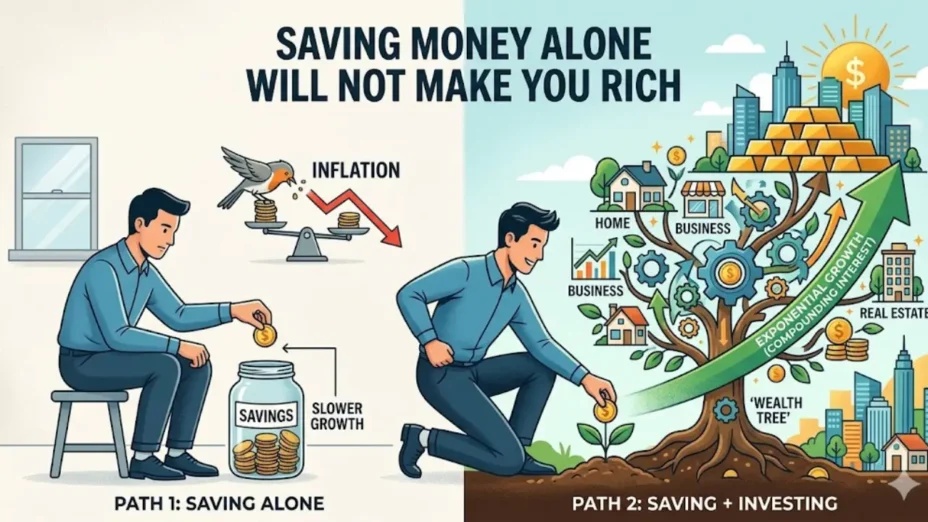
The Traditional Advice: Save, Save, Save
Where This Advice Comes From
If you grew up hearing phrases like “save for a rainy day” or “put money aside and you’ll be secure,” you’re not alone. For decades, saving money has been marketed as the cornerstone of financial success. Parents teach it to their kids, schools reinforce it, and even financial institutions promote savings accounts as the safest path to stability. At first glance, it feels like solid, responsible advice and to some extent, it is.
Historically, this mindset made a lot more sense. Back when interest rates were significantly higher, simply depositing money into a bank account could yield meaningful returns over time. People could rely on steady growth without exposing themselves to risk. Combine that with lower living costs and fewer financial complexities, and saving alone could genuinely help build a comfortable life.
But here’s the thing times have changed, and the financial landscape has evolved dramatically. What worked for previous generations doesn’t necessarily work today. Modern economies are driven by inflation, fluctuating markets, and rising costs of living. Saving money, while still important, no longer carries the same wealth-building power it once did.
There’s also a psychological layer to this advice. Saving feels safe. It gives you a sense of control and discipline. You see your bank balance grow, and that growth feels like progress. But is it really progress toward wealth, or just an illusion of security? That’s the critical question most people never stop to ask.
Why It Sounds Logical but Falls Short
At face value, saving money seems like a straightforward equation: spend less than you earn, store the difference, and eventually, you’ll accumulate wealth. It’s simple, easy to understand, and doesn’t require much financial knowledge. That’s exactly why it’s so widely accepted.
But simplicity can be deceptive.
The biggest flaw in this logic is that saving is inherently limited by your income. No matter how disciplined you are, you can only save a portion of what you earn. If your income is fixed or grows slowly, your ability to save is also restricted. This creates a ceiling on your financial progress that’s hard to break through.
Another issue is that saving doesn’t actively grow your money in a meaningful way. Most traditional savings accounts offer extremely low interest rates, often below the rate of inflation. So while your balance might increase numerically, its actual purchasing power may be stagnating or even declining.
Think of it like trying to fill a bucket with a tiny drip of water while there’s a slow leak at the bottom. You’re technically adding more water, but you’re not really getting ahead.
Saving also doesn’t take advantage of opportunity. Money sitting idle in a bank account isn’t working for you. It’s not generating income, building assets, or compounding in a significant way. In the world of wealth-building, inactivity can be just as limiting as poor financial decisions.
So while saving is a necessary foundation, relying on it alone is like trying to build a skyscraper with just bricks and no steel framework. It might get you started, but it won’t take you very far.
The Hidden Limitations of Saving Money
Inflation Quietly Eats Your Savings
Inflation is one of those financial concepts that sounds abstract until it starts affecting your daily life and your savings. Simply put, inflation is the gradual increase in the price of goods and services over time. While it might seem small on a yearly basis, its long-term impact can be surprisingly destructive.
Imagine you’ve saved $10,000 and left it untouched in a bank account for ten years. On paper, that money is still there. But in reality, its value has likely diminished. If inflation averages around 3% annually, your purchasing power could shrink significantly over that decade. What you could buy for $10,000 today might cost $13,000 or more in the future.
Now here’s where things get even more concerning most savings accounts offer interest rates that are lower than inflation. That means your money isn’t just sitting still; it’s effectively losing value over time. You’re moving backward without even realizing it.
This is why many financial experts emphasize that saving alone is not a wealth-building strategy it’s a preservation strategy at best. It helps you maintain liquidity and prepare for emergencies, but it doesn’t help you get ahead.
Warren Buffett once said, “If you don’t find a way to generate income passively, you will work until you die.” That statement accurately reflects the issue of depending only on savings. Without investment, money gradually loses purchasing power.
Understanding inflation changes the way you look at your bank balance. It forces you to ask a critical question: is your money actually working for you, or is it quietly losing ground?
Low Interest Rates vs Real Wealth Growth
Let’s talk about interest rates, because they play a huge role in determining whether saving can actually make you rich. In today’s financial environment, traditional savings accounts often offer interest rates that barely make a dent. We’re talking fractions of a percent in many cases.
At first, this might not seem like a big deal. After all, earning something is better than earning nothing, right? But when you compare these rates to other wealth-building opportunities, the difference becomes impossible to ignore.
For example, the stock market has historically delivered average annual returns of around 7–10% over the long term, even after adjusting for inflation. Real estate investments, depending on the market, can also provide substantial returns through appreciation and rental income. Compared to these options, a savings account yielding 0.5% or even 1% starts to look painfully inadequate.
The gap between saving and investing isn’t just noticeable it’s massive.
Think of it like walking versus taking a high-speed train. Both will eventually get you somewhere, but the difference in speed and distance covered is enormous. If your goal is to build wealth, you need momentum, not just stability.
Another overlooked issue is opportunity cost. Every dollar you keep in a low-interest account is a dollar that could have been invested elsewhere. Over time, these missed opportunities compound into significant financial gaps.
Saving money gives you a sense of safety, but real wealth requires growth. And growth rarely happens in environments designed for minimal risk and minimal return.
The Difference Between Saving and Investing
What Saving Actually Does
Saving money is often treated as the gold standard of financial responsibility, but when you strip it down to its core function, it’s really about preservation, not growth. Saving is what keeps you afloat when life throws unexpected expenses your way. It’s your financial cushion, your safety net, your “just in case” fund. And yes, that’s incredibly important but it’s not the same thing as building wealth.
When you save money, you’re essentially storing your purchasing power for later use. You’re delaying consumption, which is a smart move in many situations. However, the key limitation lies in what happens after that money is stored. Typically, it remains inactive. It doesn’t actively multiply, it doesn’t generate income, and it doesn’t create new opportunities.
Think of saving like parking your car in a garage. It’s safe, protected, and available when you need it but it’s not going anywhere. There’s no movement, no progress, no expansion. You’re maintaining what you have, not increasing it.
Another important angle is behavioural. Saving can sometimes create a false sense of accomplishment. You see your bank balance slowly rising, and it feels like you’re moving forward financially. But if that growth is outpaced by inflation or missed investment opportunities, you’re not actually advancing in terms of real wealth.
That doesn’t mean saving is useless far from it. It’s essential for short-term goals, emergencies, and financial discipline. But expecting saving alone to make you rich is like expecting a refrigerator to cook your meals. It’s simply not designed for that purpose.
How Investing Multiplies Wealth
If saving is about protecting money, investing is about putting it to work. This is where the real shift happens the moment your money starts generating more money. Instead of sitting idle, your funds are actively participating in economic growth.
Investing comes in many forms: stocks, real estate, businesses, bonds, and even digital assets. What they all have in common is the potential to deliver returns that significantly outpace traditional savings accounts. And over time, those returns can snowball into something substantial.
Here’s the fundamental difference: when you invest, you’re buying into systems that produce value. A stock represents ownership in a company that generates profits. Real estate can produce rental income while appreciating in value. A business can scale and expand, creating multiple income streams. In each case, your money isn’t just sitting it’s working.
Of course, investing involves risk. There’s no way around that. Markets fluctuate, businesses fail, and economic conditions change. But here’s the twist avoiding all risk can be riskier in the long run because it guarantees minimal growth.
A useful analogy is planting a tree. Saving is like keeping seeds in a jar they’re safe, but they’ll never grow. Investing is planting those seeds in the ground, where they can grow into something much larger over time. Yes, there’s uncertainty weather, soil conditions, and time all play a role but the potential reward is far greater.
Once you understand this distinction, it becomes clear why saving alone won’t make you rich. It’s only one piece of a much bigger financial puzzle.
The Power of Compound Growth
Why Time Matters More Than Amount
When people think about building wealth, they often focus on how much money they need to start. But here’s a surprising truth: time is far more powerful than the amount you invest. This is where compound growth enters the picture and it completely changes the game.
Compounding is essentially the process of earning returns on your returns. It grows progressively larger, similar to a snowball accumulating snow as it descends a slope. At first, the growth seems slow, almost unnoticeable. But as time passes, the snowball gets bigger, and the rate of growth accelerates dramatically.
Let’s say you invest $1,000 and earn a 10% return in a year. You now have $1,100. In the second year, you’re not earning 10% on your original $1,000 you’re earning it on $1,100. That extra $100 starts generating its own returns. Over decades, this effect becomes incredibly powerful.
What’s fascinating is that starting early often matters more than starting big. Someone who invests a small amount consistently over 30 years can end up with more wealth than someone who invests a large amount later in life. Time amplifies growth in a way that no savings account ever could.
Saving alone doesn’t fully leverage this power because the returns are too small. Compounding needs fuel higher returns to truly make an impact. Without that, the snowball barely grows.
This is why financial experts constantly emphasize starting early. Even modest investments can turn into significant wealth if given enough time to compound.
Real-Life Examples of Compounding
To really understand the power of compounding, it helps to look at real-world scenarios. Imagine two individuals: Alex and Jordan.
Alex starts investing at age 25, putting aside $200 per month into an investment that earns an average of 8% annually. Jordan, on the other hand, waits until age 35 to start but invests $400 per month double the amount. You might assume Jordan would come out ahead, right?
Surprisingly, Alex often ends up with more money by retirement. Why? Because those extra ten years of compounding make a massive difference. Alex’s early investments had more time to grow, and that growth built upon itself year after year.
Another example comes from long-term stock market investors. Historically, broad market indices like the S&P 500 have delivered strong returns over decades. Investors who stayed consistent even during market downturns benefited from compounding in ways that simple savers never could.
Albert Einstein is often (perhaps apocryphally) quoted as calling compound interest the “eighth wonder of the world.” Whether or not he actually said it, the idea holds true. Compounding transforms small, consistent actions into extraordinary results.
Saving money alone doesn’t tap into this phenomenon in a meaningful way. Without sufficient returns, compounding remains weak and slow. But when combined with smart investing, it becomes one of the most powerful tools for building wealth.
Income vs Wealth: Understanding the Gap
Why High Income Doesn’t Guarantee Riches
It’s easy to assume that earning a high salary automatically leads to wealth. After all, more money coming in should mean more money saved, right? However, the actual situation is quite different. There are countless high-income earners who live paycheck to paycheck, while others with modest incomes quietly build substantial wealth over time.
The key difference lies in how money is used not just how much is earned.
High income often brings lifestyle inflation. As earnings increase, so do expenses. Bigger homes, nicer cars, more frequent travel it all adds up. Before long, the extra income is absorbed into a more expensive lifestyle, leaving little room for saving or investing.
This creates a paradox: someone can earn a six-figure salary and still struggle financially, while someone earning far less can steadily grow their net worth. It’s not about the size of the paycheck it’s about what happens after you receive it.
Another issue is dependency on a single income source. If your entire financial life relies on your job, you’re vulnerable. Job loss, industry changes, or economic downturns can quickly disrupt your financial stability.
Wealth, on the other hand, is about ownership and sustainability. It’s the accumulation of assets that generate income independently of your time and effort. And that’s something saving alone rarely achieves.
Building Assets Instead of Just Income
If income is the fuel, assets are the engine that turns that fuel into long-term wealth. Building assets means acquiring things that generate value over time whether it’s cash flow, appreciation, or both.
Assets can take many forms: stocks that pay dividends, rental properties that generate monthly income, businesses that operate without constant supervision, or even intellectual property that produces royalties. What matters is that these assets work for you, rather than requiring constant effort.
This is where the mindset shift becomes critical. Instead of focusing solely on earning and saving, the goal becomes acquiring and growing assets. Every dollar saved should eventually have a purpose to be deployed into something that creates more value.
Think of it like building a team. Saving money is like recruiting players, but investing in assets is like putting them on the field where they can actually perform. Without that step, your financial “team” never wins any games.
Over time, a well-built portfolio of assets can generate enough income to cover living expenses, creating financial independence. That’s when wealth truly begins to take shape not when you have a large savings balance, but when your money consistently works for you.
The Role of Smart Risk-Taking
Why Avoiding Risk Keeps You Stuck
There’s a common belief that avoiding risk is the safest financial strategy. On the surface, that sounds reasonable after all, why would anyone willingly put their money in harm’s way? But here’s the uncomfortable truth: completely avoiding risk often guarantees stagnation.
When you keep all your money in low-risk environments like savings accounts, you’re protecting it from short-term volatility but you’re also locking yourself out of meaningful growth. Over time, inflation quietly erodes your purchasing power, and the gap between where you are and where you want to be starts to widen.
It’s a bit like refusing to leave your house because you might trip outside. Sure, you avoid the immediate danger, but you also miss out on opportunities, experiences, and progress. Financially, the same principle applies. Playing it too safe can actually be the riskiest move of all in the long run.
Another issue is that fear-driven decisions tend to limit learning. If you never invest, never explore opportunities, and never step outside your comfort zone, you never develop the skills needed to grow wealth. Financial intelligence is built through experience both successes and mistakes.
That doesn’t mean you should gamble or make reckless decisions. There’s a massive difference between blind risk and informed, calculated risk. The goal isn’t to avoid risk entirely it’s to understand it, manage it, and use it strategically.
People who build wealth aren’t necessarily fearless; they’re just more comfortable navigating uncertainty. They accept that some level of risk is unavoidable if they want their money to grow.
Calculated Risks That Build Wealth
Smart risk-taking is where real financial progress begins. Instead of asking, “How can I avoid risk?” A more pertinent question is, “What risks are justifiable?” This shift in thinking opens the door to opportunities that saving alone could never provide.
Calculated risks are backed by research, planning, and a clear understanding of potential outcomes. For example, investing in a diversified portfolio reduces the risk associated with any single asset. Starting a side business while maintaining a stable job minimizes financial exposure. Even real estate investments, when done carefully, can provide both income and long-term appreciation.
Here are a few examples of calculated risks that often contribute to wealth-building:
- Investing consistently in index funds or ETFs
- Starting a scalable side hustle or online business
- Acquiring rental properties in growing markets
- Learning high-income skills that increase earning potential
Each of these carries some level of uncertainty, but they also offer the possibility of significant returns. The key is balance taking enough risk to grow, but not so much that a single setback wipes you out.
A useful way to think about this is through probabilities. Wealthy individuals often focus on expected value the idea that over time, good decisions with positive odds will yield favourable outcomes. They’re not trying to win every single time; they’re playing a long-term game.
Saving money keeps you in the game, but calculated risk is what helps you win it.
Multiple Streams of Income: A Wealth Necessity
Why One Income Source Isn’t Enough
Relying on a single source of income is like standing on a one-legged stool it works, but it’s inherently unstable. If that one source disappears, everything collapses. In today’s unpredictable economy, this kind of dependency can be a serious vulnerability.
Jobs are no longer as secure as they once were. Industries evolve, companies restructure, and automation continues to reshape the workforce. Even highly skilled professionals aren’t immune to sudden changes. That’s why depending solely on a pay check can limit both your financial security and your growth potential.
Another limitation is that a single income stream caps your earning ability. There are only so many hours in a day, and most jobs pay based on time. This creates a ceiling that’s hard to break through, no matter how hard you work.
Wealthy individuals understand this, which is why they focus on creating multiple streams of income. Instead of relying on one source, they build a network of income channels that support and reinforce each other.
This doesn’t happen overnight, and it doesn’t require extreme complexity. It starts with small, intentional steps leveraging skills, investing wisely, and gradually expanding your financial ecosystem.
Ideas for Diversifying Income
Diversifying your income might sound overwhelming at first, but it’s more accessible than you think. The goal isn’t to do everything at once it’s to start with one additional stream and build from there.
Some common and effective income streams include:
| Income Stream | Description |
| Investments | Stocks, ETFs, or bonds that generate returns over time |
| Rental Income | Earnings from leasing property or real estate |
| Side Businesses | Freelancing, e-commerce, or service-based ventures |
| Digital Products | Courses, eBooks, or online tools |
| Dividends | Regular payouts from certain stocks |
Each of these options has its own learning curve and risk level, but they all share one important trait: they decouple income from time. That’s a game-changer.
Imagine earning money while you sleep not because of luck, but because you’ve built systems that generate value continuously. That’s the power of multiple income streams.
Saving money can help you start these ventures, but it’s the act of deploying that money strategically that creates new opportunities. Over time, these streams can grow, overlap, and compound, forming a robust financial foundation.
Mindset Shift: From Saver to Wealth Builder
Scarcity vs Abundance Thinking
Your financial habits are deeply influenced by how you think about money. A scarcity mindset focuses on limitations there’s never enough, resources are finite, and the primary goal is to hold on to what you have. This mindset often leads to excessive saving, fear of investing, and missed opportunities.
On the other hand, an abundance mindset views money as a tool for growth. It’s not about reckless spending it’s about recognizing that opportunities exist to create, multiply, and expand wealth. People with this mindset are more likely to invest in themselves, take calculated risks, and explore new income streams.
The difference between these two perspectives can be subtle but powerful. A scarcity mindset asks, “How can I avoid losing money?” An abundance mindset asks, “How can I grow it?”
Neither approach is entirely right or wrong you need elements of both. But leaning too heavily toward scarcity can keep you stuck in a cycle of saving without progress.
Habits of Financially Successful People
Wealth-building isn’t just about strategies it’s about consistent habits. Financially successful people tend to share certain behaviours that set them apart.
They prioritize investing over hoarding cash. They continuously educate themselves about money, markets, and opportunities. They’re willing to adapt, learn from mistakes, and refine their approach over time.
Another key habit is long-term thinking. Rather than pursuing short-term gains, they prioritize long-term, stable expansion. They understand that wealth is built gradually, through consistent effort and smart decisions.
They also track their finances closely. Understanding a situation promotes sound judgment, and sound judgment results in improved results. It’s not about perfection it’s about progress.
Perhaps most importantly, they take action. Having knowledge isn’t enough to create wealth; it’s putting that knowledge into action that does. Saving money is a step, but it’s what you do after saving that truly matters.
Conclusion: Saving Is the Start, Not the Finish
Saving money is often the first lesson people learn about personal finance and for good reason. It builds discipline, creates security, and provides a foundation to stand on. But stopping there is like learning the alphabet and never forming words. It’s just the beginning.
Wealth requires growth, and growth requires action. That means investing, taking calculated risks, building assets, and creating multiple income streams. It also means shifting your mindset from preservation to expansion.
If you rely solely on saving, you’re limiting your financial potential. But when you combine saving with smart strategies and a long-term perspective, you unlock opportunities that go far beyond what a bank account can offer.
The objective isn’t simply to possess funds, but to have funds that generate income for you.
FAQs
1. Is saving money still important if it won’t make me rich?
Absolutely. Saving is essential for financial stability, emergencies, and short-term goals. It’s the foundation but not the entire structure of wealth-building.
2. How much should I save before I start investing?
A common rule is to build an emergency fund covering 3–6 months of expenses. After that, you can begin investing while continuing to save strategically.
3. What’s the safest way to start investing?
Many beginners start with diversified index funds or ETFs, which spread risk across multiple assets and require less active management.
4. Can I build wealth with a low income?
Yes, but it requires consistency, discipline, and smart decision-making. Starting early and leveraging compounding can make a significant difference.
5. What’s the biggest mistake people make with money?
One of the most common mistakes is relying solely on saving without exploring ways to grow money through investing or building assets.