
Understanding the Basics of the Indian Tax System
Flow from Collection to Public Benefit
Taxes in India aren’t just random deductions from your salary or extra charges on your shopping bill they follow a structured cycle that keeps the entire economy functioning. At the heart of it, the system revolves around three core stages: collection, allocation, and utilization. Once you understand this flow, taxes stop feeling like a mystery and start making practical sense.
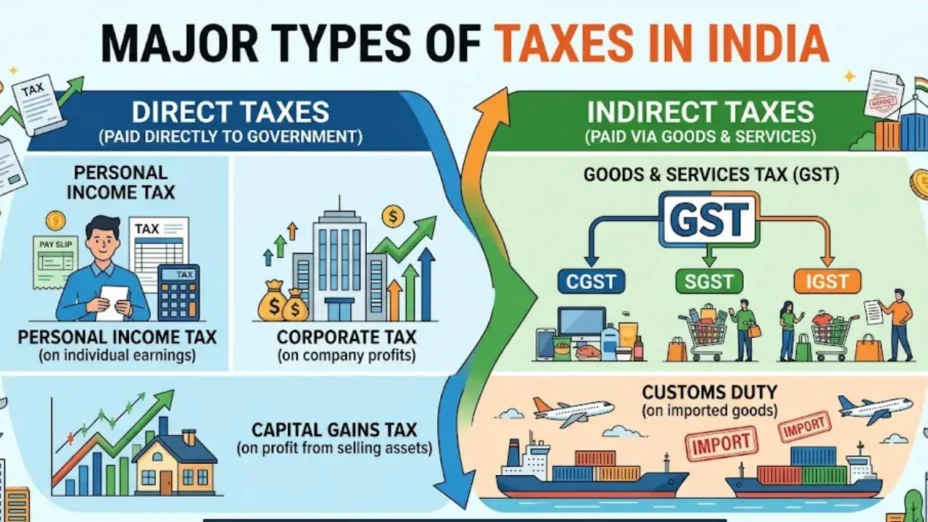
The process begins with tax collection, which is essentially the government gathering revenue from different sources. This happens through two main channels: direct taxes and indirect taxes. Direct taxes include income tax and corporate tax, paid directly by individuals and businesses based on their earnings. Indirect taxes, like GST, are collected when people spend money on goods and services. Whether you’re earning, investing, or simply buying everyday items, you’re contributing to this pool in some way. It’s a system designed so that both earning and spending activities feed into national revenue.
Once the money is collected, the next phase is allocation and planning. This is where things get more strategic. The government, primarily through financial authorities, decides how to distribute the collected funds across various sectors. This isn’t done randomly it involves detailed budgeting, forecasting, and policy decisions. Factors like economic growth, public needs, infrastructure gaps, and social welfare priorities all influence how funds are allocated. Think of it like managing a household budget, but on a national scale. Every rupee is assigned a purpose, whether it’s for development, maintenance, or emergency reserves.
The final stage is where people actually start seeing results utilization of taxes. This is when the collected and allocated funds are spent on real-world outcomes that impact daily life. A large portion goes into building and maintaining public infrastructure such as roads, railways, airports, and digital systems. Another significant share supports social services like healthcare, education, and sanitation, which directly affect quality of life.
Taxes also fund defence and national security, ensuring the country’s safety and stability. Beyond that, there are welfare programs aimed at reducing inequality and supporting vulnerable sections of society. These include subsidies, rural development initiatives, and schemes for farmers, students, and low-income families. In many ways, taxes act as a tool for redistribution taking resources from the broader economy and channelling them toward areas that need support. What makes this system interesting is its cyclical nature. The benefits created through tax utilization better infrastructure, improved services, and economic growth eventually
What is Tax and Why It Exists
If you’ve ever looked at your salary slip and wondered where a chunk of your money disappeared, you’re not alone. Taxes in India can feel like a black hole money goes in, but where does it really go? At its core, tax is simply a financial contribution imposed by the government on individuals and businesses to fund public services and infrastructure. Think of it as a collective pool where everyone chips in so society can function smoothly.
In India, taxes play a critical role in supporting everything from highways and railways to healthcare, defence, education, and welfare schemes. Without taxes, the government would struggle to maintain even basic services. It’s like running a household imagine trying to pay rent, electricity, groceries, and school fees without any income. That’s essentially what a country would face without taxation.
The Indian tax system is governed primarily by the Income Tax Act of 1961, along with various rules and amendments introduced each year in the Union Budget. The structure is designed to be progressive, meaning people who earn more pay a higher percentage of their income as tax. This ensures a level of fairness, at least in theory, where the tax burden is distributed based on earning capacity.
There’s also an important psychological angle to taxes. Many people see taxes as a burden rather than a contribution, mainly because the benefits aren’t always visible in day-to-day life. However, when you drive on a highway, use a government hospital, or benefit from public infrastructure, you’re indirectly experiencing the results of tax revenue at work.
Understanding taxes isn’t just about compliance it’s about financial awareness. Once you grasp how the system works, you can legally optimize your tax outgo, plan investments smarter, and avoid unnecessary penalties. And that’s where things start getting interesting.
Direct vs Indirect Taxes in India
Now that you know what taxes are, the next step is understanding the two major categories: direct taxes and indirect taxes. This distinction is crucial because it affects how and when you pay taxes, and whether you can shift the burden to someone else.
Direct taxes are exactly what they sound like taxes you pay directly to the government. These cannot be transferred to another person. The most common example is income tax, which is deducted from your salary or paid by you when filing returns. Other examples include corporate tax and capital gains tax. If you earn money, you are responsible for paying tax on it, plain and simple.
On the other hand, indirect taxes are a bit sneaky. These are taxes that are collected by intermediaries (like businesses) and passed on to the government. The classic example is GST (Goods and Services Tax). When you buy a smartphone, eat at a restaurant, or shop online, you’re paying GST but it’s the business that deposits that tax with the government.
Here’s a simple analogy: imagine you order food at a restaurant. The bill includes GST. You pay the full amount, but the restaurant is responsible for forwarding that tax portion to the government. So technically, you paid the tax, but indirectly.
India shifted heavily toward indirect taxation with the introduction of GST in 2017, replacing a complex web of taxes like VAT, service tax, and excise duty. This made the system more streamlined, though not necessarily simpler for everyone.
One key difference lies in fairness. Direct taxes are considered more equitable because they’re based on income levels. Indirect taxes, however, apply equally to everyone, meaning a person earning ₹20,000 a month pays the same GST rate as someone earning ₹2 lakh.
Understanding this difference helps you see where your money goes and why certain expenses feel heavier than others. It also lays the foundation for decoding the rest of India’s tax system, which builds on these two pillars.
Who Needs to Pay Taxes in India
Taxable Individuals and Entities
A common misconception is that taxes are only for the wealthy or big corporations. In reality, anyone earning above a certain threshold in India is liable to pay income tax. The system doesn’t discriminate based on profession whether you’re a salaried employee, freelancer, business owner, or even earning through investments, you’re part of the tax net if your income crosses the basic exemption limit.
In India, taxable entities include individuals, Hindu Undivided Families (HUFs), firms, companies, and even associations of persons. Each category has its own rules and tax rates, but the underlying principle remains the same: earn income, pay tax.
For individuals, taxation depends heavily on income level and age group. For instance, senior citizens enjoy higher exemption limits compared to younger taxpayers. Companies, on the other hand, are taxed at fixed rates depending on turnover and type of business.
Interestingly, even students or part-time earners may need to pay taxes if their income exceeds the threshold. This often surprises people who assume taxation only begins with full-time employment. Similarly, freelancers and gig workers like content creators, designers, or consultants must report their earnings and pay taxes accordingly.
There’s also something called Tax Deducted at Source (TDS), where tax is automatically deducted before you even receive your income. This applies to salaries, interest income, rent, and more. It’s the government’s way of ensuring tax collection happens in real time rather than relying solely on voluntary reporting.
The takeaway here is simple: if money is coming into your account, chances are the tax system is paying attention. Ignoring it doesn’t make it go away it usually just makes things more complicated later.
Residential Status and Its Impact on Taxation
Here’s where things get a bit more technical but also more fascinating. In India, your tax liability isn’t determined solely by your citizenship. Instead, it depends on your residential status, which is calculated based on the number of days you stay in the country during a financial year.
There are three main categories: Resident, Resident but Not Ordinarily Resident (RNOR), and Non-Resident (NRI). Each comes with its own tax implications, especially when it comes to global income.
If you qualify as a Resident, you are taxed on your global income, meaning income earned both in India and abroad is subject to Indian taxation. This is crucial for people working remotely for foreign companies or earning through overseas investments.
NRIs, however, are only taxed on income earned or accrued in India. So if you’re working abroad and earning money there, India generally won’t tax that income though you may still need to file returns depending on your financial ties to the country.
The RNOR category sits somewhere in between and offers certain exemptions, especially for people transitioning between resident and non-resident status.
Why does this matter? Because misunderstanding your residential status can lead to either overpaying taxes or facing penalties for underreporting. For example, someone who frequently travels between countries might assume they’re an NRI when they actually qualify as a resident under tax laws.
There are also Double Taxation Avoidance Agreements (DTAA) between India and several countries, ensuring you don’t pay tax twice on the same income. This is particularly relevant for global professionals and investors.
In a world where remote work and global income are becoming the norm, residential status isn’t just a technical detail it’s a key factor that can significantly impact your financial planning.
Types of Taxes in India Explained
Income Tax
When people talk about taxes in India, income tax is usually the first thing that comes to mind and for good reason. It’s the most direct and personal form of taxation, affecting millions of individuals across the country. At its core, income tax is levied on the money you earn during a financial year, which runs from April 1 to March 31.
The calculation isn’t as straightforward as “earn money, pay a fixed percentage.” Instead, India follows a slab system, where different portions of your income are taxed at different rates. This ensures a progressive structure where higher earners pay more.
Income tax applies to multiple sources of income, not just your salary. This includes rental income, interest from savings accounts, dividends, freelance earnings, and even winnings from lotteries. Each type of income may be taxed differently, which is why understanding classification becomes crucial later on.
A notable aspect is advance tax, which mandates that individuals earning substantial income beyond their salary pay taxes in regular payments during the year. This prevents a massive lump-sum payment at the end and helps the government maintain steady cash flow.
Filing your Income Tax Return (ITR) is an essential part of the process. Even if your tax has already been deducted via TDS, filing returns ensures proper documentation and allows you to claim refunds if excess tax was paid.
Technology has made things easier in recent years, with online portals simplifying the filing process. However, the complexity still lies in understanding deductions, exemptions, and applicable rates.
Income tax isn’t just about compliance it’s also about strategy. With the right planning, you can legally reduce your tax burden and make smarter financial decisions.
Income Tax Slabs and Regimes
New Tax Regime (Default System)
Here’s where the biggest shift has happened in recent years. The new tax regime is now the default option in India, and it’s designed to make taxation simpler and more predictable. No complicated deductions, no last-minute investment rush just straightforward tax rates applied to your income.
As per the latest FY 2025–26 (AY 2026–27) structure, the slabs are:
| Income Range | Tax Rate |
| Up to ₹3,00,000 | 0% |
| ₹3,00,001 – ₹6,00,000 | 5% |
| ₹6,00,001 – ₹9,00,000 | 10% |
| ₹9,00,001 – ₹12,00,000 | 15% |
| ₹12,00,001 – ₹15,00,000 | 20% |
| Above ₹15,00,000 | 30% |
At first glance, these look like standard progressive slabs. But the real game-changer is the rebate under Section 87A. If your taxable income is up to ₹7 lakh, your tax liability becomes zero. That’s a huge relief for middle-income earners.
Now add another layer: the ₹50,000 standard deduction, which is now available even under the new regime. This effectively pushes the “zero-tax zone” slightly higher in practical terms. So someone earning around ₹7.5 lakh may still end up paying no tax after deductions and rebates.
The beauty of the new regime lies in its simplicity. You don’t need to track dozens of deductions or submit proof of investments. It’s almost like switching from a complicated spreadsheet to a clean calculator you input your income, and the result is straightforward.
But simplicity comes with a trade-off. You give up most deductions like 80C, 80D, HRA, and others. So if you’re someone who actively invests and claims multiple benefits, this regime might not always be the best fit.
Still, for a large portion of taxpayers especially those with straightforward salary structures the new regime often results in lower taxes with less hassle. It’s not just a policy change; it’s a shift in how people approach tax planning altogether.
Old Tax Regime and When It Still Wins
Despite all the attention on the new regime, the old tax regime hasn’t gone anywhere—and for good reason. It still offers something the new system doesn’t: flexibility through deductions and exemptions.
The slab structure remains unchanged:
| Income Range | Tax Rate |
| Up to ₹2,50,000 | 0% |
| ₹2,50,001 – ₹5,00,000 | 5% |
| ₹5,00,001 – ₹10,00,000 | 20% |
| Above ₹10,00,000 | 30% |
There’s also a rebate under Section 87A, but only if your income is up to ₹5 lakh, which makes it less generous compared to the new regime.
So why would anyone still choose the old system? The answer lies in deductions. If you’re someone who:
- Invests heavily under Section 80C
- Pays home loan interest
- Claims HRA and LTA
- Pays health insurance premiums (80D)
…then your taxable income can drop significantly. In some cases, this reduction outweighs the higher slab rates.
Think of it like this: the old regime rewards financial discipline. If you’re already investing and planning, it gives you tools to reduce your tax burden. The new regime, on the other hand, rewards simplicity.
There’s no universal winner here. A salaried individual with minimal deductions might benefit more from the new regime. But someone with structured investments and long-term financial commitments could still save more under the old one.
The smartest approach? Compare both before filing every year. Because your income, expenses, and goals change and your tax strategy should evolve with them.
At first glance, the new regime looks more attractive due to lower rates. But remember you lose deductions, which can significantly reduce your taxable income under the old system.
Also, don’t forget additional components like:
- Health and Education Cess (4%)
- Surcharge for high-income individuals
The slab system works progressively. If you earn ₹10 lakh, you don’t pay 20% on the entire amount only the portion above ₹5 lakh is taxed at 20%. This layered approach ensures fairness and prevents sudden jumps in tax liability.
Understanding slabs isn’t just academic it directly influences your take-home income. Once you see how each rupee is taxed, you can start planning smarter rather than just reacting at the end of the financial year.
How Income is Classified for Taxation
Salary Income
Let’s start with the most common category: salary income. If you’re employed, this is likely your primary source of earnings. But here’s the catch your salary isn’t just your basic pay. It’s a mix of multiple components; each treated differently for tax purposes.
A typical salary structure includes:
- Basic salary
- House Rent Allowance (HRA)
- Special allowances
- Bonuses
- Perquisites (like company car, rent-free accommodation)
Each of these components has its own tax rules. For example, HRA can be partially exempt if you’re paying rent and meet certain conditions. Similarly, some allowances may be fully taxable, while others offer exemptions.
Your employer usually deducts TDS (Tax Deducted at Source) based on your estimated income. But this doesn’t mean your tax responsibility ends there. If you have additional income or missed declaring investments, you may still owe tax when filing your return.
There’s also a standard deduction (₹50,000 under both regimes currently), which reduces your taxable salary automatically. It’s like a flat discount no paperwork required.
A frequently missed consideration is perquisites, often called “ perks.” These benefits might consist of company-provided housing, stock options, or even loans with reduced interest rates. While they may not feel like income, they often have taxable value.
Understanding your salary structure is crucial because it directly affects how much tax you pay. A well-structured salary can legally reduce your tax burden without changing your actual income.
Business and Professional Income
If you’re a freelancer, consultant, or business owner, your income falls under “Profits and Gains of Business or Profession.” This category is where taxation becomes both flexible and complex.
Unlike salaried individuals, you’re taxed on net profit, not total income. That means you can deduct business-related expenses before calculating tax. These expenses might include rent, internet bills, travel costs, equipment, and even depreciation on assets.
For example, if you earn ₹10 lakh but spend ₹3 lakh on business expenses, you’re taxed only on ₹7 lakh. That’s a significant advantage if managed correctly.
There’s also something called the presumptive taxation scheme (Sections 44AD, 44ADA), which simplifies things for small businesses and professionals. Instead of maintaining detailed accounts, you can declare a fixed percentage of your turnover as income and pay tax on that.
However, flexibility comes with responsibility. You need to maintain proper records, file returns accurately, and sometimes even get your accounts audited.
Advance tax is especially important here. Since there’s no employer deducting TDS, you’re responsible for paying tax in quarterly instalments. Missing these deadlines can lead to interest penalties.
The upside? You have far more control over your tax planning compared to salaried individuals. With smart expense management and strategic investments, you can significantly optimize your tax liability.
Capital Gains and Other Sources
Ever made money from selling stocks, property, or mutual funds? That’s where capital gains come into play. This category often surprises people because it’s taxed differently depending on the type of asset and holding period.
There are two main types:
- Short-Term Capital Gains (STCG)
- Long-Term Capital Gains (LTCG)
For example, selling equity shares within a year results in STCG, typically taxed at 15%. Holding them longer may qualify for LTCG, which is taxed at 10% above a certain threshold.
Real estate, gold, and debt funds have their own rules and timelines. It’s not just about profit it’s about how long you held the asset.
Also, there’s income from “Other Sources,” which encompasses:
- Interest from savings accounts and fixed deposits
- Dividends
- Lottery winnings
- Gifts exceeding specified limits
These may seem minor individually, but they add up and yes, they’re taxable.
One interesting detail: lottery winnings are taxed at a flat 30%, with no deductions allowed. So if you win big, the taxman celebrates too.
Understanding these categories helps you avoid surprises and plan better. Because in taxation, it’s not just about how much you earn it’s about how you earn it.
Deductions and Exemptions Explained
Section 80C and Popular Deductions
If there’s one part of the Indian tax system that feels like a hidden treasure chest, it’s deductions and exemptions. This is where you can legally reduce your taxable income sometimes quite significantly just by making smart financial choices. Among all these provisions, Section 80C is the most widely used and arguably the most important for individual taxpayers.
Under Section 80C, you can claim deductions of up to ₹1.5 lakh per financial year by investing in specified instruments or making certain payments. It’s essentially the government nudging you toward saving and investing for the future while rewarding you with tax benefits today. Common options under this section include Public Provident Fund (PPF), Employee Provident Fund (EPF), Equity Linked Savings Scheme (ELSS), life insurance premiums, National Savings Certificate (NSC), and even principal repayment of home loans.
Think of it like a “tax discount basket.” The more you fill it with eligible investments (up to the limit), the lower your taxable income becomes. For instance, if your total income is ₹10 lakh and you invest ₹1.5 lakh under 80C, your taxable income drops to ₹8.5 lakh. That’s not just a small adjustment it can move you into a lower tax bracket or reduce your overall liability substantially.
But 80C isn’t the only player. There are several other sections that can further reduce your tax burden:
- Section 80D: Deduction for health insurance premiums
- Section 24(b): Interest paid on home loans
- Section 80E: Interest on education loans
- Section 80G: Donations to charitable institutions
Each of these serves a dual purpose encouraging socially beneficial behaviour while offering financial relief.
However, here’s the catch: most of these deductions are only available under the old tax regime. If you opt for the new regime, you’ll have to forgo many of these benefits. That’s why understanding deductions isn’t just about saving tax it’s about choosing the right system altogether.
The real power lies in planning ahead. Instead of scrambling at the end of the financial year to make last-minute investments, a well-thought-out strategy can help you maximize deductions without disrupting your cash flow. Done right, it feels less like paying taxes and more like redirecting your money toward meaningful goals.
Tax-Saving Investments
Now let’s go a level deeper. It’s one thing to know that you can claim deductions—it’s another to choose the right tax-saving investments that align with your financial goals. Because not all investments under Section 80C (or other sections) are created equal. Some offer safety, others offer growth, and a few try to balance both.
Take PPF (Public Provident Fund), for example. It’s one of the safest investment options available, backed by the government, with a lock-in period of 15 years. The returns are tax-free, which makes it incredibly attractive for long-term savers. But the trade-off? Limited liquidity and moderate returns.
On the other hand, ELSS mutual funds come with a shorter lock-in period of 3 years and the potential for higher returns since they invest in equities. However, they also carry market risk. It’s like choosing between a fixed deposit and a stock you’re balancing safety against growth.
Here’s a quick comparison to make things clearer:
| Investment Option | Risk Level | Lock-in Period | Returns | Tax Benefit under old regime |
| PPF | Low | 15 years | Moderate | Yes |
| ELSS | High | 3 years | High (market-linked) | Yes |
| NSC | Low | 5 years | Fixed | Yes |
| Life Insurance | Low–Moderate | Long-term | Varies | Yes |
The key is not to invest blindly just for tax saving. Ask yourself: Does this investment fit my financial plan? For instance, a young professional might lean toward ELSS for growth, while someone nearing retirement may prefer the stability of PPF.
There’s also a behavioural aspect here. Many people rush to invest in March just to save tax, often locking their money into unsuitable products. That’s like buying winter clothes in a panic during a snowstorm you’re not making the best choices.
A smarter approach is to spread your investments throughout the year, aligning them with your income flow and goals. This way, tax saving becomes a byproduct of good financial planning rather than a last-minute chore.
GST System in Detail
How GST Works in Practice
When India introduced the Goods and Services Tax (GST) in 2017, it was one of the biggest tax reforms in the country’s history. The idea was simple: replace a tangled web of indirect taxes with a single, unified system. But how does GST actually work when you buy something or run a business?
At its core, GST is a destination-based tax. This means the tax is collected where the goods or services are consumed, not where they are produced. It’s applied at every stage of the supply chain, but with a mechanism called Input Tax Credit (ITC) that prevents double taxation.
A manufacturer produces a product and sells it to a wholesaler, who then sells it to a retailer, who finally sells it to you. At each step, GST is charged. However, each business can claim credit for the tax they already paid on purchases. So effectively, tax is only paid on the value added at each stage.
Let’s make this real. Suppose a manufacturer produces a product and sells it for ₹100 plus GST. A wholesaler buys it, adds value (say packaging or branding), and sells it for ₹150 plus GST. A retailer then sells it to you for ₹200 plus GST.
At each step, businesses claim Input Tax Credit (ITC) for the tax they’ve already paid. So they’re not paying tax on the full value only on the incremental addition. This prevents the old “tax on tax” problem that existed before GST.
For consumers, the process is seamless. You don’t calculate anything you just pay the final price. But behind that simplicity is a system that tracks transactions, ensures compliance, and reduces leakages.
This system solves a major problem from the pre-GST era known as the “cascading effect”, where tax was charged on top of tax. GST eliminates this, making pricing more transparent and reducing the overall tax burden in many cases.
GST is divided into components:
- CGST (Central GST)
- SGST (State GST)
- IGST (Integrated GST for interstate transactions)
For businesses, GST compliance involves registration, issuing proper invoices, filing regular returns, and maintaining detailed records. While this adds administrative work, it also creates a more organized and accountable system.
For consumers, GST is already factored into the price. You see it on bills, but you don’t have to calculate or file anything. Still, understanding how it works helps you make sense of pricing and recognize how taxes influence the cost of everyday goods and services.
GST Slabs and Categories
Not everything is taxed equally under GST and that’s intentional. The system uses multiple tax slabs to balance affordability with revenue generation.
Here’s how it’s broadly structured:
| GST Rate | What It Covers |
| 0% | Essential goods (fresh food, basic items) |
| 5% | Mass consumption goods |
| 12% | Standard category items |
| 18% | Most services and products |
| 28% | Luxury and sin goods |
This tiered structure is designed to ensure that necessities remain affordable while luxury consumption contributes more to tax revenue.
But in real life, things aren’t always so clear-cut. Classification disputes happen more often than you’d expect. A small change in how a product is defined can shift it from 12% to 18%, affecting both businesses and consumers.
For example, something as simple as a snack item might fall into different categories depending on its ingredients or packaging. These nuances can impact pricing, margins, and ultimately what you pay.
There’s also an additional cess on certain items like tobacco and high-end cars, further increasing their tax burden.
From a consumer’s perspective, GST influences spending behaviour subtly. Higher taxes on luxury goods may discourage unnecessary purchases, while lower taxes on essentials keep daily life affordable.
Over time, GST has made pricing more transparent. You can actually see how much tax you’re paying, which wasn’t always the case before 2017.
Understanding GST slabs doesn’t just make you more informed it helps you see the logic behind pricing in a way most people overlook.
Despite these challenges, GST has improved tax compliance and increased transparency. According to government data, GST collections have consistently crossed ₹1.5 lakh crore per month in recent years, reflecting its growing efficiency and reach.
For consumers, GST influences everything from your grocery bill to your Netflix subscription. For businesses, it shapes pricing, cash flow, and compliance requirements.
Corporate Taxes and Economic Impact
When people think about taxes, they usually picture salary deductions or GST on purchases. But behind the scenes, corporate tax plays a massive role in shaping India’s economy. It’s the tax that companies pay on their profits, and it directly influences everything from job creation to pricing strategies and even foreign investment.
In India, corporate tax rates have been gradually reduced over the years to make the country more business-friendly. As of recent structures, domestic companies generally pay around 22% (plus surcharge and cess), while new manufacturing companies may benefit from even lower rates around 15%, provided they meet certain conditions. These reductions weren’t random; they were strategic moves to attract global businesses and boost economic growth.
Now, you might wonder why should this matter to you as an individual? Because corporate taxes indirectly affect your life more than you realize. When companies pay less tax, they often reinvest that money into expansion, hiring, or innovation. On the flip side, higher taxes can lead to cost-cutting, which might mean fewer jobs or higher prices for consumers.
There’s also a ripple effect. Businesses factor taxes into their pricing. So even though you’re not directly paying corporate tax, it influences the cost of goods and services you consume. It’s like an invisible layer built into the economy.
Another interesting angle is compliance. Corporations deal with complex tax structures, audits, and reporting requirements. This has led to a more digitized and transparent system, especially with tools like GST integration and e-filing platforms.
In simple terms, corporate tax is the engine working quietly in the background. You may not see it on your bill, but it shapes the economic environment you live in impacting everything from your job opportunities to the price of your morning coffee.
Conclusion
Understanding how taxes actually work in India isn’t just about memorizing slabs or filing returns it’s about seeing the bigger picture. Taxes are woven into almost every financial decision you make, from how you earn and spend to how you invest and save.
Once you break it down, the system becomes far less intimidating. You start to see patterns: direct vs indirect taxes, old vs new regimes, income classifications, deductions, and GST mechanics. Each piece fits into a larger puzzle that, when understood, gives you more control over your finances.
The real advantage comes from awareness. When you know how taxes work, you stop reacting at the last minute and start planning ahead. You choose investments more wisely, structure your income better, and avoid unnecessary penalties.
Taxes may never be exciting, but they don’t have to be confusing either. With the right understanding, they become just another part of your financial toolkit something you can manage, optimize, and even use to your advantage.
FAQs
1. Which tax regime is better in 2026?
It depends on your financial situation. The new regime suits those with fewer deductions, while the old regime benefits those who actively invest and claim tax exemptions.
2. Can I switch between old and new tax regimes every year?
Yes, people earning a salary have the option to change regimes annually. However, business owners have more restrictions on switching.
3. Do I need to file an ITR if TDS is already deducted?
Yes, filing an Income Tax Return is still necessary to report your total income, claim refunds, and maintain proper financial records.
4. What happens if I don’t pay taxes in India?
Failure to pay taxes can result in penalties, interest charges, and even legal action depending on the severity of non-compliance.
5. Is GST applicable to all goods and services?
Most goods and services fall under GST, but some items like petroleum products and alcohol are currently outside its scope.