
Introduction: A Breakthrough in India’s Defense Power
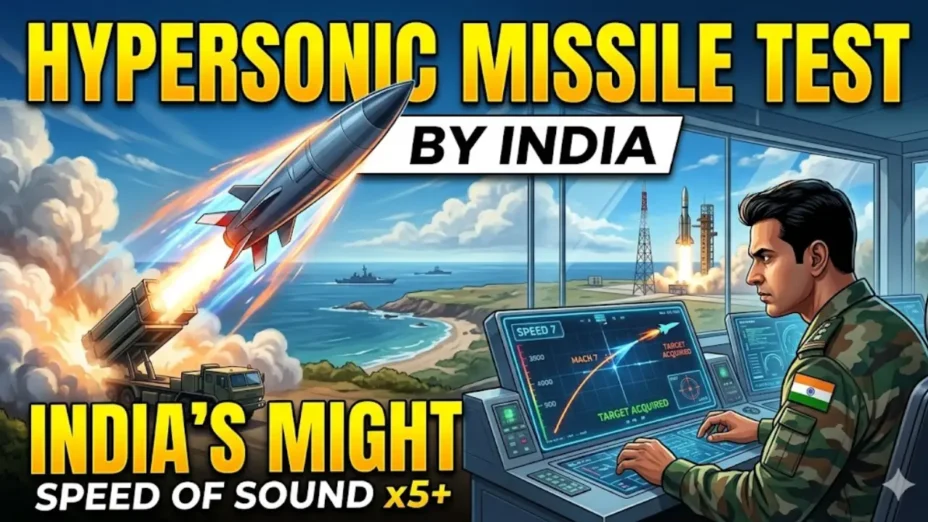
India has achieved a major milestone in its hypersonic weapons program with the successful testing of a long-range anti-ship hypersonic missile. This development is not just another defense upgrade it represents a transformational shift in India’s military capability, especially in naval warfare and maritime security.
Developed under the leadership of Defence Research and Development Organisation, this missile has now moved beyond basic testing into an advanced stage where it is close to operational deployment. With this success, India joins a very exclusive group of nations that possess such cutting-edge technology.
What Is a Hypersonic Missile and Why It Matters
Hypersonic missiles are weapons that travel at speeds greater than Mach 5, meaning five times the speed of sound. At such extreme speeds, these missiles become incredibly difficult to detect, track, and intercept.
Unlike traditional missiles, hypersonic weapons combine speed with maneuverability. This allows them to change direction mid-flight, making them unpredictable. This capability makes them far more lethal than conventional cruise or ballistic missiles.
In simple terms, by the time an enemy detects such a missile, it is often too late to respond effectively.
Details of India’s Successful Missile Test
The recent test has validated several key aspects of the missile’s performance. The missile demonstrated a range of over 1500 kilometers, which places it among the most powerful anti-ship systems in the world.
During the test, it achieved peak speeds close to Mach 10, while maintaining an average speed of Mach 5 throughout its flight. This sustained hypersonic flight is a critical achievement because maintaining such speeds over long distances is technically challenging.
The test also confirmed that the missile can operate at low altitudes during its glide phase. This makes radar detection extremely difficult for enemy ships and ground-based defense systems.
Additionally, the missile successfully validated its indigenous avionics, sensors, and airframe integrity. This means the system is not only fast but also stable and accurate at extreme speeds.
Transition From Testing to Deployment
One of the most important aspects of this achievement is that the missile has now moved from the technology validation phase to near-operational prototyping.
This indicates that it is almost ready for deployment. The next step will involve user trials conducted jointly by the Indian Navy and DRDO. If these trials are successful, the missile could be inducted into service within the next two years.
Initially, the missile will be deployed through ground-based coastal batteries. In the future, ship-launched, air-launched, and even submarine-launched variants are expected.
Ability to Hit Moving Naval Targets
A key highlight of this missile is its ability to strike both stationary and moving naval targets with high precision. Hitting a moving warship at hypersonic speeds is extremely complex due to constant changes in target position and environmental factors.
However, India’s new missile has demonstrated this capability successfully, making it a powerful anti-ship weapon.
India Joins the Elite Hypersonic Club
With this achievement, India joins countries like China and Russia that already possess operational hypersonic anti-ship missiles.
China’s YJ-21 and Russia’s Zircon missile are comparable systems. Meanwhile, the United States is still working on deploying its hypersonic weapon system known as Dark Eagle, which is currently in the testing phase.
This places India in a strong strategic position globally.
Strategic Importance in the Indian Ocean Region
The Indian Ocean is one of the most critical regions for global trade and energy supply routes. Control over this region directly impacts economic and military power.
India’s new missile significantly enhances its ability to dominate this region. By creating a large “anti-access/area denial” zone, the missile can prevent enemy ships from operating freely within a vast area.
This means that adversary naval forces will have to stay far away from Indian shores, reducing their operational effectiveness.
Impact on China’s Naval Strategy
China has been expanding its naval presence in the Indian Ocean, often referred to as its “string of pearls” strategy. However, India’s hypersonic missile creates a serious challenge for this expansion.
If deployed in strategic locations like the Andaman and Nicobar Islands, the missile can effectively monitor and control key chokepoints such as the Strait of Malacca.
This is crucial because a large portion of China’s trade and energy imports pass through this route. In a conflict scenario, this capability could severely disrupt Chinese logistics.
A Powerful Tool for Area Denial
The concept of area denial is central to modern naval warfare. It means creating a zone where enemy forces cannot safely operate.
With its high speed, low observability, and precision targeting, India’s hypersonic missile creates a lethal denial zone. Enemy ships, including aircraft carriers, destroyers, and amphibious vessels, would face extreme risk if they enter this zone.
This fundamentally changes the dynamics of naval warfare in the region.
Implications for Global Naval Powers
This development also has implications beyond regional rivals. Major naval powers rely on aircraft carrier strike groups to project power globally.
For example, the United States often deploys such groups to maintain its influence in key regions. However, hypersonic missiles pose a serious threat to these large naval formations.
If an adversary must stay 1000–1500 kilometers away to avoid missile range, it limits their ability to conduct effective air operations.
Lessons From Modern Conflicts
Recent global conflicts have highlighted the importance of advanced missile systems. Hypersonic weapons are increasingly seen as game changers due to their speed and difficulty of interception.
Even major powers are accelerating their hypersonic programs, recognizing their strategic value.
Future Developments and Expansion
India is expected to further develop this missile into multiple variants. Ship-based and submarine-based versions will significantly enhance flexibility and survivability.
Additionally, integration with advanced targeting systems, satellites, and artificial intelligence could further improve accuracy and response time.
Strengthening India’s Maritime Doctrine
India’s maritime strategy focuses on ensuring sea control for friendly forces while denying access to adversaries. This missile directly supports that doctrine.
It allows India to secure its coastline, protect trade routes, and maintain dominance in the Indian Ocean.
A Signal to the World
Beyond its military capability, this missile sends a strong message. It shows that India is capable of developing advanced indigenous defense technologies.
It also signals that India is prepared to defend its interests and maintain stability in the region.
Conclusion: A True Game Changer for India
India’s long-range anti-ship hypersonic missile is not just a technological achievement—it is a strategic breakthrough.
By combining speed, stealth, and precision, it transforms India’s naval capabilities and strengthens its position in the global defense landscape.
As the missile moves closer to deployment, it will play a crucial role in shaping the future of warfare in the Indian Ocean and beyond.
FAQs
What is a hypersonic missile?
A hypersonic missile is a weapon that travels at speeds greater than Mach 5 and can maneuver during flight, making it difficult to intercept.
What is the range of India’s new missile?
The missile has demonstrated a range of over 1500 kilometers during testing.
Who developed this missile?
It was developed by India’s Defence Research and Development Organisation (DRDO).
Why is this missile important for India?
It enhances India’s naval strength, improves coastal defense, and strengthens its strategic position in the Indian Ocean.
Which countries have hypersonic missiles?
Countries like China, Russia, and now India have advanced hypersonic missile capabilities, while the United States is still developing its systems.
When will the missile be deployed?
After user trials with the Indian Navy, it is expected to be deployed within the next two years.