
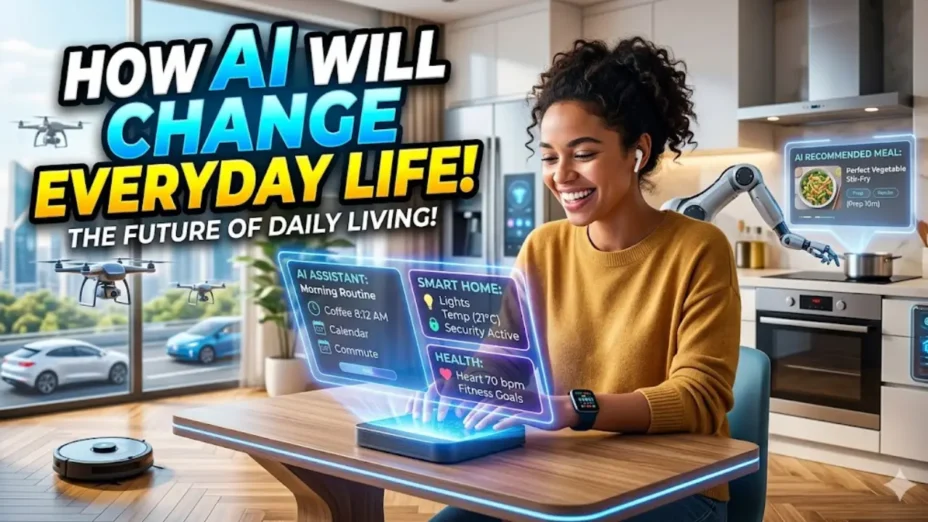
Introduction to Artificial Intelligence in Daily Life
Artificial Intelligence isn’t some distant, sci-fi concept anymore it’s already woven into the fabric of everyday life in ways many people don’t even notice. From the moment you wake up and check your smartphone to the time you wind down with a streaming service, AI is quietly working behind the scenes. It recommends what you should watch, predicts what you might type next, and even helps you avoid traffic on your commute. The real shift happening now isn’t just technological it’s deeply personal.
Think about it like electricity when it was first introduced. At first, it felt like a novelty. Now, it’s so essential that imagining life without it feels impossible. AI is following that exact same path. According to a 2025 report by McKinsey, over 70% of businesses have already integrated AI in some form, and that trickles down directly into consumer experiences. Whether it’s smarter apps, better healthcare, or more intuitive devices, AI is becoming less visible but more powerful.
What makes AI particularly transformative is its ability to learn and adapt. Unlike traditional software, it doesn’t just follow rules it evolves based on data. That means your experience with AI is uniquely yours. Your recommendations, your notifications, even your digital habits are shaped specifically for you. And while that sounds convenient and it is it also raises questions about privacy, control, and dependency.
So, how exactly is AI changing everyday life in real, tangible ways? Not in theory, but in actual, lived experiences? Let’s break it down step by step, diving into real examples that show just how deeply AI is reshaping the way we live, work, and think.
What AI Really Means for the Average Person
For most people, AI doesn’t look like robots walking around doing chores. It’s much subtler than that. It shows up as small conveniences that, over time, completely reshape expectations. Ever noticed how your phone suggests replies to messages? Or how your music app seems to know your mood better than you do? That’s AI at work quietly learning your preferences and adjusting accordingly.
The average person interacts with AI dozens, if not hundreds, of times a day without realizing it. Google Maps rerouting your drive due to traffic? AI. Your email filtering out spam? AI. Your bank detecting suspicious transactions? Also AI. These systems are designed to reduce friction in your daily routine, making decisions faster and often more accurately than humans could.
But here’s where it gets interesting: AI isn’t just reacting it’s predicting. It anticipates needs before you even articulate them. For example, Netflix doesn’t just recommend random shows; it uses complex algorithms analyzing viewing habits of millions of users to predict what you’ll enjoy. That’s why it often feels uncannily accurate.
A study by PwC suggests that AI could contribute up to $15.7 trillion to the global economy by 2030, largely driven by personalization and efficiency gains. That’s not just a business stat it reflects how deeply AI will influence individual lifestyles.
In simple terms, AI is becoming a digital extension of human decision-making. It’s like having an invisible assistant who learns from you constantly. The more you interact with it, the smarter it gets. And while that sounds incredibly helpful, it also subtly shifts how much control we retain over our choices.
Why AI Is No Longer Just a Futuristic Concept
There was a time when AI belonged in movies think humanoid robots or superintelligent machines taking over the world. But today’s AI is far more practical, and arguably more powerful because of it. It doesn’t need a physical form to have a massive impact. It lives in the cloud, in apps, in devices you already own.
One major reason AI has become so mainstream is the explosion of data. Every click, swipe, and search generates information. Combine that with increased computing power and advanced algorithms, and you get systems that can process and learn at unprecedented speeds. Companies like Google, Amazon, and Microsoft are investing billions into AI development, pushing it further into everyday applications.
Real-life examples are everywhere. Smart thermostats like Nest learn your schedule and adjust temperatures automatically, saving energy and money. Grocery apps predict what you’ll need based on past purchases. Even social media feeds are curated by AI to keep you engaged longer sometimes controversially so.
What’s fascinating is how quickly expectations have shifted. Features that felt revolutionary five years ago are now standard. Imagine using a phone without facial recognition or a car without driver assistance features it already feels outdated.
Experts like Andrew Ng, a leading AI researcher, have said, “AI is the new electricity.” And when you look at how seamlessly it’s integrating into everyday life, that comparison feels less like hype and more like reality.
AI is no longer about what might happen in the future. It’s about what’s already happening now—and accelerating faster than most people realize.
AI in Smart Homes and Living Spaces
Walk into a modern home today, and you’ll notice something subtle but powerful: the house itself is starting to “think.” Smart homes powered by AI are transforming living spaces into responsive, adaptive environments that adjust to your habits almost like a living organism. Lights turn on before you enter a room, thermostats adjust based on your preferences, and even refrigerators can suggest recipes based on what’s inside them.
This isn’t just about convenience it’s about efficiency and personalization. AI systems analyze patterns over time. For example, if you consistently lower the thermostat at night, a smart system will start doing it automatically. According to Statista, the number of smart homes worldwide is expected to exceed 500 million by 2028, showing just how rapidly this technology is being adopted.
Voice assistants like Alexa, Google Assistant, and Siri are at the centre of this ecosystem. They act as the command hub, allowing users to control multiple devices with simple voice commands. But beyond basic commands, these systems are becoming more conversational and context-aware. You’re no longer just giving instructions you’re interacting.
Security is another area where AI is making a big impact. Smart cameras can distinguish between a package delivery and a potential intruder, reducing false alarms. Doorbells with facial recognition can alert you when a familiar face arrives. It’s similar to having a security system that operates continuously.
What’s particularly interesting is how these systems are learning not just individual preferences but household dynamics. They can recognize different users and tailor responses accordingly. One person’s music preferences, another’s lighting choices all seamlessly integrated.
Of course, this level of personalization raises important questions about data privacy. After all, these systems are constantly collecting information. But for many users, the trade-off between convenience and privacy is one they’re willing to make.
Smart homes are no longer a luxury they’re quickly becoming the standard. And as AI continues to evolve, the line between living in a home and interacting with it will become increasingly blurred.
Voice Assistants and Automation
Voice assistants have quietly become one of the most widespread forms of AI in everyday life. What started as a novelty asking your phone about the weather has evolved into a central control system for entire households. Today, millions of people rely on voice assistants not just for information, but for managing daily routines.
The real power of voice assistants lies in automation. You can set routines that trigger multiple actions with a single command. Saying “Good morning” might turn on lights, start the coffee maker, and read out your schedule for the day. It’s not just convenience it’s orchestration.
According to a 2024 report by Juniper Research, there are over 8.4 billion digital voice assistants in use globally, outnumbering the human population. That statistic alone highlights how deeply embedded this technology has become.
What makes voice assistants particularly compelling is their accessibility. They are easy to use, even without specialized knowledge. They lower the barrier to interacting with complex systems, making technology more inclusive. Elderly users, for example, can control devices without navigating complicated interfaces.
However, voice assistants are also evolving beyond reactive tools. They’re becoming proactive. Imagine your assistant reminding you to leave early for an appointment because it detected traffic delays. Or suggesting you reorder groceries before you run out. These aren’t hypothetical features they’re already being implemented.
The challenge moving forward is making these systems more context-aware. Understanding not just what you say, but what you mean. Natural language processing is improving rapidly, but there’s still a gap between human conversation and machine understanding.
Even so, voice assistants represent a glimpse into a future where interacting with technology feels less like operating a machine and more like having a conversation. And that shift subtle as it may seem is fundamentally changing how we experience everyday life.
Real-Life Example of a Fully Automated Home
Picture this: you wake up before your alarm even rings, not because you suddenly became a morning person, but because your bedroom lighting gradually brightened to simulate a natural sunrise. The blinds quietly roll up, your coffee machine starts brewing, and the thermostat adjusts to your preferred morning temperature. This isn’t a luxury sci-fi scene it’s a real-life example of what a fully AI-powered smart home can already do today.
Take the example of tech enthusiast families who’ve integrated platforms like Apple HomeKit, Google Home, or Amazon Alexa into a unified system. These homes don’t just respond—they anticipate. Motion sensors detect when someone enters a room and adjust lighting accordingly. Modern refrigerators monitor expiration dates and offer recipe suggestions. Even your bathroom mirror can display weather updates, reminders, and health stats pulled from wearable devices. It’s like living inside a personalized operating system.
One widely shared case study involved a homeowner in California who reduced energy bills by nearly 30% after implementing AI-driven energy management systems. These systems analyze usage patterns, identify inefficiencies, and automatically optimize power consumption. For instance, they might delay running heavy appliances until off-peak hours or shut down unused devices.
Security is also deeply integrated. AI-powered surveillance systems can distinguish between a stray animal, a delivery person, or a potential threat. Some systems even notify you with contextual alerts like, “Your child just arrived home,” instead of a generic motion notification. That level of specificity makes the technology feel less robotic and more intuitive.
But here’s where things get interesting: these homes evolve. The longer you live in them, the smarter they become. They learn your habits, your preferences, even your quirks. Forget to lock the door often? The system adapts. Tend to watch TV late on weekends? It adjusts lighting and sound profiles accordingly.
Of course, not everything is perfect. Connectivity issues, compatibility between devices, and data privacy concerns still exist. But despite these challenges, fully automated homes offer a glimpse into a future where your living space doesn’t just shelter you it actively supports and enhances your lifestyle.
AI in Healthcare and Personal Wellness
Healthcare is one of the areas where AI isn’t just making life easier it’s literally saving lives. The integration of AI into medical systems is transforming how diseases are detected, diagnosed, and treated. And the impact isn’t limited to hospitals; it’s extending into everyday personal wellness.
Imagine going for a routine check-up and having an AI system analyze your medical history, genetic data, and lifestyle habits within seconds. It can flag potential risks that a human doctor might miss simply due to time constraints. According to a 2025 study published in The Lancet Digital Health, AI models have achieved up to 94% accuracy in detecting certain cancers from imaging scans, sometimes outperforming experienced radiologists.
But the real shift is happening outside clinical settings. AI is empowering individuals to take control of their health. Apps now track sleep patterns, monitor heart rates, and even detect irregularities that could indicate serious conditions. Instead of reacting to illness, people are moving toward prevention and AI is the driving force behind that shift.
Telemedicine has also exploded, especially after the global pandemic. AI chatbots can perform initial symptom checks, guiding users on whether they need medical attention. This reduces the burden on healthcare systems and ensures quicker responses for those who need urgent care.
There’s also a psychological aspect. Mental health apps powered by AI provide support through guided conversations, mood tracking, and cognitive behavioural therapy techniques. While they don’t replace human therapists, they offer accessible support for people who might otherwise go without help.
Still, the use of AI in healthcare raises ethical questions. Who owns your health data? How is it being used? And can algorithms truly understand the complexity of human health? These concerns are valid and ongoing.
Even with these challenges, one thing is clear: AI is shifting healthcare from reactive to proactive, from generalized to personalized. And that transformation is changing not just how we treat illness, but how we think about health altogether.
AI-Powered Diagnostics and Early Detection
One of the most groundbreaking applications of AI in healthcare is in diagnostics and early detection. Traditionally, diagnosing diseases has relied heavily on human expertise, which, while invaluable, is also limited by time, fatigue, and subjective judgment. AI changes that equation by offering consistency, speed, and the ability to analyze massive datasets in seconds.
For example, AI systems trained on thousands of medical images can detect subtle patterns that might be invisible to the human eye. In breast cancer screening, AI has been shown to reduce false positives and false negatives, improving both accuracy and patient outcomes. Early detection is critical catching a disease in its initial stages can significantly increase survival rates.
But it’s not just about imaging. AI is also being used in predictive analytics. By analyzing electronic health records, lifestyle data, and even genetic information, AI can identify individuals at high risk for certain conditions. This allows for early intervention, potentially preventing diseases before they develop.
A fascinating real-world example comes from wearable ECG monitors that use AI to detect irregular heart rhythms. These devices can alert users to potential issues like atrial fibrillation, often before symptoms appear. In some cases, this early warning has prevented strokes.
Doctors are increasingly viewing AI not as a replacement, but as a powerful assistant. It handles the data-heavy tasks, allowing medical professionals to focus on patient care. As Dr. Eric Topol, a leading digital health expert, puts it: “AI will not replace doctors, but doctors who use AI will replace those who don’t.”
The future of diagnostics is not just faster it’s smarter. And that means better outcomes for patients across the board.
Wearable Technology and Health Monitoring
Wearable technology has turned everyday accessories into powerful health-monitoring tools. Smartwatches, fitness trackers, and even smart rings are now equipped with AI algorithms that continuously analyze your body’s signals. What used to require a hospital visit can now be tracked in real time, right from your wrist.
Think about how often you check your steps or heart rate. Now expand that to include sleep quality, blood oxygen levels, stress indicators, and even early signs of illness. Devices like the Apple Watch and Fitbit use AI to interpret this data, providing insights that go beyond raw numbers. They don’t just tell you what’s happening they help you understand why.
A 2024 report by IDC found that over 600 million wearable devices are actively in use worldwide. That’s a massive amount of health data being generated every second. AI processes this data to identify patterns and anomalies, offering personalized recommendations. For instance, if your sleep quality drops consistently, your device might suggest changes in your routine.
One of the most impactful uses of wearables is in chronic disease management. Diabetic patients can use continuous glucose monitors that track blood sugar levels and provide real-time alerts. Similarly, people with heart conditions can benefit from continuous monitoring that detects irregularities early.
There’s also a behavioural aspect. Seeing real-time data can motivate people to make healthier choices. It’s one thing to know you should exercise more it’s another to see your activity levels visualized and tracked over time.
Of course, accuracy and data privacy remain concerns. Not all devices are created equal, and users need to be mindful of how their data is stored and shared. But despite these challenges, wearable AI is making health monitoring more accessible, personalized, and proactive than ever before.
AI in Transportation and Mobility
Transportation is undergoing a quiet revolution, and AI is at the centre of it. Whether you’re driving your own car, using public transport, or booking a ride through an app, chances are AI is shaping your journey in ways you might not even notice.
Navigation apps like Google Maps and Waze use AI to analyze real-time traffic data, suggesting the fastest routes and even predicting delays before they happen. This isn’t just convenient it saves time, reduces fuel consumption, and lowers stress levels. According to INRIX, traffic congestion costs the average driver over $1,000 annually in lost time and fuel. AI helps mitigate that.
Ride-sharing platforms like Uber and Lyft rely heavily on AI for matching drivers with passengers, optimizing routes, and even setting dynamic pricing. Without AI, these systems simply wouldn’t function at scale.
But the most talked-about development is autonomous vehicles. Self-driving cars are no longer experimental they’re being tested and, in some cases, deployed in real-world environments. Companies like Tesla, Waymo, and Cruise are leading the charge, using AI to interpret sensor data, recognize objects, and make driving decisions in real time.
Public transportation is also benefiting. AI is used to predict passenger demand, optimize schedules, and improve maintenance. For example, some subway systems use AI to detect potential equipment failures before they happen, reducing downtime and improving reliability.
The broader impact is significant. Safer roads, more efficient systems, and reduced environmental impact. But challenges remain, especially around regulation, safety, and public trust.
Even so, the direction is clear: AI is making transportation smarter, faster, and more responsive to human needs. And as these systems continue to evolve, the way we move through the world will change in ways that feel both subtle and profound.
Self-Driving Cars and Smart Navigation
Self-driving cars tend to grab headlines, but the reality is more nuanced than a simple switch from human drivers to fully autonomous machines. What’s happening right now is a gradual layering of AI-driven assistance systems that are quietly reshaping how we drive. Features like adaptive cruise control, lane-keeping assistance, automatic braking, and collision detection are already standard in many modern vehicles. These aren’t just add-ons they’re stepping stones toward full autonomy.
Think of it like teaching a teenager to drive. At first, they need constant supervision. Over time, they gain confidence and skill. AI systems are going through a similar learning curve, powered by billions of miles of driving data. Tesla alone reports that its vehicles have collectively driven over 10 billion miles using Autopilot features, feeding its algorithms with real-world scenarios that help improve decision-making.
Smart navigation is where AI already feels indispensable. Apps don’t just tell you where to go—they actively adjust based on real-time conditions. If there’s a sudden accident or road closure, your route changes instantly. It’s like having a co-pilot who’s always scanning the road ahead. Some systems even factor in weather conditions, construction zones, and historical traffic patterns to optimize travel time.
But full self-driving cars still face challenges. Edge cases rare, unpredictable scenarios remain difficult for AI to handle. A pedestrian behaving erratically, unusual road layouts, or extreme weather conditions can still confuse even the most advanced systems. That’s why many experts believe widespread adoption will happen gradually rather than overnight.
Safety is the biggest promise. The World Health Organization estimates that over 1.3 million people die each year in road accidents, many due to human error. AI has the potential to drastically reduce that number. But trust is a hurdle. People need to feel confident handing over control, and that takes time.
For now, the most realistic picture isn’t a world without drivers it’s a world where AI and humans collaborate, making roads safer and journeys smoother.
AI in Public Transport Systems
Public transportation might not seem like the most exciting place for AI innovation, but it’s actually one of the areas where the technology is making a huge practical difference. Behind the scenes, AI is optimizing routes, predicting demand, and improving overall efficiency in ways that directly impact millions of daily commuters.
Take city buses, for example. Traditionally, routes and schedules were fixed, often leading to overcrowded buses during peak hours and nearly empty ones during off-peak times. AI changes that by analyzing historical data, real-time passenger flow, and even weather conditions to dynamically adjust schedules. Cities like Singapore and London are already using AI to predict passenger demand with impressive accuracy.
Subway systems are also becoming smarter. AI-powered predictive maintenance can identify potential equipment failures before they happen. Sensors monitor everything from track conditions to train performance, and algorithms flag anomalies. This reduces unexpected breakdowns and keeps systems running smoothly. For commuters, that means fewer delays and a more reliable experience.
Even ticketing is evolving. AI-driven systems can analyze travel patterns to offer personalized pricing or suggest optimal routes. Imagine your transit app telling you, “If you leave 10 minutes earlier, you’ll save 15 minutes on your commute.” That’s not just helpful it changes behaviour over time.
A real-world example comes from New York City’s Metropolitan Transportation Authority (MTA), which has begun integrating AI tools to improve service reliability. Early results show measurable reductions in delays on certain services. Similarly, European rail networks are using AI to optimize energy consumption, reducing both costs and environmental impact.
There are challenges, of course. Implementing AI in large, aging infrastructure systems isn’t easy. Data integration, privacy concerns, and high upfront costs can slow adoption. But the long-term benefits efficiency, sustainability, and improved user experience make it a worthwhile investment.
Public transport might never feel glamorous, but with AI, it’s becoming smarter, more responsive, and better aligned with the needs of modern urban life.
AI in Education and Learning
Education is undergoing a transformation that’s less about replacing teachers and more about redefining how learning happens. AI is shifting the focus from one-size-fits-all instruction to highly personalized learning experiences that adapt to each student’s pace, strengths, and weaknesses.
Think back to a typical classroom setting. One teacher, dozens of students, and a fixed curriculum. Some students grasp concepts quickly, while others struggle to keep up. AI changes that dynamic by acting as a personalized guide for each learner. It analyzes performance data in real time and adjusts content accordingly. If a student is struggling with a math concept, the system can provide additional exercises or explain it in a different way.
Platforms like Khan Academy and Duolingo already use AI to tailor lessons. According to a 2025 report by HolonIQ, the global AI in education market is expected to reach $25 billion by 2030, driven largely by demand for personalized learning tools.
Teachers also benefit. AI can handle administrative tasks like grading, attendance tracking, and performance analysis, freeing up time for more meaningful interactions with students. Instead of spending hours grading papers, teachers can focus on mentoring and engagement.
There’s also a shift toward lifelong learning. AI-powered platforms make it easier for people to acquire new skills at any stage of life. Whether it’s learning a new language, coding, or professional development, education becomes more accessible and flexible.
However, there are concerns about over-reliance on technology and the potential loss of human connection in learning environments. Education isn’t just about information it’s about interaction, empathy, and social development.
Even so, AI is not replacing the classroom it’s expanding it. Learning is no longer confined to a specific place or time. It’s becoming a continuous, adaptive process that fits into everyday life.
Personalized Learning Experiences
Personalized learning is where AI truly shines in education. Instead of forcing every student through the same path, AI creates a unique journey tailored to individual needs. It’s like having a tutor who understands exactly how you learn best.
Imagine a student struggling with algebra. A traditional classroom might move on before the student fully understands the concept. An AI-powered system, however, detects the struggle immediately. It slows down, offers additional explanations, and provides targeted exercises until the concept clicks. On the flip side, students who excel can move ahead without being held back.
This adaptability isn’t just about pace it’s about style. Some people learn better through visuals, others through text or interactive exercises. AI identifies these preferences and adjusts content delivery accordingly. This leads to a more captivating and productive learning environment.
A study by the Bill & Melinda Gates Foundation found that personalized learning approaches can improve student outcomes by up to 30% in certain contexts. That’s a significant shift, especially when scaled across entire education systems.
There’s also an emotional component. Learning can be frustrating, especially when progress feels slow. AI systems can provide immediate feedback and encouragement, helping maintain motivation. It’s not the same as human support, but it fills gaps that traditional systems often leave behind.
Still, personalization comes with trade-offs. Collecting data on students raises privacy concerns, and there’s always the risk of over-optimization where learning becomes too tailored, potentially limiting exposure to diverse perspectives.
Even with these challenges, personalized learning represents a major step forward. It transforms education from a rigid system into a flexible, responsive experience that adapts to the learner, not the other way around.
AI Tutors and Virtual Classrooms
AI tutors and virtual classrooms are redefining what it means to “attend” a class. You no longer need to be physically present in a room at a specific time to learn effectively. With AI, education becomes something you can access anytime, anywhere.
AI tutors are available 24/7, offering instant help when you need it. Stuck on a problem at midnight? Instead of waiting until the next day, you can get immediate assistance. These systems use natural language processing to understand questions and provide detailed explanations, often breaking down complex topics into simpler steps.
Virtual classrooms take this a step further by creating interactive learning environments online. AI can track student engagement, identify who’s struggling, and even suggest interventions in real time. Some platforms use facial recognition and voice analysis to gauge attention levels, though this raises ethical questions about surveillance.
During the COVID-19 pandemic, virtual learning became a necessity. Now, it’s evolving into a preferred option for many. According to UNESCO, over 1.6 billion students worldwide experienced some form of remote learning, accelerating the adoption of AI-driven educational tools.
One interesting development is the use of AI-generated simulations. Medical students, for example, can practice procedures in virtual environments that mimic real-life scenarios. This hands-on experience, powered by AI, enhances learning in ways traditional methods can’t.
Of course, virtual learning isn’t without drawbacks. Screen fatigue, lack of social interaction, and digital inequality are real issues. Not everyone has access to the technology required for these systems.
Still, AI tutors and virtual classrooms are making education more flexible, scalable, and inclusive. They’re not replacing traditional education they’re expanding its reach and redefining its possibilities.
AI in Workplaces and Jobs
Work is changing and not in some distant, abstract way. It’s happening right now, quietly reshaping how tasks get done, how teams collaborate, and even how careers evolve over time. Artificial Intelligence in the workplace isn’t just about robots replacing humans; it’s more like adding a powerful co-worker who never gets tired, handles repetitive tasks effortlessly, and helps you make better decisions faster.
Walk into a modern office (or log into a remote workspace), and you’ll see AI tools everywhere. Email platforms suggest replies, project management tools predict deadlines, and analytics dashboards highlight trends you might have missed. According to a 2025 Deloitte report, nearly 80% of organizations are using AI to improve productivity and decision-making, and that number is only climbing.
What’s interesting is how AI shifts the nature of work itself. Tasks that used to take hours data entry, report generation, scheduling can now be completed in minutes. That frees up time for more strategic, creative, and human-cantered work. Instead of spending your day buried in spreadsheets, you’re interpreting insights, brainstorming ideas, or building relationships.
Remote work has also been supercharged by AI. Tools like real-time transcription, language translation, and smart scheduling assistants make global collaboration seamless. Imagine working with a team spread across five countries, speaking different languages, and still communicating effortlessly. That’s not futuristic it’s already happening.
But there’s tension here too. Automation raises concerns about job displacement. Some roles will inevitably shrink or disappear. At the same time, entirely new roles are emerging AI trainers, data ethicists, prompt engineers. The job market isn’t just shrinking or growing; it’s transforming.
The key takeaway? AI isn’t replacing work it’s redefining it. And the people who adapt, who learn how to work alongside AI, will have a significant advantage in this evolving landscape.
Automation of Repetitive Tasks
If you’ve ever spent hours doing the same monotonous task copying data, sorting emails, generating reports you already know how draining repetition can be. This is exactly where AI steps in and makes an immediate, tangible difference. Automation powered by AI is eliminating the kind of busywork that eats up time without adding much value.
Think about industries like finance, customer support, or logistics. These fields often involve high volumes of repetitive processes. AI tools can handle invoice processing, categorize emails, manage inventory, and even respond to basic customer inquiries. According to McKinsey, up to 45% of current work activities could be automated using existing technology. That’s nearly half of what many people do daily.
But here’s the nuance: automation doesn’t necessarily mean job loss it often means job evolution. For example, a customer service agent who once handled hundreds of basic queries can now focus on complex issues that require empathy and critical thinking. The AI handles the routine, while the human handles the meaningful.
There’s also a psychological shift. When repetitive tasks disappear, work becomes less about endurance and more about creativity and problem-solving. It’s like moving from assembly-line work to craftsmanship. You’re no longer just doing you’re thinking, designing, improving.
Of course, there are challenges. Not all automation is seamless. Poorly implemented AI systems can create confusion or even increase workload if they require constant oversight. There’s also the need for reskilling. Workers must learn how to use these tools effectively, which requires time and effort.
Even so, the direction is clear: repetitive work is fading into the background. And in its place, we’re seeing roles that are more dynamic, engaging, and aligned with uniquely human strengths.
Creation of New Job Opportunities
Whenever a major technological shift happens, there’s always a wave of anxiety about jobs disappearing. And yes, some roles do fade away but history shows something equally important: new opportunities emerge, often in ways people didn’t anticipate. AI is no different. It’s not just eliminating jobs; it’s creating entirely new categories of work.
Think about roles like AI trainers, who teach models how to respond accurately, or data annotators, who label datasets so machines can learn. Then there are AI ethicists, professionals focused on ensuring that systems are fair, transparent, and aligned with human values. Even creative fields are evolving, with people specializing in AI-assisted design, writing, and content production.
According to the World Economic Forum, AI is expected to create 97 million new jobs by 2030, even as it displaces around 85 million. That’s a net positive but more importantly, it reflects a shift in the type of work available.
What’s fascinating is how hybrid roles are emerging. You don’t have to be a programmer to work with AI anymore. Marketers use AI for campaign optimization, doctors use it for diagnostics, and teachers use it for personalized learning. The skill isn’t just technical it’s about knowing how to collaborate with intelligent systems.
There’s also a rise in entrepreneurship. AI tools lower the barrier to starting a business. A single person can now run operations that once required entire teams handling marketing, customer service, analytics, and more with AI assistance.
Still, the transition isn’t always smooth. Workers need access to training and education to move into these new roles. Without that, there’s a risk of widening inequality.
Even with these challenges, one thing stands out: AI is not just changing jobs it’s expanding what’s possible. And for those willing to adapt, it opens doors that didn’t even exist a decade ago.
AI in Shopping and Consumer Behaviour
Shopping today feels almost effortless and that’s no accident. AI has completely transformed how people discover, evaluate, and purchase products, often in ways so seamless that it goes unnoticed. From personalized recommendations to dynamic pricing, AI is shaping consumer behaviour at every step.
Ever wondered why online stores seem to “know” exactly what you’re looking for? That’s AI analyzing your browsing history, past purchases, and even how long you linger on certain products. Amazon, for instance, attributes a significant portion of its sales estimated at over 35% to its recommendation engine.
But it goes beyond suggestions. AI influences pricing, promotions, and even product placement. Pricing algorithms change costs in response to demand, competitors’ actions, and customer behaviour. That’s why the same product might appear at slightly different prices for different place or at different times.
In physical stores, AI is also making an impact. Smart shelves track inventory in real time, while cashier-less stores like Amazon Go use computer vision to let customers walk in, grab items, and leave without waiting in line. It’s retail without friction.
There’s also a psychological element. AI creates a sense of personalization that makes shopping feel more engaging. Instead of browsing endlessly, you’re guided toward options that match your preferences. It’s like having a personal shopper who knows your taste.
Of course, this raises questions about manipulation. If AI knows your habits so well, can it nudge you into buying things you don’t really need? That’s an ongoing debate.
Still, there’s no denying the convenience. Shopping is faster, more intuitive, and increasingly tailored to individual needs. And as AI continues to evolve, the line between browsing and buying will become even more seamless.
Personalized Recommendations
Personalized recommendations are one of the most visible and influential applications of AI in everyday life. Whether you’re shopping online, streaming music, or scrolling through social media, algorithms are constantly curating content specifically for you.
At first glance, it feels helpful. You save time, discover products you genuinely like, and avoid irrelevant options. But underneath that convenience is a complex system analyzing massive amounts of data. Every click, every pause, every purchase feeds into a model that refines its understanding of your preferences.
Netflix, Spotify, and Amazon are masters of this approach. Netflix alone reports that its recommendation system saves the company over $1 billion annually by reducing churn. That means people stick around because they keep finding content they enjoy.
But personalization isn’t just about entertainment or shopping it’s about shaping choices. When you’re consistently shown certain types of products or content, your perception of what’s available narrows. It’s like walking into a store where only items you’re likely to buy are displayed.
There’s a balance to strike. On one hand, personalization enhances user experience. On the other, it can create “filter bubbles” that limit exposure to new ideas or options.
Even with these concerns, personalized recommendations are becoming the norm. They make digital experiences feel tailored, efficient, and surprisingly intuitive. And as AI models become more sophisticated, the line between suggestion and prediction will continue to blur.
AI in Customer Service
Customer service has undergone a quiet revolution thanks to AI. Not long ago, getting help meant waiting on hold, navigating complex menus, or sending emails that took days to get a response. Now, AI-powered systems are making support faster, more accessible, and often more efficient.
Chatbots are the most visible example. They handle common queries instantly order tracking, password resets, basic troubleshooting. According to Gartner, by 2026, over 75% of customer interactions will be handled by AI in some form. That’s a massive shift in how businesses interact with customers.
But modern AI customer service goes beyond scripted responses. Advanced systems use natural language processing to understand context, sentiment, and intent. They can detect frustration and escalate issues to human agents when necessary. It’s not simply automation; it’s smart engagement.
There’s also the benefit of availability. AI doesn’t sleep. Whether it’s midnight or a holiday, support is always accessible. For global businesses, that’s a game-changer.
However, not all experiences are perfect. Poorly designed chatbots can be frustrating, especially when they fail to understand nuanced questions. That’s why the best systems use a hybrid approach AI handles the routine, humans handle the complex.
From a business perspective, AI reduces costs and improves efficiency. From a customer perspective, it reduces waiting time and increases convenience.
The end result? Customer service is becoming less of a bottleneck and more of a seamless part of the overall experience something that works quietly in the background, ready when you need it.
AI in Entertainment and Media
Entertainment has always evolved alongside technology from radio to television to streaming platforms. Now, Artificial Intelligence is reshaping how content is created, distributed, and consumed, often in ways that feel almost invisible to the audience. What used to be a passive experience is becoming increasingly interactive, personalized, and data-driven.
When you open a streaming platform like Netflix or YouTube, you’re not just browsing a library you’re stepping into a curated environment designed specifically for you. AI analyzes your viewing habits, watch time, preferences, and even when you pause or skip content. Based on that, it builds a digital profile that predicts what you’ll enjoy next. According to industry estimates, over 80% of content watched on Netflix comes from recommendations, not direct searches. That’s a staggering shift in how people discover entertainment.
Content creation itself is also being transformed. AI tools can now assist in video editing, scriptwriting, music composition, and even visual effects. While human creativity still leads the process, AI acts like a powerful collaborator, speeding up production and opening new creative possibilities. Independent creators, in particular, benefit from this what once required a full production team can now be done by a single individual using AI tools.
Social media platforms are another major arena. Algorithms decide what content you see, when it appears, and how frequently you encounter it. This has a profound impact on culture, trends, and even public opinion. Viral content isn’t just viral it’s often amplified by AI systems designed to maximize engagement.
There’s also a growing concern about authenticity. With AI-generated content becoming more realistic, distinguishing between real and artificial media is becoming harder. Deepfakes, synthetic voices, and AI-generated influencers are raising important questions about trust and transparency.
Still, the overall experience for users is more engaging than ever. Content feels tailored, discovery is easier, and creativity is more accessible. AI isn’t replacing entertainment it’s redefining how we experience it.
Content Creation and Streaming Algorithms
Behind every “recommended for you” section is a complex web of algorithms working tirelessly to predict your next faveolate show, song, or video. These streaming algorithms are one of the most powerful and sometimes controversial applications of AI in everyday life.
At their core, these systems analyze patterns. What did you watch? How long did you watch it? Did you finish it or abandon it halfway? Multiply that by millions of users, and you get a system that can identify trends with incredible precision. It’s not just guessing it’s calculating probabilities based on massive datasets.
For creators, this changes the game. Instead of producing content for a broad audience, they can target specific niches. AI insights help identify what works and what doesn’t, allowing creators to refine their approach. This has led to an explosion of content tailored to very specific interests whether it’s niche hobbies, micro-genres, or hyper-targeted storytelling.
Music platforms like Spotify use AI not only to recommend songs but to create personalized playlists like “Discover Weekly.” These playlists feel almost magical in how accurately they match your taste. But it’s all data-driven, built on listening habits and pattern recognition.
However, there’s a trade-off. Algorithms tend to favour content that keeps users engaged, which can sometimes lead to repetitive or formulaic material. It’s like eating your favourite dish every day it’s satisfying at first, but eventually, you might crave something different.
There’s also the question of visibility. Smaller creators may struggle to break through if algorithms prioritize already rich content. This creates a feedback loop where the rich get richer in terms of views and exposure.
Even with these challenges, streaming algorithms have fundamentally changed how content is consumed. They’ve made discovery faster, more intuitive, and deeply personalized turning entertainment into a tailored experience rather than a one-size-fits-all offering.
Gaming and Virtual Reality Experiences
Gaming is one of the most exciting frontiers for AI, where technology doesn’t just support the experience, it becomes part of the world itself. AI in gaming and virtual reality (VR) is creating environments that feel alive, responsive, and deeply immersive.
Think about non-playable characters (NPCs) in games. In older games, they followed predictable scripts. Today, AI allows them to adapt to player behaviour, making interactions feel more natural and less repetitive. Enemies learn from your strategies, allies respond dynamically, and entire game worlds evolve based on your choices.
Procedural generation is another fascinating application. AI can create vast, detailed worlds on the fly, ensuring that no two gaming experiences are exactly the same. Games like No Man’s Sky use AI to generate entire universes, offering near-infinite exploration.
Virtual reality takes this a step further by placing you inside the experience. AI enhances VR by making environments more interactive and realistic. For example, AI can track your movements, predict actions, and adjust the environment in real time. It goes beyond simply playing a game; it’s about immersing yourself completely within it.
According to Statista, the global gaming market is expected to surpass $300 billion by 2027, with AI playing a central role in that growth. The combination of AI and VR is opening doors to experiences that were once purely imaginative.
There are also applications beyond entertainment. VR simulations powered by AI are used for training in fields like medicine, aviation, and the military. These simulations provide safe environments to practice complex tasks.
Still, challenges exist. High costs, hardware limitations, and concerns about over-immersion are ongoing issues. But the trajectory is clear: gaming is becoming more intelligent, more immersive, and more personalized.
AI isn’t just enhancing games it’s redefining what games can be.
Ethical Concerns and Challenges of AI
For all the convenience and innovation AI brings, there’s a side that deserves just as much attention: ethics, responsibility, and unintended consequences. As AI becomes more embedded in everyday life, the questions surrounding its use become harder to ignore.
One of the biggest concerns is data privacy. To operate well, artificial intelligence systems depend on vast quantities of personal information. From browsing habits to health information, this data is incredibly sensitive. Who owns it? How is it stored? And who has access to it? These are not just technical questions they’re deeply personal ones.
Bias is another major issue. AI systems learn from data, and if that data contains biases, the system can replicate and even amplify them. There have been cases where AI tools showed bias in hiring processes, facial recognition, and lending decisions. This raises concerns about fairness and accountability.
Then there’s the question of job displacement. While AI creates new opportunities, it also disrupts existing roles. Not everyone has equal access to reskilling or education, which can widen economic gaps. Managing this transition is one of the biggest challenges societies face today.
Autonomy and control are also important. As AI systems make more decisions what you see online, how you navigate your city, even medical recommendations there’s a risk of over-reliance. At what point do we stop questioning the system and simply follow its suggestions?
Experts like Elon Musk and others have warned about the long-term risks of advanced AI, while researchers emphasize the importance of regulation and ethical frameworks. Governments and organizations are working on guidelines, but keeping up with rapid technological progress is not easy.
Despite these challenges, AI isn’t inherently good or bad it’s a tool. Its impact depends on how it’s designed, implemented, and governed. The goal isn’t to stop progress but to guide it responsibly.
Conclusion
Artificial Intelligence is no longer something waiting in the wings it’s already centre stage, quietly shaping how we live, work, learn, and interact. From smart homes that anticipate your needs to healthcare systems that detect diseases earlier than ever, the influence of AI is both subtle and profound. It’s not just about efficiency; it’s about transformation.
What makes this shift unique is how personal it feels. AI doesn’t just change industries it changes individual experiences. Your commute, your shopping habits, your entertainment choices, even your health decisions are increasingly influenced by intelligent systems that learn and adapt over time.
At the same time, this transformation comes with responsibility. Questions about privacy, fairness, and control are not side issues they’re central to how AI will shape the future. The challenge isn’t whether AI will change everyday life it already is. The real question is how we choose to guide that change.
One thing is certain: the relationship between humans and AI will continue to evolve. And as it does, everyday life won’t just become more automated it will become more connected, more personalized, and, in many ways, more complex.
FAQs
1. How is AI already used in everyday life?
AI is already embedded in many daily activities, from voice assistants and navigation apps to streaming recommendations and online shopping. It helps automate tasks, personalize experiences, and improve efficiency without most people even noticing.
2. Will AI replace human jobs completely?
AI will replace some repetitive roles but also create new opportunities. The job market is shifting rather than disappearing, with increased demand for skills that involve creativity, critical thinking, and working alongside AI tools.
3. Is AI safe to use in healthcare?
AI is generally safe and highly beneficial in healthcare when used alongside human professionals. It improves diagnostics, early detection, and patient monitoring, but ethical oversight and data privacy remain crucial.
4. What are the biggest risks of AI in daily life?
Key risks include data privacy concerns, algorithmic bias, job displacement, and over-reliance on automated systems. Responsible development and regulation are essential to address these issues.
5. What steps can people take to get ready for a future shaped by artificial intelligence?
Learning new skills, staying informed about technology, and adapting to AI tools in everyday tasks can help individuals stay relevant. Embracing lifelong learning is one of the best ways to prepare.