
What Is a Credit Score?
The Purpose of a Credit Score
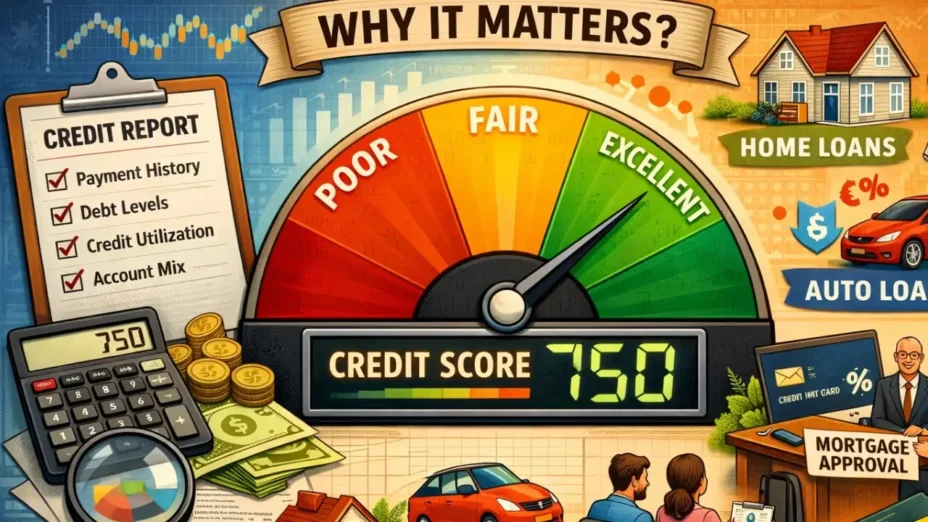
A credit score is more than just a number it’s a snapshot of your financial reliability, a quick way for lenders to decide whether they can trust you with borrowed money. Think of it like a financial reputation score, distilled into three digits that carry surprising weight in your everyday life. Whether you’re applying for a credit card, a car loan, or even renting an apartment, that number often speaks before you do.
At its core, a credit score helps lenders answer a simple question: Will this person pay me back on time? Instead of manually reviewing years of your financial behaviour, lenders rely on scoring models to evaluate your past actions and predict your future ones. This system allows decisions to be made quickly and consistently, but it also means small financial habits can snowball into big consequences over time.
Your credit score is calculated based on information found in your credit report, which includes details like payment history, outstanding debts, and how long you’ve been using credit. It doesn’t consider everything your income, for instance, isn’t directly included but it still paints a surprisingly accurate picture of your financial discipline.
What makes credit scores especially powerful is how widely they’re used. Banks, landlords, insurance companies, and sometimes even employers rely on them. It’s almost like having a financial GPA that follows you into adulthood. Ignore it, and you might pay more for everything from loans to insurance. Understand it, and you can leverage it to unlock better opportunities and lower costs.
Common Credit Score Ranges Explained
Not all credit scores are created equal, but most fall within a similar range typically 300 to 850. Within that spectrum, lenders categorize borrowers into tiers, each representing a different level of risk. Understanding where you stand can give you a clearer sense of what financial doors are open or closed to you.
Here’s a simplified breakdown:
| Score Range | Rating | What It Means |
| 800–850 | Excellent | Lowest risk, best terms |
| 740–799 | Very Good | Strong approval odds |
| 670–739 | Good | Average borrower |
| 580–669 | Fair | Higher interest likely |
| 300–579 | Poor | Limited options |
If your score lands in the “excellent” or “very good” range, lenders see you as a safe bet. You’re likely to qualify for the lowest interest rates and best credit card perks. On the flip side, a “poor” score signals risk, which often leads to higher costs or outright rejections.
But here’s the interesting part: even a small shift in your score can make a big difference. Moving from 660 to 700, for example, might lower your mortgage interest rate enough to save thousands over time. That’s why understanding these ranges isn’t just academic it’s practical.
Another important detail is that you don’t have just one credit score. Depending on the model used and the bureau reporting, your score can vary slightly. It’s like having multiple teachers grading the same paper with slightly different criteria. The differences are usually small, but they can matter in specific lending situations.
The Major Credit Scoring Models
FICO Score vs VantageScore
When people talk about credit scores, they’re usually referring to either FICO Score or VantageScore the two dominant models in the financial world. While they serve the same purpose, they’re built differently, and those differences can sometimes lead to slightly different scores.
The FICO Score, created by the Fair Isaac Corporation, is the most widely used model. In fact, over 90% of top lenders rely on FICO when making credit decisions. It evaluates your credit behaviour using a well-established formula that emphasizes payment history and credit utilization. Because it’s been around longer, it’s often considered the industry standard.
On the other hand, VantageScore was developed by the three major credit bureaus Experian, Equifax, and TransUnion as a competitor to FICO. It uses a similar scoring range (300–850) but differs in how it weighs certain factors. For instance, VantageScore can generate a score with less credit history, making it more accessible for people who are new to credit.
Here’s a quick comparison:
| Feature | FICO Score | VantageScore |
| Created By | Fair Isaac Corp. | Credit Bureaus |
| Usage | Widely used | Growing adoption |
| History Needed | Longer history | Shorter history OK |
While both models aim to predict credit risk, lenders choose which one to use based on their preferences. That’s why your score might look slightly different depending on where you check it.
Why Different Scores Exist
It might seem confusing why not just have one universal credit score? The answer comes down to competition and specialization. Different scoring models exist because lenders have different needs, and financial behaviour isn’t always one-size-fits-all.
Some models are tailored for specific industries. For example, there are auto loan scores and credit card-specific scores that weigh factors differently depending on what’s being evaluated. A person might be considered low-risk for a car loan but slightly riskier for a credit card, depending on their history.
Another reason for multiple scores is innovation. Companies like FICO and VantageScore continuously tweak their formulas to better predict risk. As consumer behaviour changes think online banking, buy-now-pay-later services, or gig economy income scoring models evolve to keep up.
It’s also worth noting that each credit bureau may have slightly different information about you. Maybe one lender reports to Experian but not TransUnion. That means each bureau’s data and therefore your score can vary slightly.
Rather than seeing multiple scores as a problem, it helps to think of them as different perspectives on the same financial story. Like multiple camera angles, they each highlight different aspects, but the overall picture remains consistent.
The Five Key Factors That Determine Your Credit Score
Payment History (35%)
If your credit score were a recipe, payment history would be the main ingredient the one that can make or break the entire dish. Accounting for roughly 35% of your FICO score, this factor carries the most weight, and for good reason. Lenders want reassurance that you’ll pay them back, and the best predictor of future behaviour is past behaviour.
Every time you make a payment on a credit card, loan, or other credit account, that activity gets recorded. Pay on time consistently, and you build a positive track record. Miss payments, even by a few days in some cases, and it can leave a mark. Payments that are 30, 60, or 90 days late are especially damaging, and they can stay on your credit report for up to seven years.
But here’s where it gets interesting: not all late payments hurt equally. A single missed payment might cause a temporary dip, especially if your credit history is otherwise clean. However, repeated delinquencies or defaults like accounts sent to collections can significantly drag your score down.
Think of payment history like trust in a relationship. One mistake might be forgivable, but repeated slip-ups erode confidence quickly. The good news? Positive habits can rebuild that trust over time. Even if your score has taken a hit, consistently paying bills on time can gradually restore your standing.
A practical tip that many people overlook is automation. Setting up auto-pay for at least the minimum amount due ensures you never accidentally miss a payment. It’s a simple safety net that can protect the most important part of your credit score without requiring constant attention.
Credit Utilization (30%)
Right behind payment history is credit utilization, which makes up about 30% of your score. This factor indicates the portion of your available credit that you are currently utilizing. It’s not just about how much you owe it’s about how that amount compares to your credit limits.
For example, if you have a credit card with a $10,000 limit and you’re carrying a $3,000 balance, your utilization rate is 30%. Generally, experts recommend keeping this ratio below 30%, but the sweet spot for excellent credit is often closer to 10% or lower.
Why does this matter so much? High utilization can signal financial stress. If you’re constantly maxing out your cards, lenders may assume you’re relying too heavily on credit, which increases the risk of default. On the flip side, low utilization suggests you’re managing your credit responsibly and not overextending yourself.
Here’s a subtle but powerful insight: utilization is calculated both per account and overall. That means maxing out even one card even if your total utilization is low can still hurt your score.
Timing also plays a role. Credit card companies typically report your balance once a month, often at the end of your billing cycle. So even if you pay your balance in full every month, a high reported balance can temporarily lower your score. One workaround is to pay down your balance before the statement closes, reducing the reported utilization.
In many ways, credit utilization is like your financial breathing room. The more space you have, the more comfortable lenders feel extending you additional credit.
Length of Credit History (15%)
The length of your credit history contributes about 15% to your score, and it’s all about time. Lenders prefer borrowers with a long, stable track record because it gives them more data to evaluate. It’s like comparing a seasoned employee with years of experience to someone just starting out there’s simply more evidence to assess reliability.
This factor considers several elements, including the age of your oldest account, the age of your newest account, and the average age of all your accounts. The longer these timelines, the better it typically is for your score.
One common mistake people make is closing old credit accounts, especially ones they no longer use. While it might seem like a good way to declutter, it can actually shorten your credit history and potentially lower your score. Keeping older accounts open even if you rarely use them can help maintain a longer average age.
There’s also a patience component here. Unlike utilization or payment history, which you can improve relatively quickly, credit history builds slowly over time. It’s not something you can rush, but you can protect it by avoiding unnecessary account closures and maintaining consistent activity.
Think of your credit history as a financial timeline. The longer and more stable it appears, the more confidence lenders have in your ability to manage credit responsibly.
Credit Mix (10%)
Your credit mix makes up about 10% of your score, and it reflects the variety of credit accounts you have. This includes things like credit cards (revolving credit), auto loans, mortgages, and personal loans (installment credit).
Lenders like to see a mix because it demonstrates your ability to handle different types of financial obligations. Managing a credit card requires different behavior than paying off a fixed loan, and successfully juggling both can signal strong financial discipline.
That said, this factor is less critical than payment history or utilization. You don’t need to open new accounts just to diversify your mix that can actually backfire if it leads to hard inquiries or increased debt. Instead, your credit mix should develop naturally over time as your financial needs evolve.
For instance, someone who starts with a credit card, later finances a car, and eventually takes out a mortgage will naturally build a diverse credit profile. Each new account adds another layer to their financial story.
Think of credit mix like a skill set. A well-rounded profile shows versatility, but it’s not necessary to master every category. What matters most is managing the accounts you already have responsibly.
New Credit Inquiries (10%)
The final piece of the puzzle is new credit inquiries, which account for about 10% of your score. Each time you request credit, the lender conducts a hard inquiry on your report. This signals that you’re seeking new credit, and multiple inquiries in a short period can raise red flags.
A single inquiry might lower your score by just a few points, and the impact is usually temporary. However, several inquiries within a short timeframe can suggest financial instability or desperation for credit, which makes lenders cautious.
There’s an important exception when it comes to rate shopping. If you’re applying for a mortgage, auto loan, or student loan, multiple inquiries within a specific window (typically 14–45 days) are often treated as a single inquiry. This allows you to compare offers without severely impacting your score.
Another key distinction is between hard inquiries and soft inquiries. Checking your own credit score, for example, is considered a soft inquiry and does not affect your score at all. Similarly, pre-qualification checks by lenders usually fall into this category.
Managing this factor is mostly about timing and restraint. Avoid applying for multiple credit accounts at once unless it’s necessary, and space out applications when possible. It’s a small part of your score, but like everything else, it contributes to the overall picture lenders see.
How Credit Bureaus Collect Your Data
Role of Experian, Equifax, and TransUnion
Behind every credit score is a network of data collectors quietly tracking your financial behavior. The three major players Experian, Equifax, and TransUnion act as the backbone of the credit reporting system. These companies don’t create your score directly, but they gather the raw data that scoring models use to calculate it.
So how do they get this information? It’s not like they’re spying on your bank account in real time. Instead, lenders voluntarily report your activity to one or more of these bureaus. This includes credit card companies, banks, mortgage lenders, auto financiers, and even some utility or telecom providers. Each time you make a payment, miss a due date, or open a new account, that information may be sent to one or more bureaus.
Here’s where things get a little uneven: not all lenders report to all three bureaus. One credit card company might report to Experian and TransUnion but skip Equifax entirely. That’s why your credit report and therefore your score can vary slightly depending on which bureau is being referenced.
Each bureau compiles this data into a credit report, which includes:
- Personal identifying information
- Credit accounts and balances
- Payment history
- Public records like bankruptcies
- Credit inquiries
This report is then used by scoring models like FICO or VantageScore to generate your credit score.
Accuracy is critical here, but mistakes do happen more often than people realize. According to a Federal Trade Commission (FTC) study, about 1 in 5 consumers has an error on at least one of their credit reports. That’s a surprisingly high number, and it highlights the importance of regularly checking your reports for inaccuracies.
You’re entitled to a free credit report from each bureau once a year through AnnualCreditReport.com. Reviewing these reports is like proofreading your financial résumé catching errors early can prevent unnecessary damage to your score.
Why Credit Scores Matter So Much
Impact on Loan Approvals
Your credit score often acts as the gatekeeper to financial opportunities. When you apply for a loan whether it’s for a house, a car, or even a small personal expense the lender uses your score as a first filter. In many cases, it determines whether your application even gets considered further.
A high credit score signals reliability. It tells lenders you’ve consistently met your financial obligations, making you a lower-risk borrower. As a result, you’re more likely to get approved quickly and with fewer conditions. On the other hand, a low score can lead to rejections or require additional steps, like providing a co-signer or paying a larger deposit.
Imagine two applicants walking into a bank. One has a score of 780, the other 580. Even if their incomes are similar, the lender will likely favor the first applicant because their history suggests a lower chance of missed payments. It’s not always fair, but it’s how risk assessment works in lending.
What’s less obvious is how automated this process has become. Many lenders use algorithms to instantly approve or deny applications based on credit scores and other data. That means your score isn’t just influencing decisions it’s often making them.
For major purchases like a home, the stakes are even higher. Mortgage lenders typically have minimum score requirements, and falling below them can delay your plans significantly. In this sense, your credit score isn’t just a number it’s a key that unlocks (or locks) major life milestones.
Influence on Interest Rates
Even if you’re approved for a loan, your credit score continues to play a crucial role it determines how much that loan will cost you. This is where things get really impactful, because even a small difference in interest rates can translate into thousands of dollars over time.
Lenders use risk-based pricing, which means they charge higher interest rates to borrowers they perceive as riskier. A person with excellent credit might qualify for a mortgage rate of, say, 5.5%, while someone with fair credit might be offered 7% or higher. That difference might not seem huge at first glance, but over a 30-year loan, it can add up to tens of thousands of dollars.
Here’s a simplified example:
| Credit Score | Mortgage Rate | Monthly Payment (Approx.) |
| 760+ | 5.5% | Lower |
| 620–639 | 7.0% | Much Higher |
The same principle applies to credit cards, auto loans, and personal loans. Higher scores unlock lower rates, which means you pay less in interest and can allocate your money elsewhere.
This is why improving your credit score isn’t just about pride it’s about saving money. A 20- or 30-point increase could be the difference between a manageable payment and one that strains your budget.
Effects on Renting and Employment
Credit scores don’t just matter in the world of loans they’ve quietly expanded into other areas of life, sometimes in ways people don’t expect. Landlords, for instance, often check your credit before approving a rental application. They’re not lending you money, but they still want assurance that you’ll pay your rent on time.
A strong credit score can make you stand out in competitive rental markets, while a low score might require a larger security deposit or even lead to rejection. It’s another example of how your financial habits ripple into everyday decisions.
Employers, particularly in finance-related roles, may also review a version of your credit report as part of the hiring process. They’re not looking at your score directly, but they are assessing your financial responsibility. The logic is that someone who manages their finances well might also be more trustworthy in handling sensitive responsibilities.
Insurance companies have joined the mix as well. In many regions, they use credit-based insurance scores to help determine premiums. Studies have shown a correlation between credit behavior and insurance risk, so better credit can sometimes mean lower premiums.
All of this adds up to one clear reality: your credit score is woven into the fabric of modern life. It influences not just what you can borrow, but where you can live, work, and how much you pay for essential services.
Common Myths About Credit Scores
Credit scores are surrounded by myths, half-truths, and outdated advice that can quietly sabotage your financial progress. One of the most persistent misconceptions is that checking your own credit score will hurt it. In reality, this is completely false. When you check your own score, it’s considered a soft inquiry, which has zero impact. Avoiding checking your score is like refusing to look at your bank balance you’re only making things harder for yourself.
Another common myth is that carrying a balance on your credit card helps your score. This one sounds believable, but it’s misleading. You don’t need to carry debt to build credit. In fact, paying your balance in full each month is the best approach. What matters is that you use your credit responsibly, not that you pay interest.
Then there’s the idea that closing old accounts improves your credit. It might feel like a clean-up move, but it can actually backfire. Shutting down an account lowers your accessible credit and may raise your utilization rate. It may also shorten your credit history, both of which can lower your score.
Some people also believe that income directly affects credit scores. Surprisingly, it doesn’t. You could earn a six-figure salary and still have a poor credit score if you mismanage debt. Conversely, someone with a modest income can have excellent credit by consistently paying bills on time and keeping balances low.
Lastly, many assume that all debt is bad for your credit. That’s not entirely true. Responsible use of credit like paying off a car loan or managing a mortgage can actually strengthen your score. The key difference lies in how the debt is handled, not just its existence.
Understanding these myths is like clearing fog from a windshield. Once you see clearly, you can make smarter decisions that actually move your score in the right direction.
How to Improve Your Credit Score Quickly
Improving your credit score doesn’t have to feel like climbing a mountain with no summit in sight. While some changes take time, there are practical steps you can take that deliver noticeable results faster than you might expect.
The first and most impactful move is to pay down your credit card balances, especially if your utilization is above 30%. Since utilization makes up a large chunk of your score, reducing balances can lead to quick improvements—sometimes within a single billing cycle. If possible, aim to get below 10% for optimal results.
Next, make sure you’re paying every bill on time. If you’ve missed payments in the past, getting current and staying consistent is crucial. Over time, recent positive behavior starts to outweigh older mistakes. Setting up automatic payments can act as a safety net, ensuring nothing slips through the cracks.
Another often overlooked strategy is to request a credit limit increase. If approved, this can instantly lower your utilization ratio without requiring you to pay off additional debt. Just be careful not to increase your spending along with the higher limit.
You should also consider disputing errors on your credit report. As mentioned earlier, inaccuracies are more common than many people think. Removing a wrong late payment or incorrect balance can lead to a significant score boost.
For those with limited credit history, becoming an authorized user on someone else’s credit card can help. If the primary user has a strong payment history, that positive activity can reflect on your report as well.
Quick improvements are often about optimizing what’s already there. You’re not reinventing your financial life you’re fine-tuning it for better performance.
Long-Term Strategies for Excellent Credit
While quick fixes can give your score a helpful boost, building excellent credit is more like tending a garden than flipping a switch. It requires consistency, patience, and a bit of strategy over time.
One of the most powerful habits you can develop is long-term consistency in on-time payments. Over the years, this builds a rock-solid payment history that becomes the foundation of a high credit score. Even if you hit occasional bumps, a long track record of reliability carries significant weight.
Another key strategy is to maintain low credit utilization over the long haul. This doesn’t mean avoiding credit altogether it means using it wisely. Think of your credit limit as a resource, not a target. Just because you can spend it doesn’t mean you should.
Diversifying your credit mix gradually is also beneficial. As your financial life evolves whether it’s financing a car, taking out a mortgage, or responsibly using credit cards you naturally build a well-rounded profile. The goal isn’t to chase variety but to manage each account responsibly.
It’s also important to limit unnecessary credit applications. Each hard inquiry has a small impact, but more importantly, frequent applications can signal instability. Spacing them out shows lenders that you’re deliberate and in control.
Finally, make it a habit to monitor your credit regularly. This keeps you informed and allows you to catch potential issues early. Many apps and financial institutions now offer free credit tracking, making it easier than ever to stay on top of your score.
Over time, these habits compound. A strong credit score doesn’t come from one big action it’s the result of hundreds of small, smart decisions made consistently.
Conclusion
Credit scores might seem like a simple three-digit number, but they carry enormous weight in shaping your financial life. From determining whether you qualify for a loan to influencing how much interest you pay, they quietly affect decisions that can cost or save you thousands of dollars over time.
What makes credit scores particularly powerful is how they reflect everyday habits. Paying bills on time, keeping balances low, and managing accounts responsibly might seem routine, but these actions collectively build a financial reputation that lenders trust. On the flip side, small missteps—like missed payments or high utilization can ripple outward and create long-lasting consequences.
The encouraging part is that credit scores aren’t fixed. They evolve based on your behavior, which means you have control over them. Whether you’re starting from scratch or trying to recover from past mistakes, understanding how scores are calculated gives you a roadmap for improvement.
In many ways, your credit score is like a financial passport. It determines where you can go, what opportunities are available, and how smoothly you can navigate major life decisions. Treat it with care, stay informed, and over time, it can open doors that might otherwise remain closed.
FAQs
1. How often do credit scores update?
Credit scores can update as frequently as new information is reported to the credit bureaus, which is typically once a month for most accounts. However, the exact timing depends on when lenders submit updates. That means your score can change multiple times within a month if different accounts report at different times.
2. What is the fastest way to raise my credit score?
The quickest way is usually to reduce your credit utilization by paying down balances. This can have an almost immediate effect once the lower balance is reported. Ensuring all payments are current also helps stabilize and improve your score.
3. How long do negative items stay on a credit report?
Most negative items, such as late payments or collections, remain on your credit report for up to seven years. More severe events like bankruptcies can stay for 7 to 10 years, depending on the type.
4. Can I have a good credit score with no credit cards?
Yes, it’s possible, but it might be more difficult. You can build credit through other accounts like loans or credit-builder programs. However, credit cards are one of the easiest and most effective tools for building and maintaining a strong score.
5. Does paying off a loan early hurt my credit score?
Paying off a loan early doesn’t hurt your score in a major way, but it can cause a temporary dip because it changes your credit mix and account history. In the long run, though, it’s generally a positive move for your financial health.