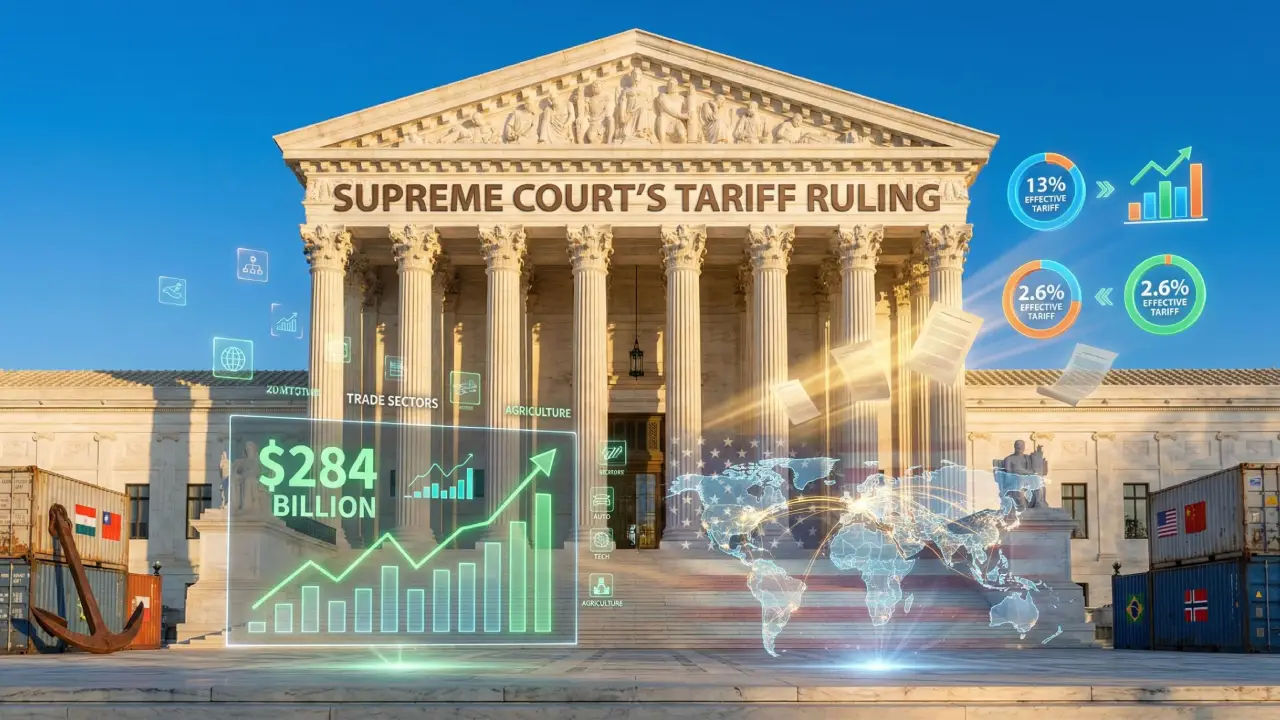
The recent US Supreme Court decision invalidating tariffs imposed under the International Emergency Economic Powers Act has sent ripples across global markets. By striking down former President Donald Trump’s use of IEEPA to justify sweeping trade tariffs, the Court has redrawn the boundaries between executive power and trade authority.
This landmark ruling reshapes global trade flows, recalibrates tariff burdens and creates new diplomatic openings. For countries like India and China, it presents immediate economic advantages. For others such as the United Kingdom, Australia and several European Union members, it introduces fresh cost pressures.
At the same time, the Trump administration’s move to introduce a temporary 15 percent global tariff under Section 122 adds another layer of complexity. The result is a global trade environment defined by opportunity, uncertainty and rapid recalibration.
Why the US Supreme Court Ruling Matters
Executive Power and Trade Authority Redefined
The case centred on whether tariffs imposed under the International Emergency Economic Powers Act were legally justified. The US Supreme Court’s ruling curtails the use of emergency powers to impose broad trade restrictions.
This is significant because trade policy in the United States traditionally falls under congressional authority. By invalidating the IEEPA-based tariffs, the Court reinforced constitutional checks and balances.
For global trading partners, this decision reduces the unpredictability associated with sudden executive trade actions.
Markets React to Policy Stability
Financial markets crave clarity. The ruling has been interpreted as a signal that arbitrary or emergency-driven tariff decisions may face stronger judicial scrutiny in the future.
Exporters and multinational corporations now see a slightly more predictable US trade policy landscape. However, predictability does not mean stability, especially with new tariffs emerging under different legal provisions.
India and China: Clear Short-Term Winners
Reduced Average Tariff Burden
With the IEEPA tariffs invalidated, India and China find themselves in relatively favourable positions compared to certain Western allies.
For India, which has been expanding exports in pharmaceuticals, electronics and textiles, the reduction in tariff exposure enhances competitiveness in the US market.
Lower effective tariff rates translate directly into price advantages.
Strategic Positioning in Supply Chains
India has been positioning itself as an alternative manufacturing hub amid global supply chain diversification.
This ruling may accelerate the shift of production contracts toward Indian exporters, especially in sectors such as electronics assembly and speciality chemicals.
China, despite ongoing geopolitical tensions, also benefits in the short term through reduced tariff constraints. Its manufacturing depth and scale remain unmatched.
In trade, relative advantage matters more than absolute conditions.
The UK, Australia and EU Nations Face Pressure
Higher Average Tariffs Create Cost Concerns
While India and China gain relative advantage, countries like the United Kingdom and Australia, along with some European Union nations, may face comparatively higher average tariffs under the evolving framework.
This creates uneven competitive conditions in sectors such as automotive components, machinery and processed foods.
Exporters in these regions must now factor in increased cost pressures and potential erosion of market share.
Diplomatic Trade Negotiations Intensify
Trade is rarely just economic. It is diplomatic.
The tariff realignment may prompt faster trade negotiations between affected countries and the United States. The goal will be to secure exemptions, preferential quotas or sector-specific adjustments.
For European exporters, the challenge lies in balancing transatlantic relations while safeguarding domestic industries.
Section 122: Temporary Relief or New Uncertainty?
Understanding the 15 Percent Global Tariff
Following the Court’s ruling, the Trump administration introduced a 15 percent global tariff under Section 122 of the Trade Act.
Unlike IEEPA-based tariffs, Section 122 allows temporary measures to address balance-of-payments concerns.
This move provides short-term continuity in tariff revenue and political signalling.
However, it also introduces fresh uncertainty.
Temporary Measures, Long-Term Implications
Section 122 tariffs are time-bound. Their temporary nature means businesses cannot rely on long-term stability.
Exporters must now navigate a scenario where tariff frameworks may shift again depending on political developments and economic indicators.
Investors dislike policy fluidity.
The global trade system now sits at the intersection of law, politics and market expectations.
Impact on Exporters and Investors
Shipment Timing and Contract Adjustments
Exporters are closely monitoring shipment schedules.
If tariffs are temporary or subject to renegotiation, companies may accelerate shipments to exploit favourable windows or delay them to await clarity.
For Indian exporters, especially in sectors like engineering goods and pharmaceuticals, timing could influence profit margins significantly.
Sector-Specific Tariffs Under Review
The broader tariff debate also intersects with sector-specific policies.
Steel, aluminium, semiconductors and electric vehicle components remain sensitive sectors in US trade strategy.
Even if broad-based tariffs shift, targeted sectoral duties could persist.
Investors are therefore examining industry-level exposure rather than just country-level data.
India’s Strategic Opportunity
Strengthening Bilateral Trade Talks
India can leverage this moment to deepen trade discussions with the United States.
With relative tariff advantage in place, New Delhi has room to negotiate improved market access in IT services, pharmaceuticals and agricultural exports.
The ruling indirectly enhances India’s bargaining position.
Boosting Domestic Manufacturing
Lower tariff barriers align with India’s “Make in India” and production-linked incentive schemes.
If Indian goods gain better price competitiveness in the US, domestic manufacturing output could expand.
This would support employment generation and foreign exchange earnings.
Policy shifts abroad often create strategic openings at home.
China’s Complex Advantage
Economic Gain Amid Political Friction
China’s export engine benefits from any reduction in US tariff pressure.
However, geopolitical tensions between Washington and Beijing continue to influence technology and defence-related trade.
The Court ruling may ease certain cost burdens but does not eliminate broader strategic rivalry.
China’s advantage, therefore, is economic but conditional.
The Bigger Picture: Policy, Diplomacy and Markets
Legal Precedent Shapes Trade Diplomacy
The US Supreme Court decision sets a precedent.
Future administrations may exercise greater caution before invoking emergency economic powers for trade actions.
This recalibration strengthens the role of legislative oversight.
For global partners, this enhances confidence in institutional processes.
Markets Adjust to Hybrid Trade Models
The emerging scenario combines judicial constraints, executive action under alternate laws and ongoing diplomatic negotiation.
It is neither pure free trade nor aggressive protectionism.
Instead, it reflects a hybrid model shaped by domestic politics and global competition.
What Lies Ahead for Global Trade
Short-Term Volatility
Expect continued volatility in currency markets, shipping contracts and commodity pricing.
Investors will respond quickly to any new policy announcements.
Trade-sensitive sectors such as electronics, auto parts and energy equipment may see price adjustments.
Long-Term Structural Shifts
In the longer term, this episode reinforces the importance of diversified supply chains.
Countries that maintain competitive production costs and stable trade relationships will benefit most.
For India, consistency in export policy, infrastructure improvements and regulatory clarity will be key.
Conclusion
The US Supreme Court’s ruling on IEEPA tariffs is more than a legal decision. It is a recalibration of global trade dynamics.
India and China emerge as short-term winners due to relative tariff advantages. Meanwhile, the UK, Australia and parts of the EU face new cost challenges.
The introduction of a 15 percent global tariff under Section 122 offers temporary relief but deepens uncertainty.
Global trade now operates in a space where law, diplomacy and economics constantly interact.
For India, this is a moment of strategic possibility. By strengthening manufacturing competitiveness and diplomatic engagement, it can convert policy shifts abroad into growth opportunities at home.
The coming months will determine whether this ruling becomes a stabilising force or merely another chapter in an evolving trade contest.
Related posts:
 SEBI Cautions Investors: Digital Gold Products Are Not Regulated Gold
 US Tech Giants Oppose India’s 6 GHz Spectrum for Mobile Use
 A320 Aircraft Issue Disrupts IndiGo and Air India Flight Operations
 Vi ₹1 Recharge Pack: Cheap SIM Activation for Light Users
 SEBI bans Avadhut Sathe’s academy, impounds Rs 546 cr for unregistered advisory — major blow to finfluencers
 Ultimate Guide to Jio ₹3333 Annual Plan and ₹369 Recharge
 Andhra Pradesh Hosts World’s Largest Green Ammonia Project Kakinada
 India EU Trade Deal May Boost Smartphone Exports Significantly
 India-US Trade Deal Textile Benefits and Zero Tariff Access
 Great Nicobar Mega Project Cleared A Turning Point