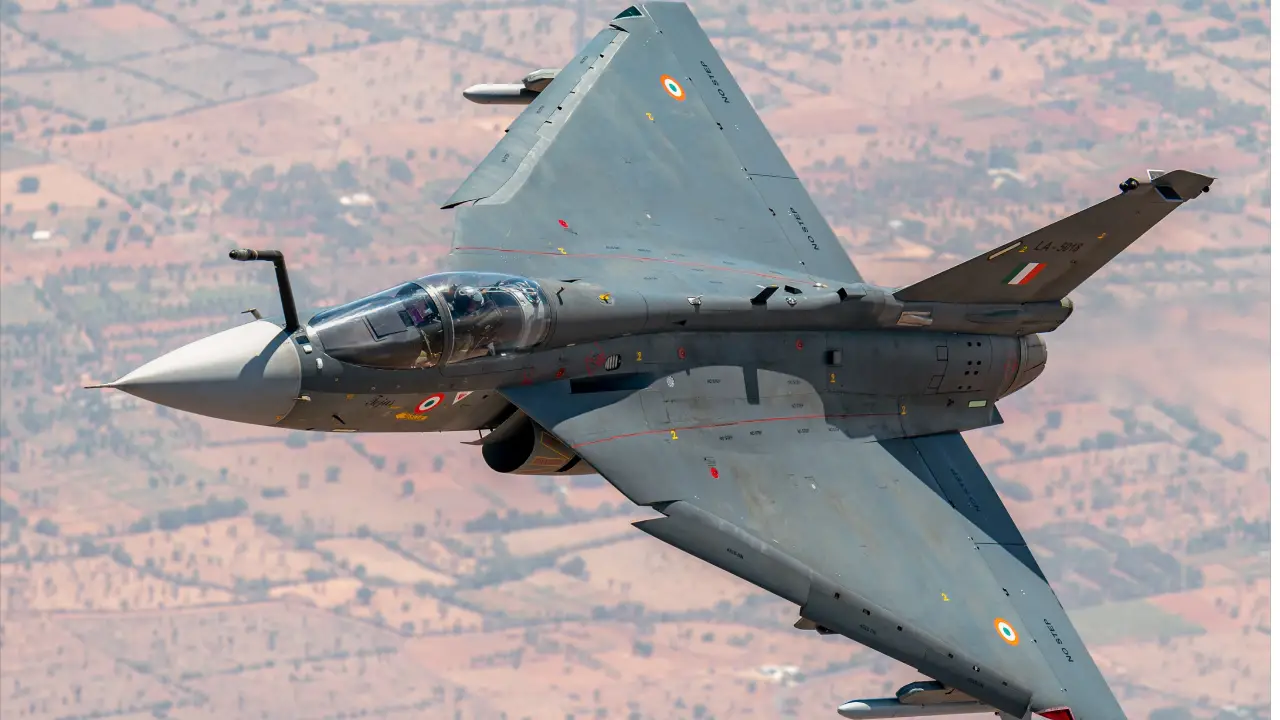
India’s ambitious indigenous fighter programme has hit turbulence. The Indian Air Force (IAF) has grounded its entire fleet of Tejas light combat aircraft after one jet sustained major airframe damage while overshooting the runway at a frontline airbase. The incident, reportedly triggered by a suspected brake failure during landing, has prompted a comprehensive technical review of nearly 30 single-seat Tejas fighters currently in service.
The pilot ejected safely after the aircraft failed to stop on time following a routine training sortie. While there has been no official public statement from the IAF regarding the February 7 accident, the move to ground the fleet reflects caution and seriousness.
This is not merely an aviation incident it is a moment of strategic introspection for India’s indigenous defence ecosystem.
Why the Tejas Grounding Matters
A Safety-First Signal from the IAF
Grounding an entire fleet is never a trivial decision. It disrupts operational schedules, training cycles and combat readiness. However, it also signals institutional maturity.
By halting flights across the Tejas fleet, the IAF has demonstrated that flight safety overrides operational urgency. In modern air forces worldwide, temporary grounding after technical anomalies is standard protocol.
Such decisions prevent systemic risks and ensure that any mechanical or design flaw is thoroughly examined before aircraft return to service.
Third Accident Raises Critical Questions
This incident marks the third accident involving the Tejas programme.
In March 2024, a Tejas jet crashed near Jaisalmer. In November 2025, another aircraft crashed during an aerial display at the Dubai Airshow. Though each case had different circumstances, repeated accidents inevitably raise concerns about reliability and quality assurance.
However, it is important to understand context. New fighter aircraft programmes often experience developmental and operational setbacks before stabilising. The key question is whether lessons are being absorbed and corrective mechanisms are robust.
Understanding the Tejas Programme
India’s Indigenous Fighter Dream
The Tejas light combat aircraft is manufactured by Hindustan Aeronautics Limited (HAL). It represents India’s long-standing ambition to reduce dependence on foreign military hardware.
Tejas is a single-engine, multi-role fighter designed for high-threat environments. It is capable of air-to-air combat, ground attack and reconnaissance missions.
For India, Tejas is more than a jet. It is a symbol of self-reliance under the “Atmanirbhar Bharat” vision.
The Mk-1A Variant and Delivery Delays
The current focus is on the Tejas Mk-1A variant, an upgraded version featuring improved avionics, radar and electronic warfare capabilities.
In February 2021, the defence ministry signed a Rs 48,000 crore contract with HAL for 83 Tejas Mk-1A jets. In September last year, another Rs 62,370 crore deal was signed for 97 additional Mk-1A aircraft.
These orders underscore the IAF’s long-term commitment to the platform.
However, deliveries have been delayed. A major reason cited is missed deadlines by GE Aerospace in supplying F404 aero engines required to power the jets.
Engine supply bottlenecks have slowed production timelines, affecting squadron planning.
The February Runway Overshoot Explained
Suspected Brake Failure and Airframe Damage
The recent incident involved a suspected brake malfunction during landing. Aircraft landing phases are among the most sensitive parts of flight operations.
If braking systems fail or underperform, runway overruns can occur. In this case, the aircraft reportedly overshot the runway, causing significant structural damage to the airframe.
The pilot ejected safely, which highlights the effectiveness of the aircraft’s safety systems and pilot training protocols.
Why Grounding Is a Standard Procedure
When an aircraft type faces a serious incident involving a critical subsystem, regulators and operators typically ground the fleet pending inspection.
This allows engineers to check for common mechanical vulnerabilities, software glitches or maintenance oversights.
The grounding does not automatically imply a design flaw. It is part of aviation’s preventive culture.
Safety culture, not panic, drives such decisions.
Operational and Strategic Implications
Temporary Impact on Squadron Strength
The IAF already operates with fewer fighter squadrons than its sanctioned strength.
Grounding the Tejas fleet, even temporarily, puts pressure on other aircraft types to fill training and operational roles.
However, the IAF still maintains a diverse fleet including Sukhoi-30 MKIs, Rafale fighters and Mirage 2000 jets.
The disruption is real but manageable in the short term.
Market Reaction and HAL’s Credibility
Shares of Hindustan Aeronautics Limited reportedly fell over 3 percent following news of the grounding.
Financial markets react quickly to uncertainty. Investors worry about production delays, cost overruns and reputational damage.
Yet long-term confidence in HAL depends not on avoiding setbacks, but on resolving them transparently and efficiently.
If investigations lead to improvements and strengthened quality control, investor trust can stabilise.
Broader Challenges in Indigenous Defence Manufacturing
Technology Dependence Still Persists
While Tejas is indigenous, critical components like engines are imported.
This exposes the programme to global supply chain vulnerabilities.
The reliance on foreign engines highlights a gap in India’s defence manufacturing ecosystem.
Engine technology remains one of the most complex areas in aerospace engineering.
Balancing Speed with Safety
India’s push for rapid indigenisation must align with rigorous testing standards.
Delivering aircraft on schedule is important, but ensuring reliability is critical.
Any perception of compromised safety could undermine the credibility of the entire programme.
Therefore, grounding the fleet reflects a commitment to long-term trust rather than short-term optics.
The Road to Recovery
Technical Scrutiny and Fleet Return
The current technical scrutiny will likely involve detailed examination of braking systems, hydraulic lines, software diagnostics and maintenance logs.
If the issue is isolated, the fleet could return to service quickly after necessary corrections.
If systemic concerns are identified, upgrades may be implemented across all aircraft.
Such corrective cycles are common in aviation development phases.
Strengthening the Ecosystem
This episode also presents an opportunity.
India can use the incident to reinforce quality audits, improve component testing and accelerate indigenous engine development initiatives.
Greater collaboration between the IAF, HAL and private suppliers can create a more resilient defence ecosystem.
Is This a Crisis or a Course Correction?
Public perception often magnifies defence setbacks.
However, military aviation history shows that even advanced nations have faced early accidents in new aircraft programmes.
The United States, Europe and Russia have all experienced grounding phases during aircraft induction cycles.
The real test lies in response quality.
If investigations are transparent, lessons are implemented and timelines recalibrated realistically, Tejas can emerge stronger.
Strategic resilience is built not by avoiding setbacks, but by overcoming them.
Conclusion
The grounding of the Tejas fleet is a serious development, but it is not a collapse of India’s indigenous fighter dream.
It reflects caution, responsibility and the aviation principle that safety comes first.
For India, Tejas represents technological ambition, industrial growth and defence sovereignty.
Short-term turbulence does not erase long-term vision.
If handled with technical rigour and institutional transparency, this episode may ultimately strengthen both the aircraft and the ecosystem that supports it.
The coming weeks will reveal whether this moment becomes a setback or a strategic reset for India’s defence aviation future.
Related posts:
 Trump Warns NATO Exit Over Greenland Deal and Security Concerns
 PM Modi Launches Kaziranga Corridor, Amrit Bharat Trains in Assam
 United States Completes Historic Withdrawal From World Health Organization WHO
 Diplomatic Tensions Rise After Sheikh Hasina’s Recorded Delhi Message
 Save Manipur Rally Shows Unity Against Division, Demands Peace, Resettlement
 Myanmar Earthquake Shakes Kolkata, Tremors Felt Across Eastern India
 SSB Clears No Man’s Land Encroachment Along India Nepal Border
 Tragic Noida and Delhi Pit Accidents Safety Negligence Claims Lives
 Bangladesh Rushes Secret US Trade Deal Ahead of Crucial Elections
 European Legal Gateway Office Opens New Doors