
OpenAI Steps Into Hardware: What Is Happening
OpenAI, the company best known for ChatGPT and advanced AI models, is now preparing to enter the hardware space. The San Francisco-based AI giant has officially confirmed that it plans to introduce its first AI-enabled hardware product later this year. While the company has remained tight-lipped about exact details, recent leaks and patent filings are offering early clues about what OpenAI’s first device might look like and how it could change the way users interact with artificial intelligence.
Industry watchers believe this move is part of OpenAI’s long-term strategy to bring AI closer to everyday life, beyond apps and screens, and into wearable technology.
OpenAI’s First Hardware Could Be AI-Powered Earbuds
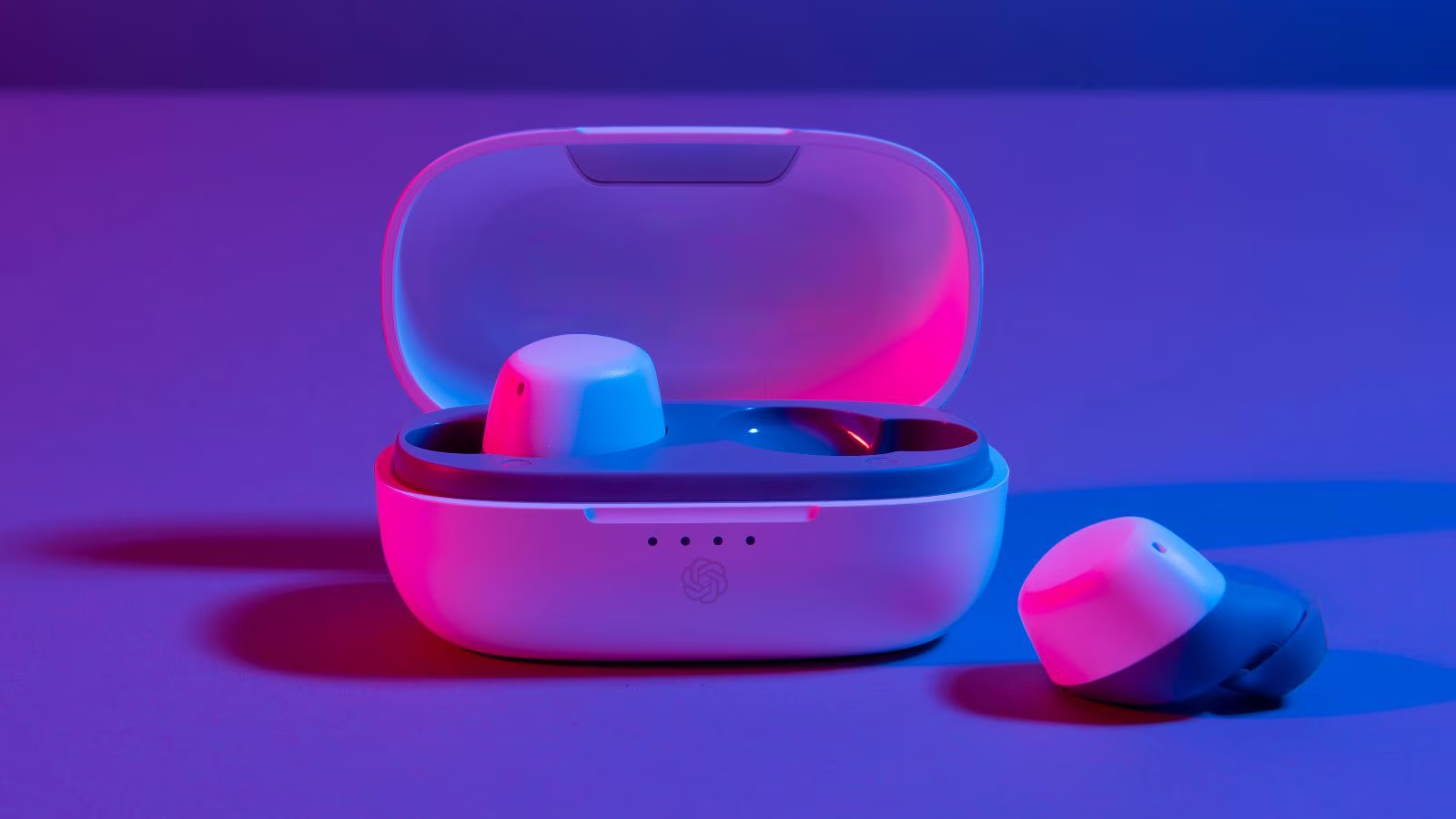
According to a new leak shared by tipster Smart Pikachu, OpenAI’s first hardware product may take the form of AI-enabled earbuds. The leaked information suggests that the earbuds could be named “Dime,” a compact and audio-focused wearable designed to offer seamless AI interaction through voice.
A recently surfaced patent filing linked to OpenAI in China reportedly mentions the name Dime, strengthening speculation that earbuds are indeed the company’s first step into consumer hardware. These earbuds are expected to focus on voice-based AI features, allowing users to interact with OpenAI’s models hands-free, without relying on a phone screen.
Why OpenAI May Start With a Simpler Device
The leak also claims that OpenAI plans to launch a more basic version of its AI hardware before introducing a more advanced and ambitious product. The reason behind this cautious approach appears to be supply chain challenges, particularly the global shortage of High Bandwidth Memory, also known as HBM.
HBM is a critical component for AI computing, and its limited availability has reportedly pushed up the bill of materials for more powerful AI devices. Because of this, OpenAI may delay a “phone-like” AI device with heavy computing capabilities and instead release simpler AI earbuds first. The basic version is expected to arrive in 2026, while a more advanced hardware model could follow once component prices stabilise.
Timeline: When Could OpenAI Hardware Launch
While OpenAI has not officially announced a launch date, previous statements from company executives provide some direction. Chris Lehane, OpenAI’s Chief Global Affairs Officer, has already confirmed that OpenAI plans to build its first AI device this year. However, he stopped short of revealing when consumers might actually be able to buy it.
Based on current leaks and supply chain realities, analysts expect the first OpenAI hardware announcement to happen later this year, with shipments possibly starting in early 2027. The simpler earbuds version may appear sooner, potentially in 2026, as OpenAI tests the market and gathers user feedback.
How This Fits Into OpenAI’s Bigger AI Vision
OpenAI’s move into hardware is not happening in isolation. The company continues to push the boundaries of artificial intelligence on the software side as well. Recently, OpenAI introduced GPT-5.3-Codex, a new AI model designed specifically for agentic coding and advanced software development tasks.
The company claims that GPT-5.3-Codex is around 25 percent faster than its previous version and can autonomously handle complex projects over millions of tokens. This includes building web games from vague prompts, managing full software lifecycles, writing product requirement documents, analysing spreadsheets, editing copy, and even monitoring systems.
By pairing such powerful AI models with dedicated hardware like earbuds, OpenAI could offer a more natural and always-available AI assistant experience.
What AI Earbuds Could Mean for Users
If the leaks turn out to be accurate, OpenAI earbuds could mark a major shift in how people interact with AI. Instead of typing prompts, users could speak naturally and receive real-time responses through audio. This could be especially useful for tasks like quick research, reminders, navigation help, coding ideas, or creative brainstorming while on the move.
Unlike traditional smart earbuds, OpenAI’s AI hardware is expected to prioritise intelligence and context awareness rather than just music and calls. This would place it in direct competition with future AI wearables from big tech companies.
Final Thoughts on OpenAI’s Hardware Ambitions
OpenAI entering the hardware market is a clear sign that AI is moving beyond screens and into everyday physical devices. While details about the Dime earbuds and other AI hardware remain unofficial, the leaks paint a picture of a cautious but strategic rollout. By starting with a simpler wearable and gradually scaling up, OpenAI appears to be laying the groundwork for a new generation of AI-powered consumer products.
As more official information emerges in the coming months, OpenAI’s first hardware launch could become one of the most closely watched tech events in recent years.
Related posts:
 What Happens to Your Brain When Smartwatch AI Lives on Your Wrist
 Perplexity Strengthens Comet Assistant with Smarter Safeguards and Control
 CERT-In Urges Apple Users to Update Devices to Prevent Hacks
 Apple iOS 26.2 Update Brings Alarms, Lock Screen Changes
 Google Dark Web Report Shutdown 2026: What Users Need Know
 China’s Superconducting Maglev Train Smashes Speed Record At 700 Kmph
 China Proposes AI Safety Rules for Human-Like Interaction and Ethics
 iQOO 15 Ultra Leaks 2026: Gaming Flagship With Elite Performance
 Android 17 New Design Leaks Reveal Blur Effects, Features
 Nothing Phone 4a Pro Launch, Specs, Battery, Price Expectations 2026