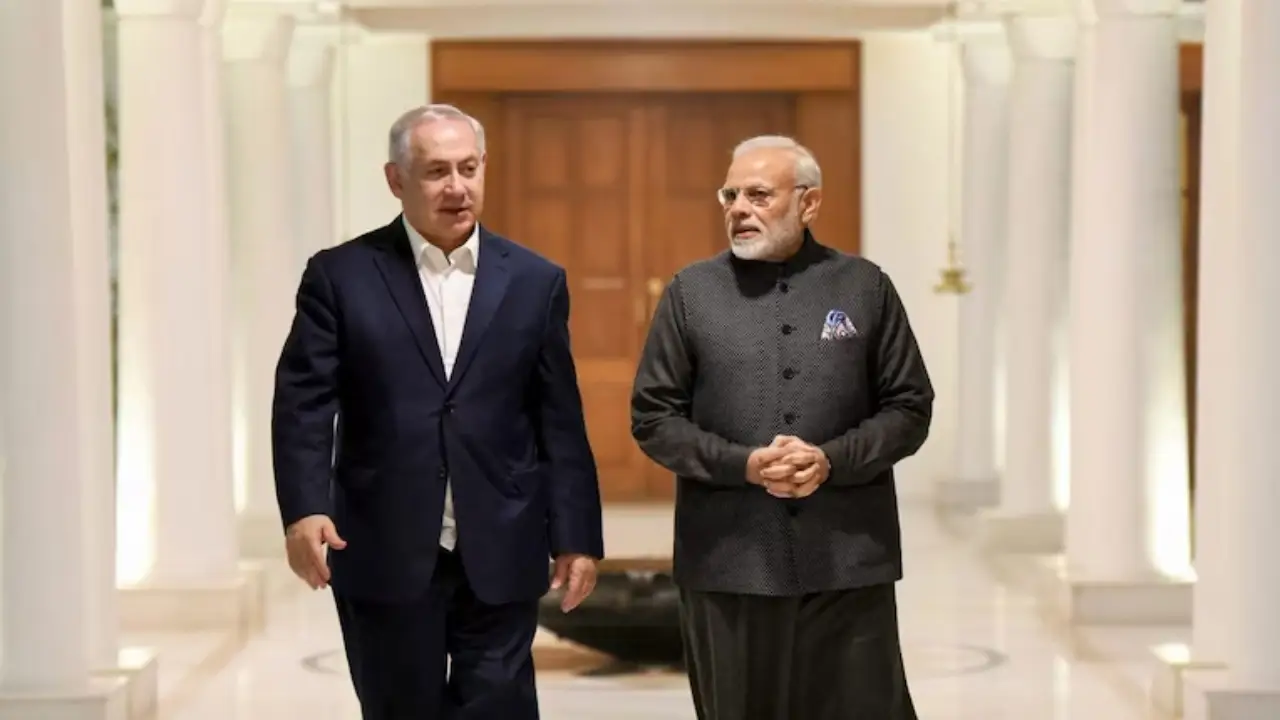
When Benjamin Netanyahu speaks about building a new alliance framework in the Middle East, and names Narendra Modi as a central partner, it signals more than a routine diplomatic exchange. Modi’s upcoming two-day visit to Israel from February 25 is being framed as a strategic milestone one that could reshape defence cooperation, economic ties, and regional diplomacy.
For India, this visit represents continuity and expansion of a relationship that has grown steadily over the past decade. For Israel, India stands out as a trusted defence partner and a rising global power whose alignment carries geopolitical weight.
The visit is not just symbolic. It is strategic, economic, and security-driven.
Why Netanyahu Sees Modi’s Visit as Strategic
At the opening of a government meeting, Netanyahu described the visit as part of a broader strategic vision. He spoke of creating “a complete system of alliances” around or within the Middle East.
The Vision of a “Hexagon of Alliances”
Netanyahu referred to India, Greece, and Cyprus as part of what he termed a “hexagon of alliances,” alongside unnamed Arab, African, and Asian partners.
The message was clear. Israel is looking to build partnerships with countries that share similar security concerns and geopolitical outlooks.
By including India in this framework, Israel is acknowledging New Delhi’s growing global influence.
Countering Regional Radical Axes
Netanyahu framed this alliance-building effort as a response to what he called both a “radical Shiite axis” and an “emerging radical Sunni axis.”
While such terminology reflects Israel’s regional security calculations, India’s position is more nuanced. New Delhi traditionally maintains balanced ties across West Asia, including with Gulf nations and Iran.
For India, the visit is about strengthening bilateral cooperation without getting drawn into rigid blocs.
Defence Cooperation: The Core of the Visit
Defence ties remain the strongest pillar of India–Israel relations.
Missile Defence and Mission Sudershan
India is keen to jointly develop advanced anti-ballistic missile systems under Mission Sudershan. Israel’s layered missile defence architecture makes it a natural partner.
Israel’s experience in developing multi-tiered systems capable of intercepting short- and long-range threats positions it as a critical collaborator for India’s long-term security goals.
In an era of evolving missile technologies, missile defence cooperation is not optional — it is essential.
Advanced Laser and Precision Weapon Systems
Reports suggest Israel may provide advanced technologies, including laser-based defence systems and high-precision stand-off weapons.
Laser-based interception systems represent the future of cost-effective air defence. If collaboration advances in this field, it could significantly strengthen India’s indigenous defence capabilities.
An MoU on security cooperation is also expected to be signed, institutionalizing deeper military coordination.
High-Tech Collaboration Beyond Defence
While defence dominates headlines, high-technology cooperation is equally significant.
Artificial Intelligence and Quantum Technologies
Netanyahu highlighted artificial intelligence and quantum technologies as priority areas for expansion.
India’s strong IT ecosystem combined with Israel’s innovation-driven startup culture creates natural synergy.
Joint research initiatives, startup exchanges, and academic partnerships in AI and quantum computing could benefit both economies.
This collaboration moves the partnership from buyer-seller defence ties to knowledge-driven innovation.
Cybersecurity and Emerging Technologies
With cyber threats rising globally, India and Israel share a common interest in strengthening digital security.
Israel is widely recognized for its cybersecurity expertise, and India’s digital transformation makes such cooperation timely and relevant.
Expanding Cooperation in Agriculture and Water
The India–Israel relationship is not limited to defence and technology.
Agricultural Innovation for Indian Farmers
Israel’s drip irrigation and precision agriculture techniques have already been introduced in several Indian states through Centres of Excellence.
Expanding cooperation could help Indian farmers increase productivity while conserving water.
For a country where agriculture supports millions, such partnerships carry long-term impact.
Water Management and Sustainability
Water scarcity is a serious challenge in many Indian regions.
Israel’s advanced desalination and water recycling technologies offer practical solutions.
Greater collaboration in water management aligns with India’s sustainable development goals.
Diplomatic Implications: Balancing West Asia
India has historically maintained balanced relations across West Asia.
New Delhi engages with Israel, Gulf countries, and Iran, while also maintaining energy partnerships and diaspora connections.
Strategic Autonomy Remains Central
Even as India deepens defence ties with Israel, it is unlikely to abandon its strategic autonomy.
India’s foreign policy traditionally avoids being drawn into rigid alliance systems.
The emphasis will likely remain on issue-based cooperation rather than bloc politics.
Israel’s Perspective: India as a Key Global Partner
For Israel, India represents both a major defence market and a strategic diplomatic partner.
India’s growing global role in multilateral forums enhances its importance in Israel’s broader alliance calculations.
Personal Diplomacy and Symbolism
Netanyahu referred to his “special relationship” with Modi, recalling past visits and describing him as a personal friend.
He remarked that they had “swum in the Mediterranean” and that much water had flowed since then “in the Mediterranean, in the Ganges, and in the Jordan.”
Such symbolic language highlights the personal rapport that has developed between the two leaders.
Personal diplomacy often strengthens institutional cooperation.
Economic Opportunities from the Visit
Beyond defence and diplomacy, economic cooperation is expected to gain momentum.
Trade and Investment Expansion
Bilateral trade between India and Israel has grown steadily, particularly in diamonds, technology, and defence.
New agreements could expand collaboration into renewable energy, fintech, and biotechnology.
Startup and Innovation Bridges
India’s startup ecosystem, one of the largest in the world, can benefit from closer ties with Israel’s innovation-driven economy.
Joint innovation funds and venture collaborations may emerge as outcomes of deeper engagement.
Regional Context: Heightened Flux
The visit comes at a time of heightened regional uncertainty.
Geopolitical tensions, shifting alliances, and emerging security threats define the current Middle Eastern landscape.
In such an environment, Israel seeks reliable partners.
India, with its stable democratic framework and expanding global presence, fits that description.
However, India will likely approach any alliance narrative with measured pragmatism.
What This Means for India
For India, the visit signals continuity in strengthening ties with Israel.
It underscores India’s commitment to modernizing its defence systems and expanding technological capabilities.
At the same time, India will continue balancing its broader West Asian relationships.
The key takeaway is strategic diversification, not alignment rigidity.
Conclusion: A Partnership Entering a New Phase
Netanyahu’s remarks about creating a new alliance framework underscore Israel’s strategic vision.
Modi’s visit to Israel could mark another milestone in a relationship that has matured significantly over the years.
Defence collaboration, high-technology partnerships, agricultural innovation, and diplomatic coordination are all likely to deepen.
For India, the visit reflects confidence, pragmatism, and strategic ambition.
For Israel, it signals trust in India as a long-term partner in a complex region.
As much water has flowed in the Mediterranean, the Ganges, and the Jordan, so too has the India–Israel partnership evolved from cautious engagement to strategic cooperation.
The upcoming visit may well define its next chapter.
Related posts:
 Trump Announces Permanent Pause on Migration from Third World Countries
 Major Anti-Drug Operation: Telangana and Delhi Police Bust Big Network
 Assam GoM Recommends ST Status for Six Communities in Report
 Fresh FIR Against Gandhis Sparks Congress Allegations of Vendetta Politics
 Five Indians Kidnapped in Mali Amid Rising Extremist Violence Crisis
 KK Muhammed Urges Restraint in Mandir-Masjid Disputes Across India
 Latest Update on 8th Pay Commission Notification and Key Issues
 Chilling Public Execution in Khost by the Taliban Sparks Global Outrage
 Putin praises Modi: India-Russia ties deepen through trust and friendship
 Airlines in Turmoil-DGCA and MoCA Swing Into Action to Stabilize the Situation