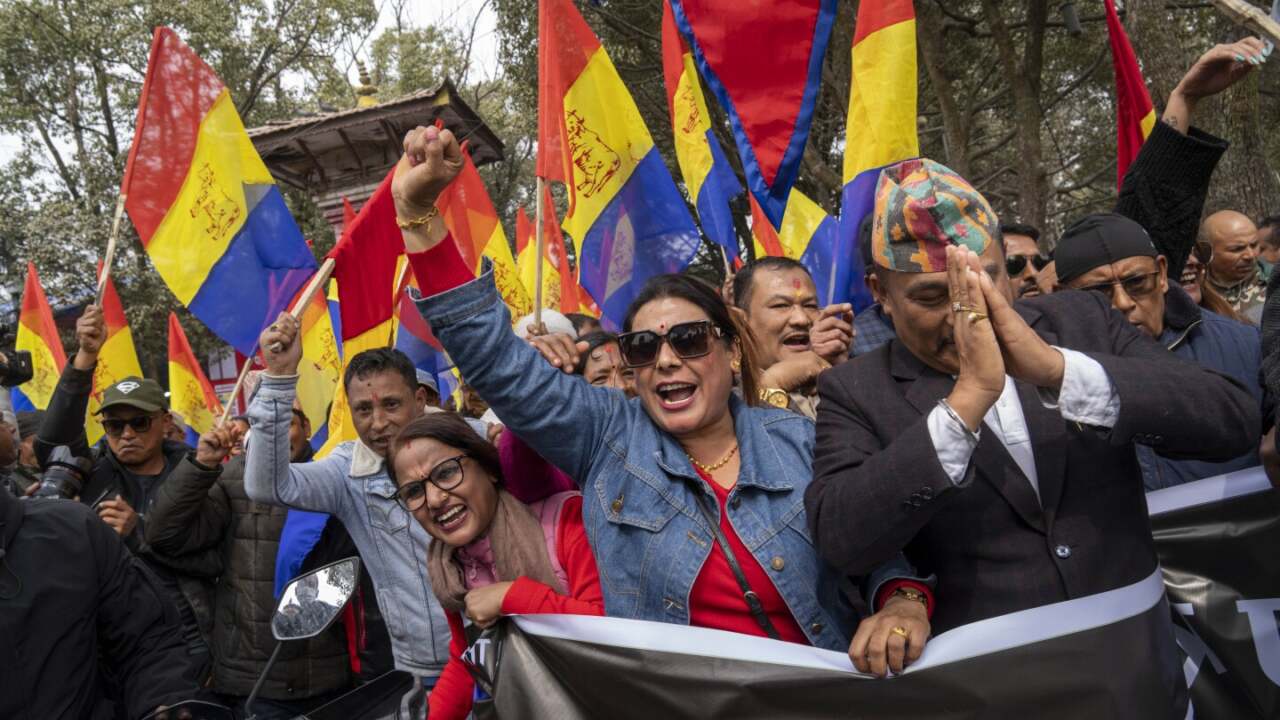
Thousands of supporters of former king Gyanendra Shah gathered outside Tribhuvan International Airport on Friday, demanding the restoration of the monarchy as he arrived in the capital amid heavy security.
The dramatic scenes unfolded despite prohibitory orders issued by the Kathmandu District Administration Office, which had banned gatherings of more than five people around the airport premises.
The rally signaled a renewed and visible push to restore Nepal’s monarchy at a politically sensitive moment.
Why the Nepal Monarchy Debate Is Back in Focus
Nepal formally abolished its 240-year-old monarchy in 2008, becoming a federal democratic republic. The decision followed years of political turmoil and a mass uprising that forced Gyanendra Shah to relinquish his direct rule in 2006.
Yet, the call for monarchy restoration has resurfaced.
Public Discontent and Political Instability
Over the past few years, Nepal has faced economic stress, governance challenges and frequent changes in coalition governments.
Political instability has eroded public trust in mainstream parties.
For some citizens, the monarchy represents stability, national unity and cultural identity.
Supporters argue that a constitutional monarch could act as a unifying figure above party politics.
The 2006 Uprising and Abolition of Monarchy
In 2006, massive street protests known as the People’s Movement compelled King Gyanendra to step down from absolute rule.
Two years later, Nepal’s parliament formally abolished the monarchy, ending centuries of royal governance.
Gyanendra vacated the Royal Palace and began living as a private citizen.
The transition was hailed as a major democratic milestone in South Asia.
However, the re-emergence of pro-monarchy rallies suggests unresolved debates about governance and national direction.
Inside the Airport Demonstration in Kathmandu
The recent protest near Tribhuvan International Airport drew cadres from the Rastriya Prajatantra Party and other monarchist groups.
Senior leader Kamal Thapa was among prominent political figures linked to the mobilization.
Supporters chanted slogans demanding the return of the king as Gyanendra waved from the sunroof of his car.
Defying Prohibitory Orders
Authorities had imposed restrictions on large gatherings around the airport area.
Hundreds of police officers in riot gear attempted to manage the swelling crowd.
Despite restrictions, demonstrators gathered from early morning, highlighting the intensity of mobilization.
The scale of turnout demonstrated that pro-monarchy sentiment retains organized political backing.
The Role of Activist Leaders
Figures such as Navaraj Subedi and medical professional Durga Prasai have played active roles in mobilizing supporters.
During a press interaction in Kathmandu, Prasai stated that the monarchy must be restored before the upcoming general election.
He argued that holding elections without addressing the monarchy agenda would undermine national interests.
Such statements add pressure to an already polarized political climate.
Nepal General Elections 2026: A Critical Turning Point
Nepal is preparing for early general elections scheduled for March 5, 2026.
The polls are being framed as pivotal for the country’s democratic consolidation.
Prime Minister Calls for Peaceful Participation
Sushila Karki urged citizens to participate actively in the elections to ensure national progress.
Speaking ahead of the polls, she emphasized the importance of conducting the vote peacefully.
She described the election as a milestone in Nepal’s transition to a new political phase.
The government views democratic participation as the solution to the current political impasse.
Elections Amid Constitutional Debate
The renewed monarchy demand complicates the electoral environment.
Nepal’s current constitution defines the country as a secular federal democratic republic.
Pro-monarchists seek not only the restoration of the monarchy but also the reinstatement of Nepal as a Hindu state.
This demand touches deeply sensitive constitutional and identity issues.
Understanding the Appeal of a Hindu Monarch
Nepal was officially a Hindu kingdom until 2008.
For many traditionalists, the monarchy symbolized both religious and national continuity.
Cultural and Religious Identity
Supporters argue that reinstating a Hindu monarch would protect cultural heritage and religious traditions.
They claim the secular republican framework has diluted Nepal’s historic identity.
However, critics warn that such a shift could marginalize minority communities and reverse secular gains.
Governance Versus Symbolism
Political analysts suggest that nostalgia for monarchy often reflects dissatisfaction with governance rather than a concrete institutional blueprint.
Nepal’s democratic experiment has faced coalition instability and policy gridlock.
The monarchy debate may be less about royal power and more about public frustration.
Whether reinstating a monarch would resolve structural governance challenges remains widely debated.
Security, Stability and Democratic Values
The airport rally underscores the delicate balance Nepal must maintain.
Managing Protest and Public Order
Security forces were deployed in significant numbers to prevent escalation.
While protests remained largely symbolic, authorities are wary of unrest during the election period.
Ensuring peaceful political expression without destabilization is a core challenge.
Protecting Democratic Institutions
Nepal’s republican framework was built after years of conflict and negotiation.
Reopening the monarchy question could reshape the political landscape.
The coming months will test Nepal’s democratic resilience and institutional maturity.
Much will depend on how political leaders respond to public sentiment without undermining constitutional processes.
The Broader Political Context in South Asia
Nepal’s monarchy debate resonates beyond its borders.
South Asia has witnessed varied political systems, from constitutional monarchies to republics.
Nepal’s transition to a republic was seen as a significant democratic shift in the region.
A reversal would carry symbolic weight.
International observers are likely to monitor developments closely, particularly regarding election transparency and stability.
Conclusion: A Nation at a Crossroads
The arrival of Gyanendra Shah in Kathmandu and the enthusiastic reception by supporters highlight a deeply emotional and politically charged issue.
Nepal stands at a crossroads between reaffirming its republican identity and revisiting its monarchical past.
The upcoming general election will serve as a crucial test of public opinion and institutional stability.
Whether the monarchy restoration movement gains broader traction or remains a vocal minority will shape Nepal’s political future.
For now, the renewed monarchy debate reflects both dissatisfaction with current governance and enduring attachment to historical identity.
As Nepal approaches March 5, 2026, the balance between democratic progress and nostalgic restoration will define its next chapter.
Related posts:
 Pakistan’s 27th Amendment: Cementing Field Marshal Asim Munir’s Power
 Trump Warns NATO Exit Over Greenland Deal and Security Concerns
 PM Modi Launches Kaziranga Corridor, Amrit Bharat Trains in Assam
 United States Completes Historic Withdrawal From World Health Organization WHO
 Diplomatic Tensions Rise After Sheikh Hasina’s Recorded Delhi Message
 Save Manipur Rally Shows Unity Against Division, Demands Peace, Resettlement
 Myanmar Earthquake Shakes Kolkata, Tremors Felt Across Eastern India
 SSB Clears No Man’s Land Encroachment Along India Nepal Border
 Tragic Noida and Delhi Pit Accidents Safety Negligence Claims Lives
 Bangladesh Rushes Secret US Trade Deal Ahead of Crucial Elections