
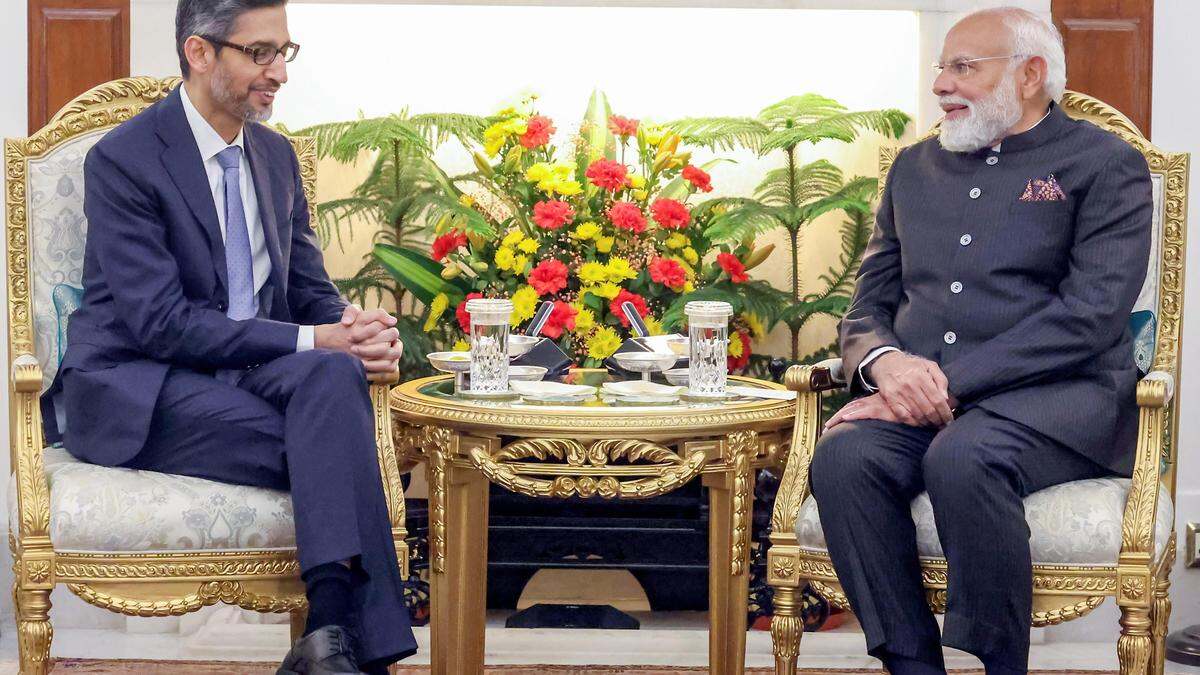
India’s artificial intelligence ambitions received a major boost when Prime Minister Narendra Modi met Sundar Pichai, CEO of Google and its parent Alphabet Inc., in New Delhi on February 18, 2026.
The high-level interaction took place on the sidelines of the India AI Impact Summit at Bharat Mandapam, where global policymakers, tech leaders, startups and investors gathered to discuss the future of artificial intelligence.
The meeting signals a deeper collaboration between India and one of the world’s most influential technology giants at a time when AI is reshaping economies, education and employment.
Why the Modi–Sundar Pichai Meeting Matters for India
Artificial Intelligence is no longer a futuristic concept. It is already transforming industries such as healthcare, agriculture, finance, manufacturing and education.
India’s Growing AI Ambitions
India has been actively positioning itself as a global AI hub. With one of the world’s largest pools of engineers and software developers, the country has a natural advantage in digital innovation.
The Prime Minister highlighted the work India is doing in AI and discussed how Google could collaborate with Indian students and professionals in this fast-growing field.
This conversation is significant because AI is expected to contribute billions of dollars to India’s GDP in the coming decade.
India AI Impact Summit: A Global Technology Platform
The meeting took place during the India AI Impact Summit in New Delhi, a major international gathering focused on AI development and responsible innovation.
Global Participation Reflects India’s Rising Influence
More than 20 heads of State, 60 ministers and 500 global AI leaders attended the summit. This scale of participation shows that India is no longer just a consumer of technology but a key player shaping its direction.
The summit was accompanied by the India AI Impact Expo, featuring over 600 high-potential startups and 13 country pavilions.
Such events provide Indian startups exposure to global investors and technology partners.
For young innovators, this platform is a gateway to international recognition and funding.
How Google Can Support India’s AI Ecosystem
Google already has a significant presence in India, from cloud services to Android and digital payments.
However, AI collaboration could open a new chapter.
AI Training and Skill Development for Students
One of the key discussion points was how Google can work with India’s talented students.
India produces lakhs of engineering graduates every year. With the right AI-focused training, these students can become global innovators rather than just service providers.
Google’s expertise in AI research, machine learning models and cloud computing can help Indian universities integrate advanced AI curricula.
Skill development in AI can improve employability and create high-value jobs.
Supporting Indian Startups with AI Tools
Startups are the backbone of India’s digital economy.
Google’s AI platforms and cloud infrastructure can help startups scale faster. For example, AI-driven analytics can improve decision-making for e-commerce platforms. Healthcare startups can use AI for disease prediction and diagnostics.
Collaboration at this level could strengthen India’s startup ecosystem and reduce dependency on foreign technology imports.
India’s Strategic Vision in Artificial Intelligence
The government has been investing in AI for public good, focusing on sectors such as agriculture, healthcare and governance.
AI in Agriculture and Rural Development
AI can help farmers predict crop diseases, optimise irrigation and improve yield forecasting.
With India’s large rural population, AI-driven agricultural innovation can enhance food security and farmer income.
AI in Healthcare and Public Services
AI tools can assist doctors in diagnosing diseases, especially in remote areas where specialist access is limited.
For example, AI-based imaging systems can detect early signs of tuberculosis or cancer.
Digital governance systems powered by AI can also streamline public service delivery.
India’s AI vision is not just about technology growth but about inclusive development.
Sundar Pichai’s Indian Roots and Symbolism
The meeting carries symbolic importance as well.
Sundar Pichai, born in Chennai, leads one of the world’s most powerful technology companies.
His presence at the India AI Impact Summit highlights India’s growing influence in global tech leadership.
For Indian students, Pichai’s journey serves as inspiration that global leadership roles are achievable.
AI, Employment and the Future Workforce
AI often raises concerns about job displacement.
However, experts believe that while some repetitive jobs may decline, new opportunities will emerge in AI research, data science, robotics, and AI ethics.
Upskilling Is the Key
India’s demographic dividend can turn into a strength if the workforce is trained in advanced technologies.
Collaboration between the government and companies like Google can create certification programmes, internships and research partnerships.
This approach ensures that India remains competitive in the global digital economy.
Economic Impact of India–Google AI Collaboration
A deeper partnership can attract foreign direct investment and boost innovation.
Google’s support in AI research centres or data infrastructure could generate employment and enhance India’s global standing.
Moreover, AI innovation can improve productivity across industries, from manufacturing automation to fintech fraud detection.
The ripple effect could transform India’s economic trajectory.
India’s Position in the Global AI Race
Countries like the United States and China dominate AI research and investment.
India aims to carve out its own space by focusing on ethical AI, cost-effective solutions and large-scale digital adoption.
Hosting global AI leaders and fostering partnerships reflects India’s intent to be a responsible and influential AI power.
The India AI Impact Summit demonstrates that India is serious about shaping the global AI narrative.
What This Means for Indian Youth
For students in engineering colleges and tech institutes across India, this meeting sends a powerful message.
AI is not just a trend; it is a long-term opportunity.
Government support combined with global tech collaboration can create research labs, hackathons and incubation centres.
Young professionals should focus on learning machine learning, data analytics and AI ethics to stay relevant.
Final Thoughts: A Transformational Moment for India
The meeting between Prime Minister Narendra Modi and Sundar Pichai goes beyond a diplomatic courtesy.
It represents India’s ambition to lead in artificial intelligence and digital innovation.
With the right policies, funding and skill development initiatives, India can become a global AI powerhouse.
If partnerships like this translate into action, India’s AI revolution may just be getting started.
As the world watches the rapid evolution of artificial intelligence, India’s strategic collaborations today could define its technological future for decades to come.
Related posts:
 Trump Announces Permanent Pause on Migration from Third World Countries
 Major Anti-Drug Operation: Telangana and Delhi Police Bust Big Network
 Assam GoM Recommends ST Status for Six Communities in Report
 Fresh FIR Against Gandhis Sparks Congress Allegations of Vendetta Politics
 Five Indians Kidnapped in Mali Amid Rising Extremist Violence Crisis
 KK Muhammed Urges Restraint in Mandir-Masjid Disputes Across India
 Latest Update on 8th Pay Commission Notification and Key Issues
 Chilling Public Execution in Khost by the Taliban Sparks Global Outrage
 Putin praises Modi: India-Russia ties deepen through trust and friendship
 Airlines in Turmoil-DGCA and MoCA Swing Into Action to Stabilize the Situation