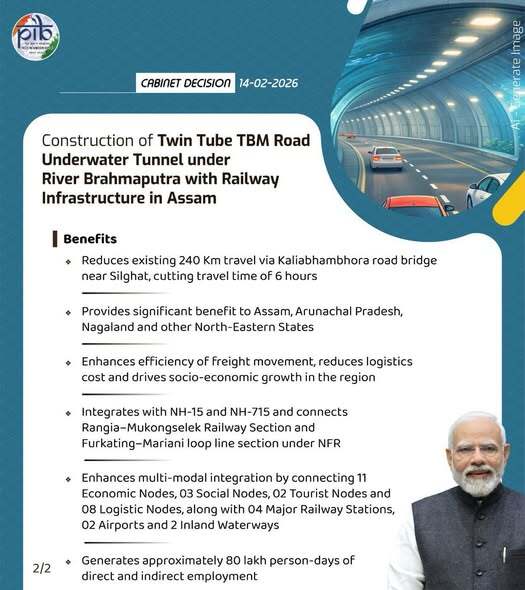
In a landmark decision, the Cabinet Committee on Economic Affairs (CCEA) has approved India’s first underwater twin tube road-cum-rail tunnel project in Assam. Estimated at a total capital cost of ₹18,662 crore, this mega infrastructure initiative is poised to transform connectivity across the Northeast.
The project will be constructed beneath the mighty Brahmaputra River, linking Gohpur on NH-15 with Numaligarh on NH-715. Once completed, it will reduce travel distance from 240 km to just 34 km and cut journey time from nearly six hours to only 20 minutes.
This is not just an engineering milestone. It is a strategic and economic game-changer for Assam and neighboring states.
What Makes This Underwater Twin Tube Tunnel Historic
India has built long tunnels before, but this will be the country’s first underwater road-cum-rail tunnel and only the second such tunnel globally.
Twin Tube Design for Multi-Modal Efficiency
The total project length is approximately 33.7 to 34 km. At its core lies a 15.79-km Twin Tube Tunnel Boring Machine (TBM) driven underwater section.
One tube will carry a two-lane road corridor, while the other will include rail infrastructure along with road capacity. This integrated approach ensures seamless multi-modal connectivity.
The twin-tube model enhances safety, traffic flow, and operational flexibility.
Engineering and Construction Mode
The project will be executed under the Engineering, Procurement and Construction (EPC) mode. This means a single contractor will be responsible for design, procurement, and construction, ensuring streamlined execution.
The construction timeline is expected to be five years.
The tunnel will include road cut-and-cover sections and dedicated rail cut-and-cover components, ensuring structural resilience and operational efficiency.
Strategic Connectivity for the Northeast
Although located in Assam, the tunnel’s impact extends beyond state boundaries.
Linking Key Highways and Rail Networks
The alignment integrates with two major National Highways, NH-15 and NH-715.
On the railway side, it connects the Rangia–Mukongselek section under the Northeast Frontier Railway’s Rangia Division and the Furkating–Mariani loop line under the Tinsukia Division.
This integration will provide high-speed connectivity between Assam and Arunachal Pradesh, particularly benefiting cities like Numaligarh, Tezpur, Gohpur, Dibrugarh, and Itanagar.
The project is expected to double average travel speeds in the corridor.
Transforming Travel Time and Distance
Currently, commuters travel via the Kaliabhomora bridge near Silghat, passing through areas including Kaziranga and Biswanath.
The journey spans about 240 km and takes nearly six hours.
After the tunnel becomes operational, that stretch will shrink dramatically to 34 km, requiring just 20 minutes.
Such a drastic reduction in time will reshape daily mobility and logistics planning.
Economic and Logistic Boost Across the Region
The tunnel is designed to enhance economic growth and reduce logistics costs.
Connecting Economic and Industrial Nodes
The project will integrate 11 economic nodes, including industrial areas in Numaligarh, Titabor, Nagaon, Demow, and Jogighopa.
It will also connect key railway stations such as Numaligarh, Gohpur, Golaghat Town, and Simaluguri Junction.
Additionally, it links two inland waterway terminals at Biswanath Ghat and Tezpur, along with two airports — Donyi Polo Airport in Itanagar and Tezpur Airport.
This multi-layered integration creates a powerful logistics network across the Northeast.
Boost to Trade and Border Infrastructure
The Northeast is strategically important due to its proximity to international borders.
Faster connectivity can improve cross-border trade, strengthen supply chains, and enhance defense logistics.
By improving freight efficiency, the tunnel is expected to significantly lower transportation costs for goods movement.
Tourism Growth and Social Impact
Infrastructure development in the Northeast often translates into tourism expansion.
Easier Access to Tourist Hotspots
The tunnel corridor will provide improved access to major tourist nodes such as Kaziranga National Park and the Deopahar Archaeological Site.
Kaziranga, a UNESCO World Heritage Site, attracts both domestic and international tourists.
Better road and rail connectivity can boost visitor inflow, benefiting hotels, transport services, and local businesses.
Support for Aspirational and Tribal Districts
The project connects social nodes, including tribal districts and aspirational districts like Udalguri and Darrang.
Improved infrastructure typically enhances access to healthcare, education, and employment opportunities.
Infrastructure is not just about roads; it is about inclusive development.
Employment Generation and Economic Multiplier
The project is expected to generate around 80 lakh person-days of direct and indirect employment.
Large infrastructure projects often create ripple effects across sectors such as construction, steel, cement, logistics, and services.
Local contractors, suppliers, and workers will likely benefit during the construction phase.
Employment generation at this scale can significantly stimulate regional economic activity.
Technical and Traffic Projections
The projected Annual Average Daily Traffic (AADT) for FY-25 is estimated at 4,680 Passenger Car Units.
This figure suggests strong anticipated usage even before completion, reflecting the strategic importance of the corridor.
The tunnel’s design will accommodate high-capacity movement, ensuring it remains future-ready as traffic volumes grow.
Why This Project Matters Nationally
This underwater twin tube tunnel represents a broader shift in India’s infrastructure ambitions.
Engineering Ambition and Global Standing
Executing a 15.79-km underwater TBM tunnel beneath the Brahmaputra River demonstrates advanced engineering capability.
It strengthens India’s credentials in complex infrastructure development.
Projects of this scale signal confidence, technological maturity, and long-term vision.
Accelerating Northeast Integration
For decades, connectivity challenges have slowed the economic integration of the Northeast with mainland India.
Mega projects like this reduce geographic isolation and promote balanced regional growth.
Enhanced infrastructure can attract private investment, tourism, and industrial development in the region.
Final Outlook: A Transformative Milestone
India’s first underwater twin tube road-cum-rail tunnel is more than a construction project. It is a strategic investment in connectivity, growth, and national integration.
By cutting travel time from six hours to 20 minutes and reducing distance from 240 km to 34 km, the project promises measurable economic and social benefits.
If completed on schedule within five years, it could redefine transportation standards in the Northeast and set a new benchmark for infrastructure innovation in India.
The Brahmaputra tunnel is not just an engineering marvel in the making — it is a symbol of India’s infrastructure future.
Related posts:
 Delhi NCR Approves Two New Delhi-Gurgaon RRTS Corridors for Connectivity
 Unified Northeast India Tourism Strategy Could Transform Regional Travel
 Discover Kochi in December: Culture, Beaches, History and Holiday Vibes
 Indian Railways New Unreserved Ticket Rule: Mandatory Printed Ticket Explained
 Grand Exposition of Sacred Piprahwa Relics Opens in New Delhi
 Vande Bharat Sleeper Train Promises Transparent, Premium, Fair Travel Experience
 Toy Train Jungle Safari Siliguri Resumes, Boosting Tourism And Jobs
 Vande Bharat Expansion Plan.
 Indian Railways Launches Amrit Bharat II Express With New Rules
 Badrinath Dham Gates Reopening Date April 23 for Devotees