
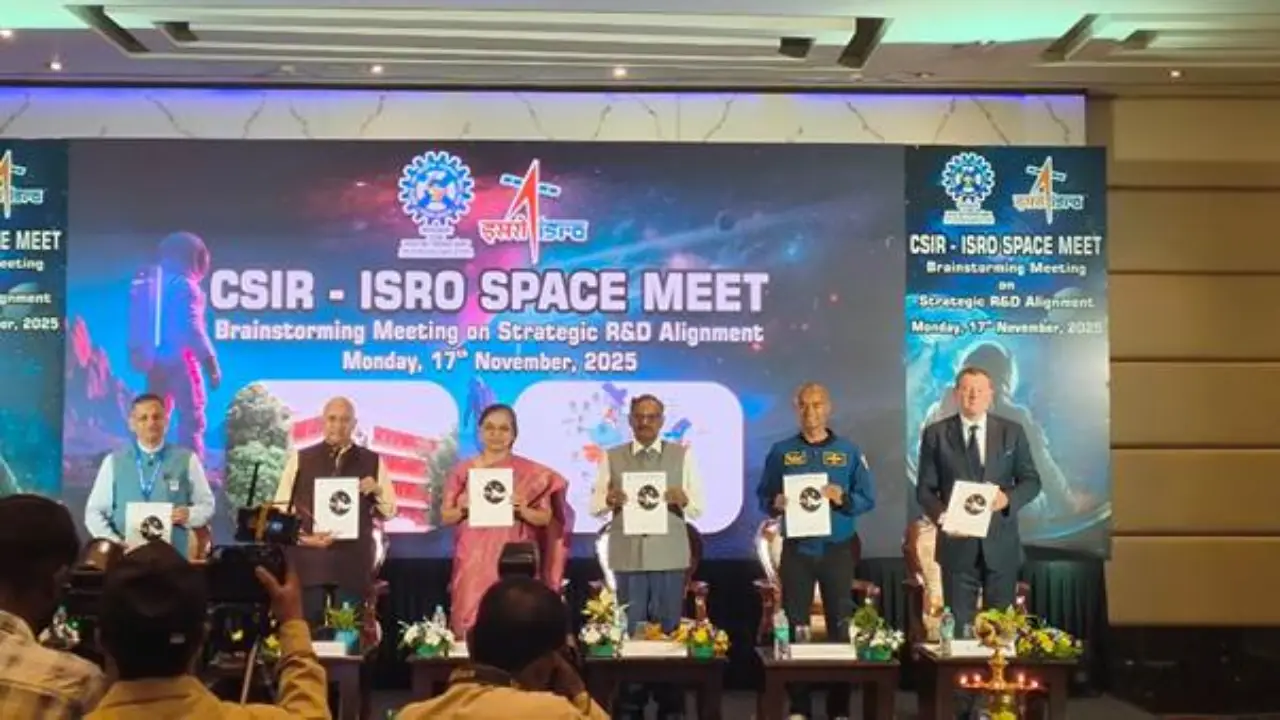
On 17 November 2025, the Council of Scientific and Industrial Research (CSIR) and the Indian Space Research Organisation (ISRO) came together in Bengaluru to host the CSIR–ISRO Space Meet 2025, an event aimed at aligning multidisciplinary research, technological innovation, and institutional collaboration to accelerate India’s human spaceflight ambitions. The meeting was held at CSIR’s National Aerospace Laboratories (CSIR–NAL), which played the role of the nodal organizing institute.
In her welcome address, Dr. N. Kalaiselvi, Secretary, DSIR & Director General of CSIR, emphasized the strong scientific and technological contributions of CSIR toward bolstering India’s space capability. She noted that the gathering was not only a forum for knowledge sharing among scientists, researchers, and astronauts, but also a space to learn from international experts, and identify and address critical “gap areas” in India’s human spaceflight efforts. Her remarks underlined India’s steady commitment to indigenous innovation and collaborative research and development, with gratitude for the guidance of the Union Minister, Dr. Jitendra Singh, in realizing national scientific and technological goals.
Delivering the strategic address, Dr. V. Narayanan, Secretary of the Department of Space and Chairman of ISRO, stressed that the Gaganyaan human spaceflight mission requires coordinated input across ministries, R&D institutes, academia, and partner organizations. He outlined the evolving mission priorities—such as the development of next-generation crew safety systems, sophisticated life-support technologies, and advanced scientific payloads. More ambitiously, he projected India’s long-term vision, which includes a future human mission to the Moon, Mars exploration, and even the establishment of a national space station.
Dr. Abhay A. Pashilkar, Director of CSIR–NAL, welcomed the participants by reaffirming NAL’s dedication to advancing aerospace technologies, materials research, and testing capabilities that support India’s goals in human spaceflight. Complementing this national outlook, a special video message from Jean-Francois Clervoy, a veteran ESA astronaut, brought a global perspective—highlighting the value of international cooperation and shared scientific learning in pushing forward human space exploration.
One of the most inspiring parts of the meet was the experience-sharing session. Group Captain Prasanth B. Nair, an ISRO astronaut, spoke candidly about his astronaut training, microgravity simulations, operational readiness, and recovery frameworks. Alongside him, Wing Commander (Retd.) Rakesh Sharma, India’s first astronaut from the 1984 Soyuz mission, reflected on his journey and acknowledged CSIR–NAL’s longstanding contributions to aerospace. Both astronauts emphasized that India’s human spaceflight program is deeply rooted in the spirit of “peaceful exploration” and in advancing human-centric scientific research.
The meet also included a number of technical and thematic sessions led by national and international experts. For instance, Dr. Lucia Roccaro from ESA discussed human spaceflight physiology, while Dr. Akiko Otsuka from JAXA offered perspectives on collaborative research. From the Indian side, Professor Pradipta Biswas of IISc spoke on human-technology interaction and interface design for crewed missions key issues for future spaceflights.
According to official reports, the Space Meet drew between 150 and 200 delegates, including scientists, technologists, astronauts, and representatives from major organisations such as the European Space Agency (ESA), the Japan Aerospace Exploration Agency (JAXA), the French Space Agency (CNES), as well as national bodies like DRDO, IISc, and the Indian Air Force. The agenda covered a wide spectrum of topics: human spaceflight physiology, biomedical instrumentation, materials science, life sciences in microgravity, and even systems for spacecraft maintenance. There were also discussions around more futuristic and applied fields such as the growth of plants in space, space food development, microfluidics, ceramic metamaterials, and preventing microbial corrosion.
Beyond scientific discussions, the meeting was seen as a way to forge a roadmap for future human spaceflight missions a way to translate vision into mission-driven research. Through stronger linkages among institutions, the aim is to promote innovation in space medicine, human factors engineering, and translational technologies that benefit both space exploration and societal applications on Earth.
Importantly, this Space Meet comes at a time when India’s Gaganyaan mission is rapidly progressing. According to media reports, ISRO Chairman Dr. Narayanan has stated that about 85–90 percent of subsystem-level activities for Gaganyaan have been completed, with integrated tests and software validation underway. This high level of readiness underscores why convening a meeting like this is so timely bringing together scientific thinkers, engineers, and astronauts to ensure the mission is safe, efficient, and scientifically rich.
India’s Human Spaceflight Programme: Recent Progress & Key Updates
Since the CSIR–ISRO Space Meet in November 2025, India’s human spaceflight ambitions under the Gaganyaan programme have continued to advance, albeit with adjusted timelines, stronger technological readiness, and major institutional investments.
One of the most important recent developments is that ISRO now estimates around 90 percent of the Gaganyaan mission’s development work has been completed. According to ISRO Chairman Dr. V. Narayanan, critical systems such as the crew escape mechanism, life-support systems, human-rated launch vehicle, and other human-centric subsystems are nearing full readiness. This high degree of completion reflects the organisation’s rigorous preparation and commitment to safety.
However, the first uncrewed test flight, which many hoped would happen in 2025, has been delayed to early 2026. ISRO says it will conduct three uncrewed missions before any crewed launch, to thoroughly validate environmental control, re-entry, and other critical systems. The delay underlines ISRO’s caution: human spaceflight is inherently risky, and the agency is not compromising on safety.
Looking ahead, the first crewed Gaganyaan mission is now targeted for early 2027, according to government and space agency sources. This phased strategy uncrewed tests first, then crewed flight allows for incremental risk reduction and system validation, a model followed by many space-faring nations.
In parallel, ISRO has made technical breakthroughs. For example, it has completed the development of the Service Module Propulsion System (SMPS), a critical propulsion component that will enable in-orbit maneuvering, module control, and safe return. Also, parachute-based deceleration systems have been successfully tested: in earlier test flights, a simulated crew module was dropped from altitude and its multi-parachute recovery system worked as planned.
On the institutional front, India has increased its budget for Gaganyaan. Reports indicate that the mission’s funding has been raised to US$ 2.32 billion (about ₹201.93 billion), underscoring the government’s long-term commitment. This expanded funding is not only for uncrewed and crewed missions but also supports plans for India’s first national space station.
Indeed, India’s vision goes beyond Gaganyaan. ISRO and the Department of Space plan to build the “Bhartiya Antariksh Station”, with initial operations by 2028. Over time, this station may expand into a modular facility (up to five modules by 2035), capable of hosting more crew and longer-duration missions. This space station is expected to support not only astronaut missions but also international research, microgravity experiments, and space-based innovation.
India is also deepening its international collaborations: for instance, ISRO has conducted radio-frequency compatibility tests (RFCT) with the European Space Agency (ESA), ensuring that the Gaganyaan Orbital Module communications systems are interoperable with ESA’s ground stations. Moreover, ISRO has signed a framework MoU with the Sree Chitra Tirunal Institute for Medical Sciences and Technology (SCTIMST) to collaborate in space medicine covering areas like radiation biology, crew medical kits, telemedicine, and behavioral health studies in microgravity.
On the human side, astronaut readiness is under focus. The selected crew have undergone extensive training, including simulations, microgravity exercises, and mission-specific preparation. There is also a spotlight on ensuring missions are safe and scientifically meaningful.
Interestingly, India’s space programme is also embracing space analogue missions: HOPE, a high-altitude mission conducted in Ladakh (over 4,500 meters above sea level), has been launched as a way to simulate planetary conditions. This helps test physiological responses, validate mission protocols, and prepares for future long-duration missions to orbit or even to the Moon / Mars.
All these updates reflect a mature and methodical approach to human spaceflight. Rather than rush into a crewed flight, India is building its capabilities step by step: testing critical systems, strengthening international partnerships, investing in infrastructure, and ensuring astronaut safety. The delay of the first crewed flight until 2027 is not a setback but a sign of cautious progress one that could help avoid costly mistakes and ensure a successful, sustainable human spaceflight future for India.
Related posts:
 ISRO’s Chandrayaan-2 Radar Maps Moon’s Poles with Ground-breaking Clarity
 AI-Powered Academic Discovery Transforms Research Literature Review Efficiency
 Seven New Frog-Shaped Leafhoppers Discovered in Uganda Rainforest by Scientist
 Magnetic Microrobots: Precise Drug Delivery to Treat Stroke, Cancer, Infections
 NASA’s ESCAPADE Mission Drives Future Low-Cost Mars Exploration
 IISF 2025 Science Festival Signals India’s Bold Innovation Progress
 COP30 in Belém: Climate Deal Raises Hope, But Fossil Gaps
 How Dogs Sense Human Fear Through Smell, According to Science
 Russia’s Baikonur Launch Pad Damage Threatens Future Human Space Missions
 Pune Breakthrough in Hydrogen Transport Could Change India’s Clean Energy

Very nice