
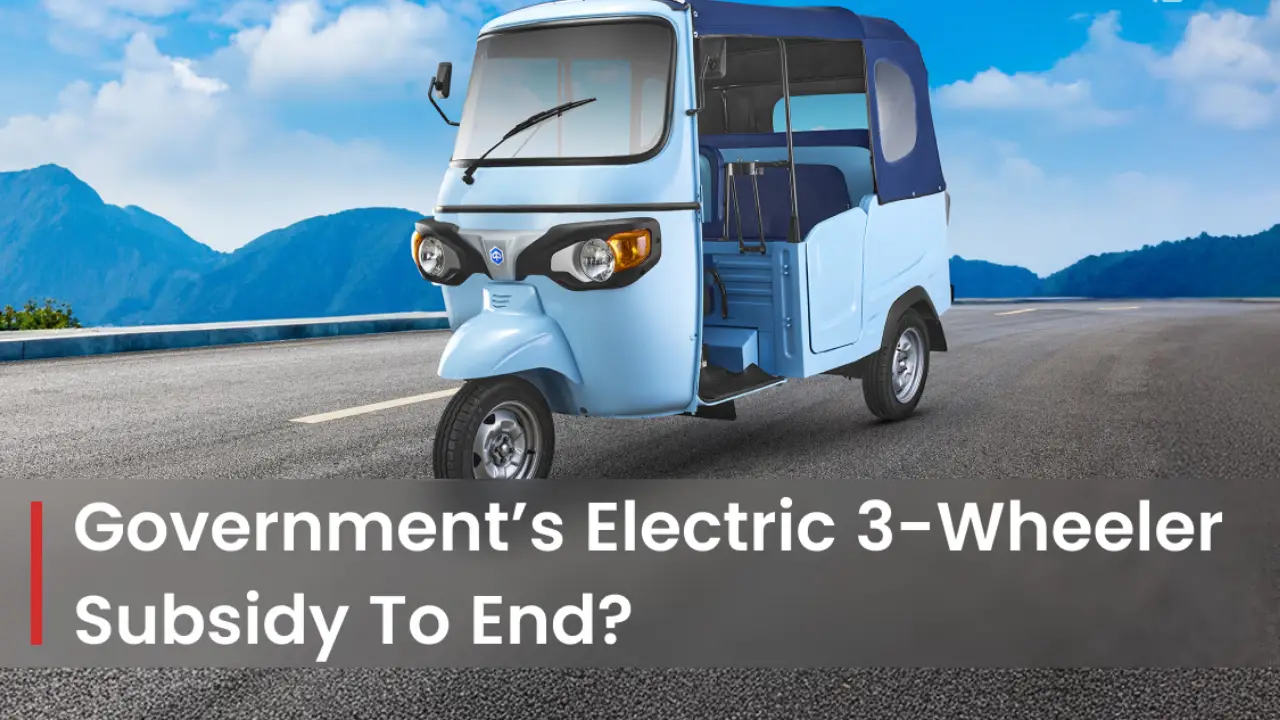
The Indian government has announced that its electric three-wheeler subsidy under the PM E-DRIVE scheme will not be extended beyond the current fiscal year, raising concerns among manufacturers and industry stakeholders. While the broader PM E-DRIVE program has been extended, the support for e-rickshaws and electric 3-wheelers is still slated to end on March 31, 2026.
This subsidy phase-out comes as the Ministry of Heavy Industries confirms that the PM E-DRIVE scheme’s total outlay of ₹ 10,900 crore remains unchanged, and the extension of the scheme applies only to certain categories such as e-buses, e-trucks, and ambulances. According to official notification, incentives for electric two-wheelers, e-rickshaws, and three-wheelers will conclude as originally planned.
For the three-wheeler EV segment (L5 and e-rickshaws), this means that the purchase incentives will no longer be available after March 2026. The decision is rooted in a “fund-limited” scheme, according to which further claims beyond the allocated budget of the scheme will not be entertained.
The subsidy for cargo electric three-wheelers (L5) in particular had already been reduced. Earlier, they enjoyed an incentive of ₹ 5,000 per kWh capped at ₹ 50,000 per vehicle, but this was halved to ₹ 2,500 per kWh, with a new cap of ₹ 25,000 for vehicles registered after November 8, 2024. Experts argue that phasing out this subsidy too soon might slow down adoption, especially when these three-wheelers are critical for last-mile logistics and affordable commercial transport.
The PM E-DRIVE scheme was designed to push the adoption of electric mobility across different vehicle segments, and its target included 30 percent EV penetration by 2030. Under this scheme, as of early November 2025, around 2.54 lakh electric three-wheelers were supported, nearing the target of 2.89 lakh units. But with the subsidy ending for e-3W, many original equipment manufacturers (OEMs) are urging the government to reconsider and extend support, arguing that continued incentives are important for sustaining momentum in EV three-wheeler adoption.
On the other hand, a senior government official justified the move by saying that once a segment reaches 25–30 percent penetration, it can become self-sustaining. According to the official, the e-3W category has already crossed 32 percent penetration, which in the government’s view reduces the need for further subsidy.
In conclusion, while the PM E-DRIVE scheme itself will continue till March 2028 for certain vehicle types, the electric three-wheeler subsidy is being phased out, potentially altering the future of the e-rickshaw and e-auto market. For OEMs, this means a shift toward pricing their EVs with less dependence on direct demand incentives, and for the sector, it may slow down growth unless other supporting measures or innovations are introduced.
Related posts:
 India’s Top Affordable Electric SUVs 2025: Price, Range and Features
 Hyundai Pulls Plug on Tucson India; No Replacement Planned Yet
 Maruti Suzuki e-Vitara Launch December 2 2025: India’s First Electric SUV
 Honda Prelude Hybrid Coupe Coming to India as a Dreamy Halo Car
 Mahindra’s Bold Move: XUV 700 Facelift Likely to Be XUV 7XO
 Mahindra Launches Charge_IN Network to Boost Ultra-Fast EV Charging
 Mahindra BE 6 Formula E Edition Debuts with Racing-Inspired Style
 Land Rover Unveils Defender Dakar D7X-R for 2026 Rally Debut
 Lexus RX 350h Exquisite: New Hybrid SUV Grade Hits India
 Nissan India’s New MPV Unveil 18 December 2025 Future Plans
Very informative