
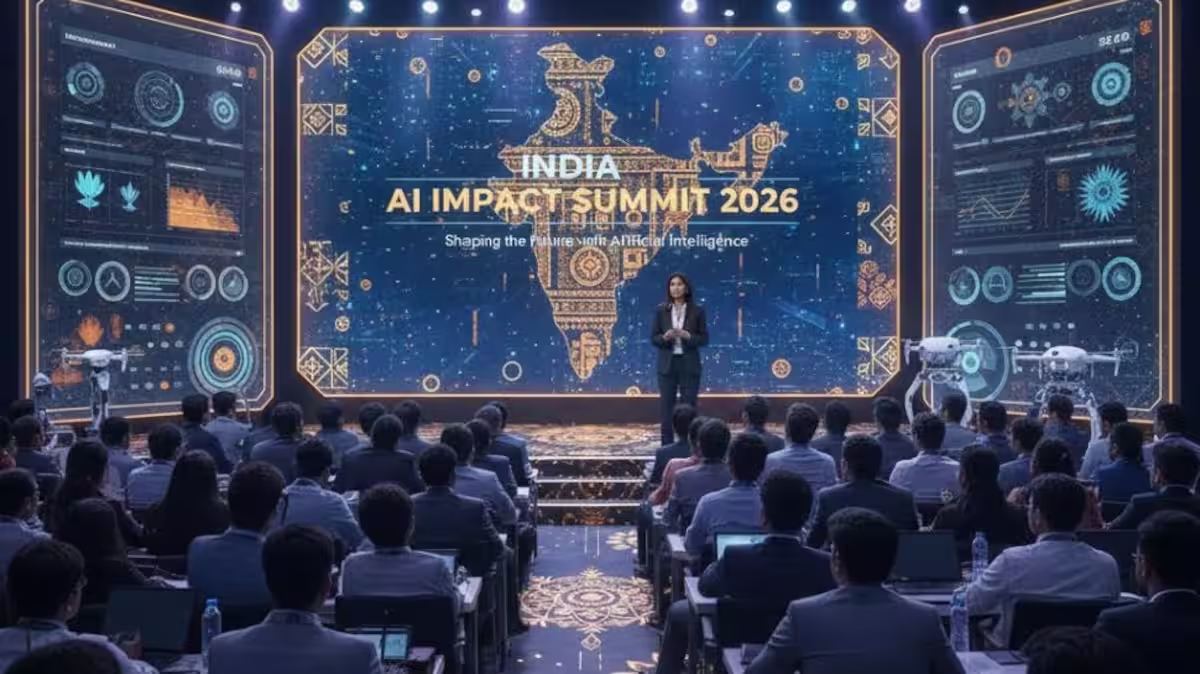
India is set to host one of the world’s largest artificial intelligence gatherings as the India AI Impact Summit 2026 begins on February 16 in New Delhi. The five-day summit, concluding on February 20, will be held at Bharat Mandapam and is expected to draw global leaders, policymakers and technology executives.
The event will be inaugurated by Prime Minister Narendra Modi and organised by the Ministry of Electronics and Information Technology under the government’s IndiaAI Mission.
With more than 15 heads of government, 50 ministers and around 40 CEOs expected to attend, the summit marks a defining moment for India’s AI ambitions.
Why the India AI Impact Summit 2026 Matters
The India AI Impact Summit is more than a technology conference. It reflects India’s strategic push to position itself as a global AI powerhouse.
Sessions will run daily from 10:00 AM to 6:00 PM IST, focusing on artificial intelligence infrastructure, innovation and responsible deployment.
Showcasing Progress Under the IndiaAI Mission
The IndiaAI Mission aims to build national AI infrastructure, high-quality datasets, skilling frameworks and research ecosystems.
The summit will highlight progress in these areas and demonstrate how AI is being deployed across healthcare, agriculture, governance and education.
India is signaling that AI is not just about innovation, but about inclusive national development.
Bringing Global Stakeholders Together
The summit will convene global technology leaders, startups, academia and investors under one platform.
Such collaboration is crucial for scaling AI solutions and ensuring interoperability with global standards.
India’s role as both a technology consumer and producer strengthens its influence in shaping global AI norms.
Three Key Takeaways from Ashwini Vaishnaw’s Speech
At the ET NOW Global Business Summit 2026, Union Minister Ashwini Vaishnaw outlined three major priorities for India’s AI journey.
His remarks offered insight into the government’s strategic direction.
AI for the Benefit of the Masses
Vaishnaw emphasized that AI must serve people, industry and students.
He highlighted the importance of AI diffusion, stating that widespread adoption would drive return on investment and long-term productivity gains.
Open-source AI models, available in large numbers globally, offer opportunities for innovation.
However, the real challenge lies in building practical solutions that address real-world problems.
The focus is not just on creating AI models, but on deploying them for measurable social and economic impact.
India’s vast internet user base and thriving startup ecosystem make it uniquely positioned to achieve this diffusion at scale.
Sovereign AI Models and Data Protection
The second key theme was sovereign AI.
Vaishnaw stressed the importance of protecting national data and ensuring that India’s AI models operate on secure, domestic platforms.
Sovereign AI refers to models trained and deployed within national frameworks, reducing dependency on foreign infrastructure.
In an era of data-driven geopolitics, digital sovereignty is emerging as a strategic priority.
India’s push for sovereign models aligns with global trends where nations seek greater control over data governance and AI ethics.
Semiconductor Progress and AI Infrastructure
The third major takeaway was India’s progress in semiconductors.
Vaishnaw noted that skepticism about India’s semiconductor ambitions has faded in recent years.
Semiconductor manufacturing is critical for AI infrastructure, powering data centers and advanced computing systems.
AI leadership is impossible without a robust semiconductor ecosystem.
India’s efforts to strengthen domestic chip manufacturing complement its broader AI ambitions.
India’s AI Workforce: A Global Asset
India’s AI workforce is now the second largest in the world.
The country accounts for nearly 20% of the global AI talent pool and data processing capabilities.
This positions India as a key hub for both domestic and international AI initiatives.
Talent, Data and Scale Advantage
India’s demographic dividend provides a steady pipeline of engineers, developers and data scientists.
Combined with one of the world’s largest internet user bases, the country generates vast volumes of data essential for training AI systems.
Scale, talent and digital penetration give India a structural advantage in AI development.
Global companies increasingly view India not just as a back-office hub, but as a center for innovation.
Nvidia’s Presence and Jensen Huang’s Cancellation
The summit was expected to feature Jensen Huang, CEO of Nvidia, as a marquee speaker.
However, Huang’s visit to New Delhi was cancelled due to unforeseen circumstances.
Despite this, Nvidia reiterated its commitment to India’s AI ecosystem.
A senior delegation led by Executive Vice President Jay Puri will represent the company at the summit.
The continued participation of Nvidia underscores India’s importance in the global AI supply chain.
AI for Public Good and Economic Growth
One of the central themes of the summit is AI for public good.
India aims to deploy artificial intelligence in ways that directly improve citizens’ lives.
Transforming Healthcare and Agriculture
AI-powered diagnostics and predictive analytics can improve healthcare delivery in remote regions.
In agriculture, AI tools can enhance crop forecasting, irrigation management and supply chain efficiency.
These applications demonstrate how AI can address structural challenges in developing economies.
Strengthening Governance and Education
AI-driven governance platforms can streamline public services and reduce inefficiencies.
In education, adaptive learning systems can personalize instruction for millions of students.
AI’s transformative potential lies in its ability to scale solutions across diverse and populous regions.
India’s Strategic Position in the Global AI Race
The India AI Impact Summit 2026 comes at a time when nations are competing to define the future of artificial intelligence.
The United States and China dominate AI research and infrastructure, but India is emerging as a significant player.
Policy Dialogue and Responsible AI
The summit will also facilitate discussions on ethical AI, regulatory frameworks and responsible deployment.
India’s approach seeks to balance innovation with accountability.
Establishing clear policies will be essential to attract investment and foster trust.
A Platform for Long-Term Partnerships
By bringing together governments and corporations, the summit aims to create durable partnerships.
International collaboration can accelerate technology transfer and capacity building.
India’s AI strategy is not isolationist but collaborative, with sovereignty at its core.
Conclusion: A Defining Moment for India’s AI Future
The India AI Impact Summit 2026 represents a milestone in the country’s technological evolution.
From sovereign AI models to semiconductor growth, India is aligning policy, infrastructure and talent toward a unified vision.
While high-profile cancellations like Jensen Huang’s absence drew attention, the broader narrative remains strong.
India’s AI ecosystem continues to expand, backed by government support, industry investment and a robust talent base.
As the summit unfolds in New Delhi, it signals that India is not merely participating in the global AI race it is shaping its direction.
Related posts:
 What Happens to Your Brain When Smartwatch AI Lives on Your Wrist
 Perplexity Strengthens Comet Assistant with Smarter Safeguards and Control
 CERT-In Urges Apple Users to Update Devices to Prevent Hacks
 India Gears Up for Deep-Sea Breakthrough With Matsya-6000 Submersible
 New VoxeLite Finger Wearable Brings Realistic Digital Touch Technology
 Banking Connect Boosts Real-Time Monitoring and Transforms India’s Bill Payments
 India Introduces New Mandatory SIM Rule for Messaging Apps Nationwide
 NASA Artemis II Mission 2026: Humanity’s Moon-Fly Opportunity
 Android 17 New Design Leaks Reveal Blur Effects, Features
 Nothing Phone 4a Pro Launch, Specs, Battery, Price Expectations 2026