
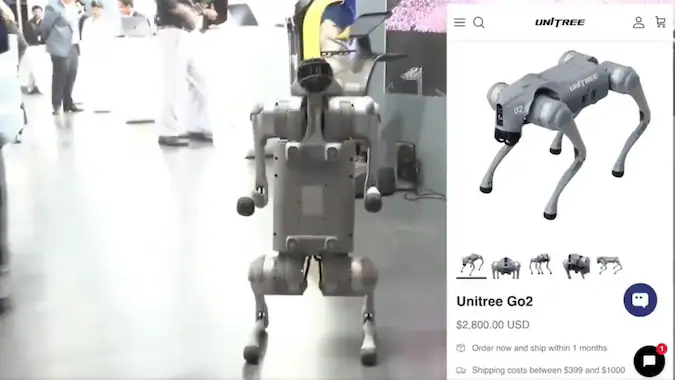
A social media controversy surrounding Galgotias University has ignited a wider debate about innovation, transparency and branding in India’s rapidly expanding artificial intelligence ecosystem.
The issue surfaced after an X (formerly Twitter) user alleged that the university showcased a commercially available robotic dog at the Delhi AI Summit while presenting it as part of its own AI innovation ecosystem. The claim quickly went viral, triggering intense online discussions.
At the centre of the controversy is a quadruped robot that appears to resemble the Unitree Go2, developed by Unitree Robotics.
While the university has not issued a public response at the time of writing, the episode raises larger questions about how institutions present technology at high-profile events.
How the Controversy Began
The allegation was made by X user Roshan Rai, who claimed that the robot displayed by Galgotias University during the Delhi AI Summit was not an in-house innovation but a commercially available product.
According to the viral post, the robot resembled the Unitree Go2, a robotic dog priced at approximately $2,800, which translates to around ₹2.3–2.5 lakh depending on exchange rates and shipping costs.
Screenshots shared online compared images of the robot displayed at the summit with promotional images of the Unitree Go2 available online. The visual similarities sparked debate among users.
The post further claimed that the robot was showcased as part of the university’s reported ₹350 crore AI ecosystem initiative.
Within hours, the post gathered thousands of views and reactions, with users questioning whether the robot was being misrepresented.
However, it is important to note that these are allegations circulating on social media and have not been officially confirmed.
What Is the Unitree Go2 Robot?
The Unitree Go2 is a quadruped robotic platform widely used in research, education and industrial inspection.
It is designed to be programmable and adaptable, making it popular among universities and robotics laboratories worldwide. The robot can perform tasks such as obstacle navigation, terrain mapping, data collection and experimental AI model testing.
Importantly, the Unitree Go2 is not marketed as a finished consumer product but as a research and development platform.
Many institutions purchase such robots to build custom applications on top of them.
Owning a commercially available robot does not automatically mean there is no innovation involved. The innovation may lie in the software, algorithms or applications developed on the hardware.
The Delhi AI Summit Context
The Delhi AI Summit, attended by policymakers, researchers and technology leaders, is meant to showcase India’s growing capabilities in artificial intelligence.
Universities and institutions often use such platforms to highlight their research infrastructure, partnerships and innovation ecosystems.
In this context, if a commercially available robot was displayed, the critical question becomes how it was presented.
Was it shown merely as part of a larger research setup? Or was it implied to be an original product developed by the university?
The distinction matters.
In technology exhibitions, clarity of communication is as important as the technology itself.
Understanding AI Ecosystems in Universities
Many Indian universities today are investing heavily in AI labs, robotics centres and interdisciplinary research hubs.
A ₹350 crore AI ecosystem initiative, as reported in the viral post, would typically include infrastructure, research collaborations, startup incubation, faculty development and industry partnerships.
Commercial robotics platforms like the Unitree Go2 are often used as tools within such ecosystems.
For example, an institution might buy a robotic dog platform but develop its own AI-powered navigation system, medical inspection application, or disaster response prototype.
In such cases, the hardware is purchased, but the value addition lies in the custom software and research output.
The real innovation often happens inside the code, not the metal frame.
Social Media, Perception and Public Trust
This controversy highlights the power of social media in shaping public narratives.
In the age of instant sharing, a single post can influence perception before official clarifications are issued.
For universities, reputation is critical.
Institutions that position themselves as leaders in AI and advanced technology must maintain transparency in how they present their achievements.
Even a minor misunderstanding can trigger widespread skepticism.
At the same time, social media debates sometimes oversimplify complex technological realities.
Displaying a commercially available platform does not automatically equate to misrepresentation.
The issue lies in whether the presentation accurately described the nature of the technology.
India’s AI Ambitions and the Bigger Picture
India is positioning itself as a global leader in artificial intelligence.
From national AI missions to university-level research centres, significant investments are being made in digital infrastructure.
In such an environment, credibility becomes essential.
If institutions claim innovation, they must be prepared to demonstrate original research, patents, publications or proprietary developments.
Transparency builds confidence among students, investors and policymakers.
This incident also reflects a broader global trend.
Universities worldwide use commercially available robotic platforms as research tools. Even leading global institutions often purchase hardware from specialised robotics manufacturers.
The question is not whether the hardware is bought.
The question is what value is created on top of it.
The Need for Clear Communication
If Galgotias University purchased the Unitree Go2 as part of its AI ecosystem, it would not necessarily be unusual.
What matters is how it was described at the summit.
Clear communication could easily resolve such controversies.
For instance, if the university clarifies that the robot serves as a research platform for developing indigenous AI applications, the narrative could shift significantly.
Until an official response is issued, conclusions remain speculative.
Transparency, not silence, is often the best way to handle such debates.
Lessons for Indian Institutions
This episode offers lessons beyond a single university.
As India accelerates its digital and AI ambitions, institutions must balance ambition with authenticity.
High-profile summits attract scrutiny.
Every claim, demonstration and presentation is likely to be examined closely.
Clear labelling, proper attribution and open communication can prevent misunderstandings.
At the same time, public discourse must also recognise that innovation is often collaborative and layered.
Buying hardware and building original AI systems on top of it is a legitimate and common research practice.
A Debate That Reflects India’s Growing Tech Confidence
Ultimately, the Galgotias University robot row reflects something positive as well.
It shows that Indians care deeply about innovation, originality and technological leadership.
The fact that such a debate gained traction indicates heightened public awareness about AI and robotics.
India’s journey toward becoming a global AI powerhouse will involve experimentation, partnerships and learning.
Controversies, when handled transparently, can strengthen accountability.
In the end, the true test of an AI ecosystem is not a single robot on display, but the knowledge, skills and solutions it produces for society.
Related posts:
 What Happens to Your Brain When Smartwatch AI Lives on Your Wrist
 Perplexity Strengthens Comet Assistant with Smarter Safeguards and Control
 CERT-In Urges Apple Users to Update Devices to Prevent Hacks
 India Gears Up for Deep-Sea Breakthrough With Matsya-6000 Submersible
 New VoxeLite Finger Wearable Brings Realistic Digital Touch Technology
 Banking Connect Boosts Real-Time Monitoring and Transforms India’s Bill Payments
 India Introduces New Mandatory SIM Rule for Messaging Apps Nationwide
 NASA Artemis II Mission 2026: Humanity’s Moon-Fly Opportunity
 Apple iOS 26.2 Update Brings Alarms, Lock Screen Changes
 Google Dark Web Report Shutdown 2026: What Users Need Know