
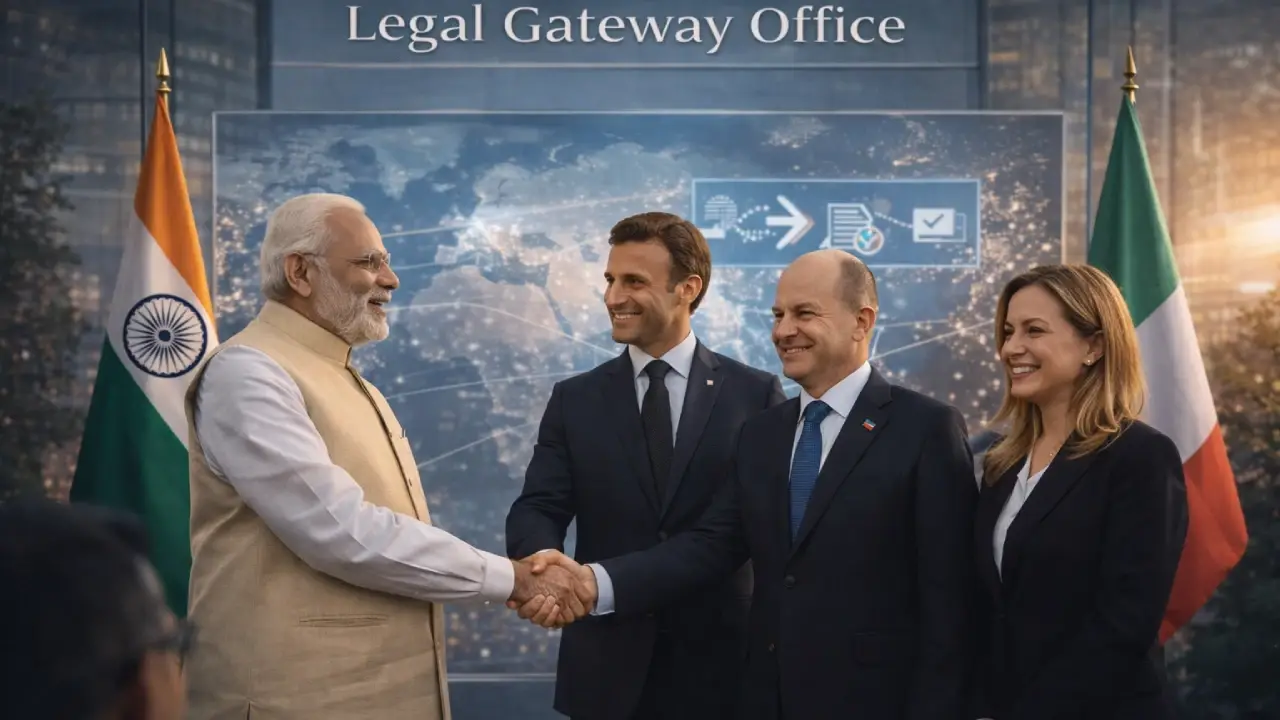
The launch of the European Legal Gateway Office marks a transformative moment for Indian students and professionals looking toward Europe. Announced jointly by India and the European Union, this new initiative is more than just an information desk. It represents a structured, transparent, and mutually beneficial pathway for talent mobility between India and the 27 EU member states.
At a time when global economies are shifting, supply chains are being reconfigured, and technology is redefining work, the European Legal Gateway Office arrives as a timely bridge connecting India’s growing talent pool with Europe’s evolving workforce needs.
Why the European Legal Gateway Office Matters for India
The European Legal Gateway Office is the first of its kind launched by the EU in a partner country. Its physical presence in New Delhi and Brussels signals the strategic importance the EU places on India as a talent partner.
During the launch, India’s External Affairs Minister S. Jaishankar emphasised India’s growing contribution to global talent pools, especially in digital, scientific and emerging technologies. With one of the world’s youngest populations, India produces millions of skilled graduates every year in engineering, information technology, research and innovation.
Europe, on the other hand, faces demographic challenges. Many EU countries are dealing with ageing populations and skills shortages in critical sectors such as ICT, artificial intelligence, cybersecurity and advanced manufacturing. The Gateway Office aligns these complementary realities.
For India, this initiative is not just about migration. It is about structured opportunity, legal protection and global recognition of Indian talent.
How the European Legal Gateway Office Works
The initiative operates through three key pillars designed to simplify and secure mobility.
A One-Stop Information Hub for Indian Talent
The Gateway Office in India will provide reliable information on work, study and research opportunities across all EU member states. Instead of navigating 27 different systems separately, Indian students and professionals can access clear guidance on visa pathways, qualification recognition and skills requirements.
In its initial phase, the focus is on the ICT sector. This is particularly relevant for India, which is already a global IT powerhouse. Indian professionals working in software development, cloud computing, data science and AI will benefit from streamlined guidance tailored to European labour market needs.
Support for EU Employers and Universities
The initiative also includes a support office in the EU that will help European employers and higher education institutions engage with Indian talent more effectively.
This two-way model ensures that mobility is not one-sided. European companies struggling with talent shortages can connect directly with qualified Indian professionals. Universities can attract high-performing Indian students and researchers in a structured and transparent manner.
A Digital Platform for Transparency
A digital tool will act as a central portal for mobility opportunities. This online platform will provide up-to-date information on legal migration routes, study programs and research collaborations.
Transparency and legality are at the core of the European Legal Gateway Office. In an era when irregular migration poses risks and uncertainties, this initiative promotes safe and legal pathways.
Strategic Context: India-EU Relations Deepen
The launch of the Gateway Office is the first deliverable following the recent India-EU Summit. The summit was attended by European Commission President Ursula von der Leyen and European Council President Antonio Costa, underlining the high-level political commitment behind the partnership.
One of the most significant outcomes of the summit was the conclusion of negotiations for a free trade agreement, often described as the “mother of all trade deals.” The FTA, once implemented, is expected to boost trade, investment and technological collaboration between India and the EU.
The European Legal Gateway Office dovetails with a mobility agreement signed by both sides. Together, these frameworks create a broader ecosystem where trade, investment and talent mobility reinforce one another.
In practical terms, this means Indian professionals may increasingly find opportunities in European firms that are simultaneously expanding their footprint in India.
The Global Workforce Is Becoming a Reality
Minister Jaishankar highlighted a critical trend shaping the 21st century: the emergence of a global workforce.
He pointed out that de-risking supply chains, technological transformation and sharply diverging demographics are redefining economic strategy. Countries that manage talent flows effectively will be better positioned to adapt.
From an Indian perspective, this reflects a confident shift in foreign policy. India is no longer seen merely as a source of labour but as a strategic partner in digital innovation and scientific research.
European Commission Executive Vice-President Henna Virkkunen acknowledged that Indians already form the largest group entering the EU for study and research. Indian students and researchers are making substantial contributions to European universities, laboratories and companies.
The Gateway Office formalises and structures this reality. It aims to make the exchange mutually beneficial rather than ad hoc.
Practical Impact for Indian Students and Professionals
For an Indian engineering graduate in Bengaluru, the Gateway Office could mean clear guidance on which EU countries recognise their degree and what additional certifications might be required.
For a cybersecurity expert in Hyderabad, it could provide insight into skill shortages in countries like Germany or the Netherlands and explain the visa process in straightforward terms.
For a PhD scholar in biotechnology from Delhi, the platform may highlight research grants, mobility programs and collaboration opportunities across European universities.
The biggest advantage is predictability. Instead of relying on scattered sources or private agents, Indian applicants can access verified information directly linked to EU institutions.
A Trusted Talent Corridor Between India and Europe
Henna Virkkunen described the initiative as a “trusted and practical talent corridor.” This phrase captures its long-term vision.
By creating both physical offices and digital systems, the EU is institutionalising talent mobility with India. Job fairs, study visits and targeted outreach will further deepen engagement.
From India’s standpoint, this also strengthens its image as a responsible and reliable global talent partner. It aligns with India’s broader vision of contributing to global solutions through connected societies and cooperative frameworks.
Challenges and the Road Ahead
While the European Legal Gateway Office is a major step forward, implementation will be key.
Recognition of qualifications across diverse EU systems remains complex. Language requirements, cultural adaptation and regulatory procedures vary between member states. The success of the Gateway Office will depend on how effectively it simplifies these complexities.
Moreover, India must continue investing in skill development aligned with European standards. Areas such as green technology, digital governance and advanced manufacturing are likely to see increasing demand.
If both sides maintain momentum, this initiative could redefine India-EU mobility for the next decade.
Conclusion: A Turning Point for India-EU Talent Mobility
The European Legal Gateway Office is not just an administrative development. It is a strategic move reflecting deeper economic and geopolitical alignment between India and the European Union.
For Indian students and professionals, it offers clarity, safety and structured opportunity. For Europe, it provides access to one of the world’s most dynamic talent pools.
In a world shaped by technological disruption and demographic imbalance, structured talent mobility may become one of the most powerful tools of international cooperation.
The European Legal Gateway Office stands as a symbol of that future where opportunity flows legally, transparently and mutually between India and Europe.
Related posts:
 Pakistan’s 27th Amendment: Cementing Field Marshal Asim Munir’s Power
 Trump Warns NATO Exit Over Greenland Deal and Security Concerns
 PM Modi Launches Kaziranga Corridor, Amrit Bharat Trains in Assam
 United States Completes Historic Withdrawal From World Health Organization WHO
 Diplomatic Tensions Rise After Sheikh Hasina’s Recorded Delhi Message
 Save Manipur Rally Shows Unity Against Division, Demands Peace, Resettlement
 Myanmar Earthquake Shakes Kolkata, Tremors Felt Across Eastern India
 SSB Clears No Man’s Land Encroachment Along India Nepal Border
 Tragic Noida and Delhi Pit Accidents Safety Negligence Claims Lives
 Bangladesh Rushes Secret US Trade Deal Ahead of Crucial Elections