Gambhir and Kohli Equation Back in Spotlight
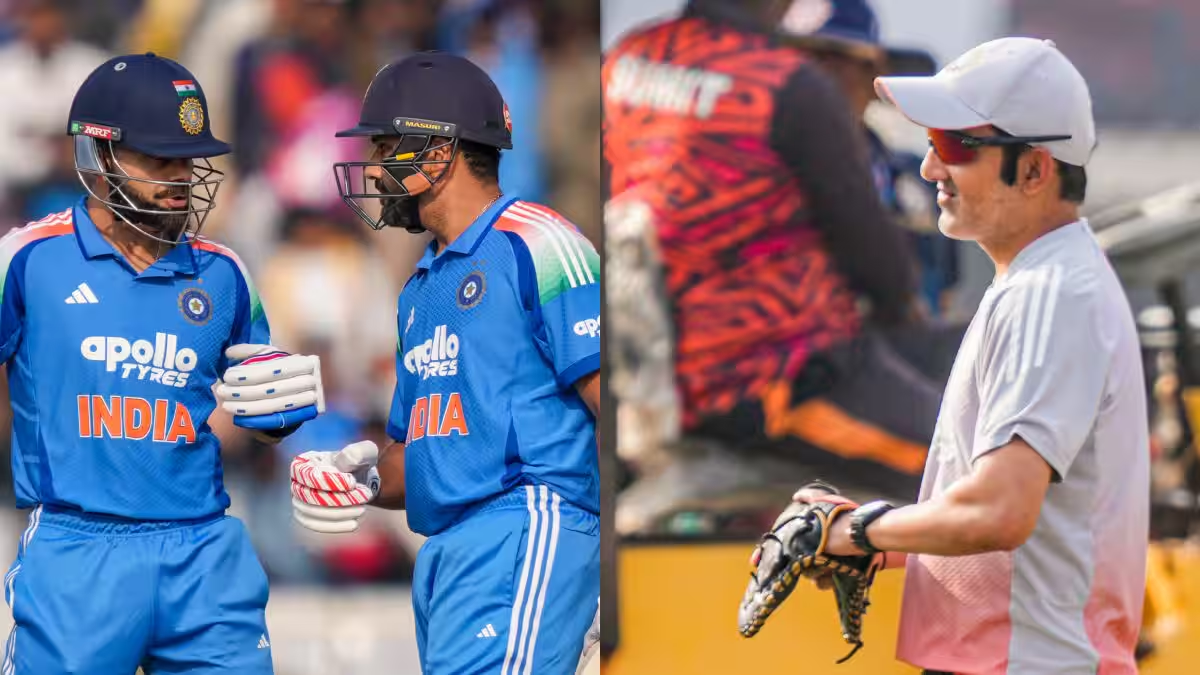
The relationship between India head coach Gautam Gambhir and former captain Virat Kohli has once again become a hot topic in Indian cricket. From fiery IPL clashes in the past to quiet moments in the Indian team setup, fans and experts have closely watched every interaction between the two. Speculation intensified after Gambhir took charge of the senior men’s team, with many wondering if their history would affect team harmony.
Initially, things appeared smooth, but the narrative shifted after India’s disappointing Border-Gavaskar Trophy performance. Soon after, Virat Kohli announced his retirement from Test cricket, choosing to continue only in ODIs. This decision fueled fresh rumors about internal tensions within the team management.
Rumors Grow After On-Field and Off-Field Moments
Over the last few months, social media has been buzzing with theories about a possible rift. Observers noted that Kohli and Gambhir were rarely seen talking during net sessions. The situation gained more attention when Kohli appeared to walk past Gambhir without acknowledgment after the first ODI against New Zealand.
These moments, though small, were enough to reignite old memories of their heated IPL 2023 exchange. Fans quickly linked the past with the present, suggesting that unresolved issues might still exist behind closed doors.
BCCI Secretary Finally Breaks Silence
Amid growing speculation, BCCI secretary Devajit Saikia addressed the issue directly. Speaking on the India Today Podcast, Saikia firmly denied any conflict between Gautam Gambhir and Virat Kohli. According to him, the two share a professional and cordial relationship, and there has been no fighting or disagreement within the team setup.
When reminded of their IPL altercation, Saikia brushed it aside, stating that he had not personally witnessed the incident and emphasized that IPL behavior should not be confused with national duty. His remarks aimed to put an end to the ongoing rumors that had dominated cricket discussions.
“Nobody Can Force Virat Kohli,” Says BCCI
One of the biggest talking points was Kohli’s sudden Test retirement and whether it was influenced by the team management. Saikia categorically dismissed these claims, saying that a player of Virat Kohli’s stature cannot be forced into retirement.
He described Kohli as a legend of Indian cricket who makes decisions independently. According to Saikia, the BCCI does not interfere in a player’s career choices, and any suggestion otherwise is purely speculative. This statement also applied to Rohit Sharma, who retired from Tests around the same time.
ODI Performances Silence Critics
After stepping away from Tests and T20Is, both Kohli and Rohit committed themselves fully to the ODI format. Despite rumors that they might retire after the Australia series last year, the duo responded in the best possible way—with runs.
Virat Kohli has looked in complete control in ODIs, while Rohit Sharma, despite a brief lean patch against New Zealand, delivered strong performances against Australia and South Africa. Their form reinforced the belief that experience still plays a crucial role in India’s white-ball success.
Central Contracts Reshuffle Explained
Another major development that sparked debate was the release of the BCCI central contracts list for the 2025–26 season. Virat Kohli and Rohit Sharma were demoted from the A+ category to the B category. However, this move was not entirely surprising.
The BCCI has always prioritized players who represent India in all three formats. Since Kohli and Rohit now play only ODIs, their shift to the B category follows existing logic rather than indicating a loss of trust or importance.
New Contract Structure and Top Category Players
For the 2025–26 season, the BCCI has reportedly removed the A+ category altogether. Players are now divided into three groups—A, B, and C. The top A category includes only three names: Shubman Gill, who now leads India in Tests and ODIs, Jasprit Bumrah, and Ravindra Jadeja.
The B category features experienced and key players such as Virat Kohli, Rohit Sharma, Suryakumar Yadav, KL Rahul, Hardik Pandya, Rishabh Pant, and others. The C category includes emerging talents and consistent performers like Rinku Singh, Axar Patel, Sanju Samson, and Arshdeep Singh.
While earlier contract values ranged from INR 1 crore to INR 7 crore, the new payment structure has not yet been officially disclosed.
What This Means for Indian Cricket
Taken together, these developments paint a picture of transition rather than turmoil. The BCCI appears focused on performance, format specialization, and long-term planning. Gautam Gambhir’s role as head coach and Virat Kohli’s continued presence in ODIs suggest that both are still central to India’s cricketing future.
Despite external noise, official statements and on-field performances indicate that professionalism remains intact. The Kohli-Gambhir equation, while always under scrutiny, does not seem to be affecting team decisions or results.
Final Word: Facts Over Speculation
In Indian cricket, big names naturally attract big debates. But as BCCI officials have clarified, not every silent moment or contract change signals conflict. Virat Kohli continues to be an integral part of the Indian team, Gautam Gambhir remains focused on results, and the board appears committed to stability.
For now, facts outweigh rumors—and Indian cricket moves forward with both its legends and future stars firmly in place.
Related posts:
 Supreme Court signals skill-based tournaments may escape India’s new gaming ban
 India Clinches Nine Golds in World Boxing Cup Finals 2025
 Lionel Messi India Tour Ends in Delhi With Grand Events
 From Struggle to Stardom: IPL Mini Auction Changed These Lives
 Palestinian Flag Controversy Erupts at Jammu Kashmir Domestic Cricket Match
 Mohammed Shami Ignored Again as India ODI Squad Announced
 Why Vaibhav Suryavanshi Is Forcing India’s T20I Selection Rethink
 ICC Warns Pakistan of Isolation Over T20 World Cup Boycott
 Pakistan May Skip India Match at T20 World Cup 2026
 Rashid Khan Nears Historic 700 T20 Wickets Milestone