Why Baba Vanga’s 2026 Prediction Is Trending Again
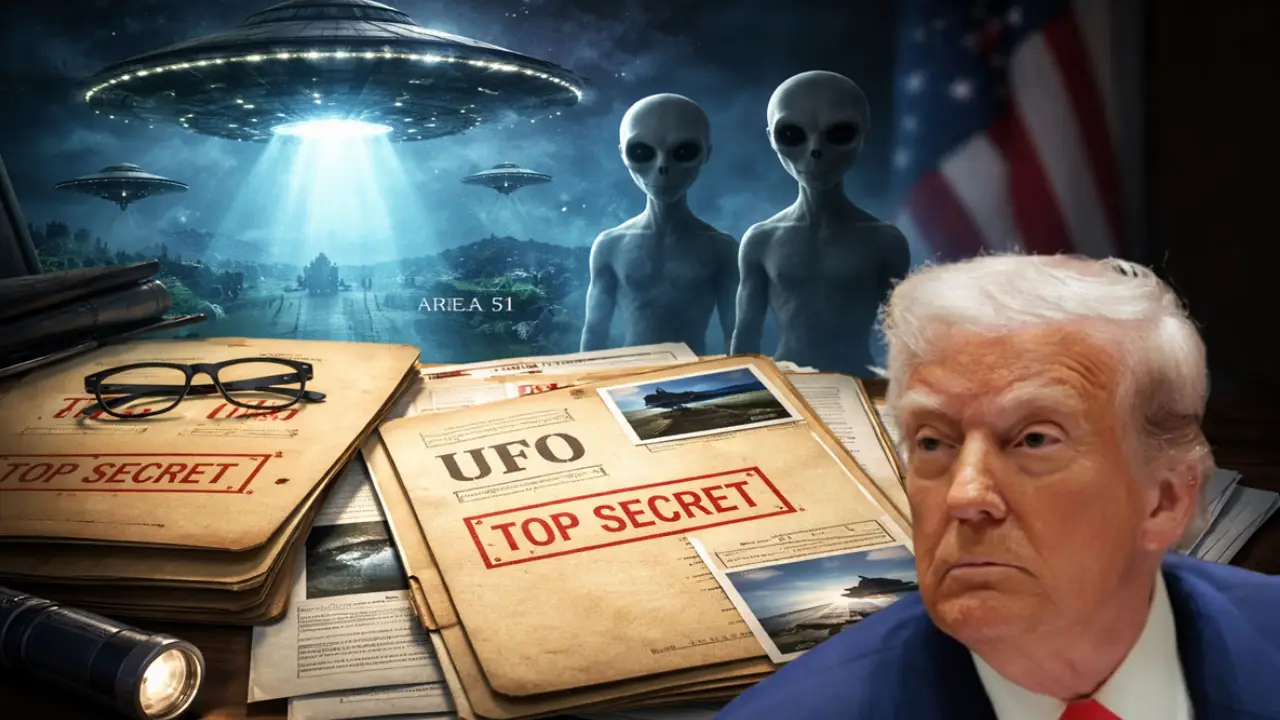
The internet has a long memory, especially when it comes to prophecy. As discussions about UFOs and UAPs return to headlines following orders by former US President Donald Trump to release government files, one name has resurfaced across social media platforms Baba Vanga.
According to viral claims, Baba Vanga predicted that in 2026, a massive spaceship would enter Earth’s atmosphere, proving humanity is not alone. The timing of these resurfaced claims has intensified public curiosity.
When government transparency meets ancient prophecy, speculation spreads fast.
For Indian audiences, such stories tap into a long cultural tradition of astrology, prophecy, and cosmic curiosity. From Vedic astronomy to ISRO’s Mars missions, India has always balanced science with spiritual wonder.
Who Was Baba Vanga and Why Do People Believe Her?
Baba Vanga was born in Bulgaria in 1911 and reportedly lost her eyesight at the age of 12 after a storm-related accident. Her followers claimed that after losing her sight, she gained extraordinary predictive abilities.
She died in 1996 at age 86.
Over the years, supporters have credited her with predicting events such as the fall of the Soviet Union and the 9/11 attacks in the United States. Because of these claims, she was often called the “Nostradamus of the Balkans.”
However, unlike Nostradamus, Baba Vanga did not leave behind written manuscripts. Most of her predictions were recorded through accounts from her niece Krasimira Stoyanova and followers.
This creates ambiguity.
Without written documentation, interpretations can easily evolve over time.
What Exactly Is the 2026 Alien Prediction?
Supporters claim Baba Vanga foresaw that in November 2026, a “huge ship” would arrive on Earth, offering definitive proof of extraterrestrial life.
She reportedly did not specify whether the arrival would be peaceful or hostile. Nor did she detail the purpose of this spacecraft.
In addition, some online discussions link her 2026 prediction to artificial intelligence. According to these interpretations, she believed AI would begin operating beyond human governance, dramatically reshaping daily life.
This part of the prediction resonates strongly today.
In India, AI is already influencing banking, healthcare, education, and governance. The idea of AI evolving beyond control taps into real global debates about regulation and ethics.
But again, there is no direct written record confirming these exact words.
Trump’s UFO File Release Order: What Happened?
The renewed attention to Baba Vanga’s prediction coincides with recent discussions in the United States about declassifying UFO-related documents.
Following remarks attributed to former President Barack Obama regarding unidentified aerial phenomena, Trump reportedly directed the Pentagon to begin releasing documents related to UAPs, UFOs, and extraterrestrial matters.
He stated publicly that government agencies should identify and release files connected to alien and extraterrestrial life, unidentified aerial phenomena, and unidentified flying objects.
The Pentagon has for years acknowledged that unidentified aerial phenomena exist. However, it has consistently maintained that there is no verified evidence confirming extraterrestrial origin.
It is important to distinguish between “unidentified” and “alien.”
An unidentified object simply means it has not yet been explained — not that it is extraterrestrial.
Are Declassified Documents Likely to Reveal Aliens?
Historically, declassified UFO documents have revealed confusion, radar anomalies, experimental aircraft tests, and unexplained sightings. They have not provided concrete proof of alien life.
Governments often classify data for national security reasons. Advanced drone technology, stealth aircraft testing, and surveillance systems can appear mysterious to civilians.
If new documents are released, they may offer more transparency about unidentified sightings. However, the likelihood of dramatic alien confirmation remains uncertain.
For Indian readers, it is worth remembering that even India has recorded unexplained aerial phenomena in the past. Yet, none have been confirmed as extraterrestrial.
Science demands evidence, not excitement.
How Conspiracy Theories Amplify Viral Buzz
Social media thrives on mystery. Algorithms reward dramatic claims.
When Baba Vanga’s prediction intersects with government transparency announcements, the narrative becomes irresistible. Videos, reels, and posts claim that 2026 will change humanity forever.
But there is a psychological factor at play.
Humans are wired to seek patterns. When two unrelated events happen close in time, people connect them.
Trump’s document release order does not automatically validate a prophecy made decades ago. Yet the coincidence fuels viral speculation.
The AI Angle: A More Realistic Prediction?
Interestingly, the part of Baba Vanga’s alleged prediction regarding AI may be more grounded in observable trends.
AI systems are advancing rapidly. Discussions at global forums increasingly focus on AI governance, ethical concerns, and regulatory frameworks.
In India, government initiatives are pushing AI integration across sectors while also discussing safeguards.
If any part of the 2026 prediction aligns with reality, it may be the acceleration of AI’s influence rather than a giant alien spaceship.
Sometimes symbolic prophecy reflects technological change rather than literal events.
India’s Perspective on Alien Curiosity
India has a rich history of cosmic imagination. Ancient texts speak of celestial beings and flying chariots. Modern India sends missions to the Moon and Mars.
Public fascination with extraterrestrial life is not new.
However, India’s scientific institutions like ISRO rely strictly on empirical evidence. The search for life beyond Earth continues through space exploration and astronomical observation.
As of now, no credible scientific body globally has confirmed alien contact.
Balancing Curiosity With Critical Thinking
It is natural to wonder whether we are alone in the universe. Scientists agree that the vastness of space makes the possibility of life elsewhere plausible.
But possibility is not proof.
When evaluating viral claims, especially about prophecies, context matters. Many predictions attributed to Baba Vanga have been retroactively interpreted.
Without primary documentation, certainty remains elusive.
What Should We Expect in 2026?
Realistically, 2026 may bring further technological breakthroughs, AI expansion, and perhaps more transparency about unexplained aerial phenomena.
Will it bring a massive alien spaceship?
There is currently no scientific evidence suggesting such an event.
However, curiosity itself drives innovation. The desire to explore the unknown pushes humanity forward.
The real story may not be about aliens arriving — but about humans advancing.
Final Thoughts: Between Mystery and Reality
The resurfacing of Baba Vanga’s 2026 prediction highlights how quickly prophecy and politics can intertwine in the digital age.
Government transparency initiatives spark speculation. Social media amplifies it. Ancient predictions gain new life.
For Indian readers and global audiences alike, the key lies in balance.
Stay curious.
Stay informed.
Stay critical.
Because whether or not aliens ever visit Earth, our responsibility is to separate fascination from fact.
And that, perhaps, is the most important revelation of all.
Related posts:
 Air India Flight 171 Investigation: Pilot Not Blamed, Report Shows
 Viral Lawrence Bishnoi Bail Video Sparks Confusion and Fact-Check
 Good News for Gas Consumers: CNG & PNG Price Relief 2026
 Young Cricket Prodigy Suryavanshi Draws Tendulkar Comparisons From Shashi Tharoor
 Shashi Tharoor supports India’s humanitarian approach amid Bangladesh tensions
 How Butterfly Pea Flower Farming Is Transforming Rural India’s Livelihoods
 Goa Considers Social Media Ban for Children Inspired by Australia
 Trump Praises India Gate, Plans America’s Biggest Triumphal Arch
 South Korea Birth Rate Row Official Expelled Over Import Women Remark
 Bhagirath Bhatt Sitar Maestro Blending Indian Classical Music With Fusion