
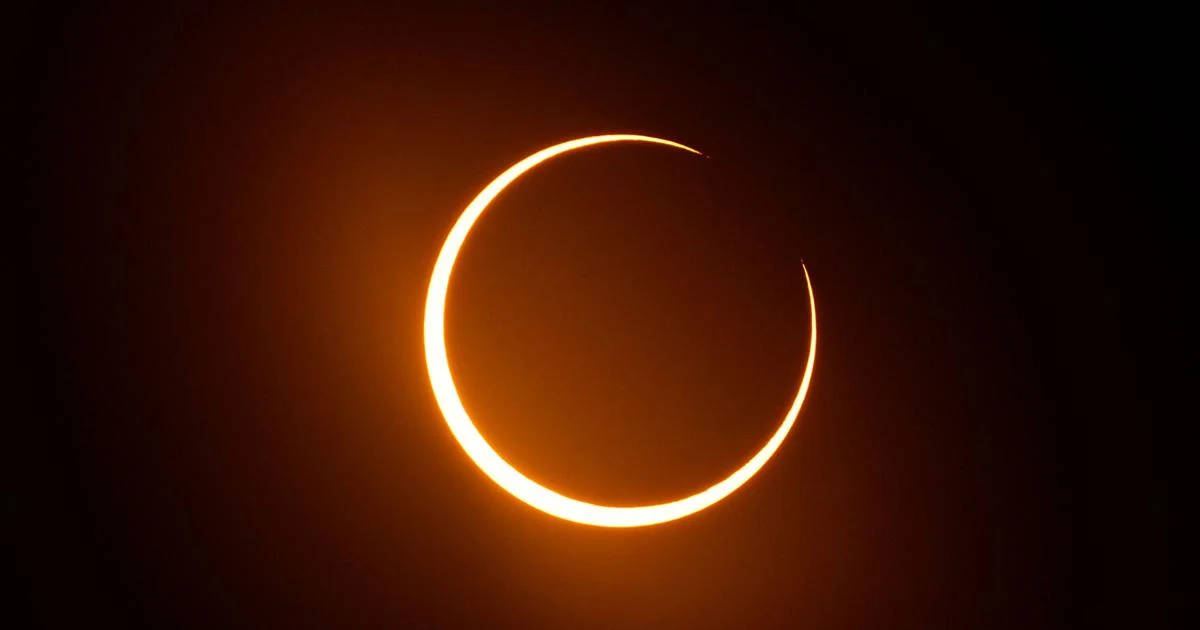
The idea of witnessing a solar eclipse in Antarctica sounds almost unreal. Yet, for a small group of scientists stationed at some of the most isolated research bases on Earth, this rare celestial event is a scientific goldmine.
As a “Ring of Fire” solar eclipse approaches, teams at Concordia Station and Mirny Station are preparing for one of the most demanding observation missions imaginable. In temperatures that drop below minus 30 degrees Celsius, precision science becomes a battle against nature itself.
Why Antarctica Is Perfect for Solar Eclipse Research
While Antarctica may seem like the worst place to conduct astronomical research, it is scientifically ideal.
Crystal-Clear Skies Enhance Solar Eclipse Observation
The Antarctic plateau offers extremely dry and thin air, especially at Concordia Station, often nicknamed “White Mars” due to its isolation and Mars-like environment.
Water vapour in the atmosphere distorts solar observations. However, the lack of moisture in Antarctica creates a natural advantage.
Clear skies and minimal atmospheric interference provide an unmatched window into the Sun’s outer layers.
This is why researchers endure months of isolation to capture just a few minutes of eclipse data.
Extreme Cold: The Biggest Obstacle in Antarctica Solar Eclipse Studies
Studying a solar eclipse in Antarctica is not simply about pointing a telescope at the sky.
Telescopes vs. Freezing Temperatures
At minus 30°C or colder, standard lubricants inside telescope gears freeze and turn into thick glue-like substances. This can stop mechanical tracking systems entirely.
Engineers must use:
Specialised dry lubricants
Built-in heating systems
Cold-resistant materials
Even a minor failure during the eclipse’s brief totality could destroy years of preparation.
In Antarctica, technology must survive conditions harsher than many space missions.
Wind Threats at Mirny Station
While Concordia sits inland on a high plateau, Mirny Station is located along the coast. Coastal winds there can be intense.
Strong gusts risk:
Vibrating delicate solar instruments
Blurring images
Distorting high-resolution data
Researchers must anchor equipment securely and constantly monitor stability.
In such extreme conditions, even the smallest vibration can compromise valuable observations.
What Makes the Solar Corona So Important?
The main objective of this Antarctica solar eclipse mission is to study the solar corona — the Sun’s outer atmosphere.
Unlocking the Mystery of the Solar Corona
The corona is usually invisible because the Sun’s bright surface overwhelms it. During a solar eclipse, when the Moon blocks the Sun’s disk, the corona becomes visible.
Scientists aim to measure:
Magnetic field structures
Plasma behaviour
Energy release patterns
These observations help researchers understand why the corona is significantly hotter than the Sun’s surface a mystery that has puzzled astrophysicists for decades.
How Solar Flares Affect Earth
Studying the corona is not just about curiosity.
Solar flares and coronal mass ejections (CMEs) originate from this region. These eruptions can:
Disrupt satellite communications
Damage GPS systems
Affect aviation routes
Trigger power grid failures
Understanding solar activity helps protect modern infrastructure back on Earth.
In an increasingly technology-dependent world, accurate space weather prediction is essential.
A High-Stakes Scientific Marathon
A solar eclipse lasts only minutes, but preparation takes years.
Precision Timing and Risk
Researchers must synchronise cameras, telescopes, and sensors perfectly. If a single component malfunctions during totality, the opportunity is lost.
Millions of dollars in funding, months of planning, and years of anticipation hinge on flawless execution.
In Antarctica’s brutal climate, the smallest oversight can mean total failure.
Why This Solar Eclipse Matters Globally
Although only a handful of researchers witness the Antarctica solar eclipse firsthand, its impact extends worldwide.
The data collected could:
Improve solar storm forecasting
Enhance satellite protection systems
Advance astrophysics research
Contribute to climate and atmospheric studies
Antarctica remains one of the most valuable natural laboratories on Earth for space observation.
The frozen continent offers clarity that few other places can match.
Final Thoughts: Science at the Edge of the World
The Antarctica solar eclipse is more than a breathtaking celestial event. It represents human determination to pursue knowledge in the harshest environment on Earth.
At Concordia and Mirny stations, scientists battle freezing winds, mechanical failures, and extreme isolation all for a few minutes of cosmic insight.
Their mission highlights a powerful truth: even in the coldest, most remote corner of our planet, curiosity burns brighter than the Sun itself.
And when the Moon finally masks the Sun over Antarctica, the world may gain answers hidden in the solar corona for centuries.
Related posts:
 India’s craft beer revolution led by Millennials & Gen Z experiences
 Indian Army’s High-Altitude Monorail Boosts Logistics at 16,000 Feet
 Arunachal Indian Woman Alleges Harassment at Shanghai Airport Incident
 X’s New Location Feature Sparks Controversy Over Foreign Political Accounts
 India Releases Translated Constitution Versions as Nation Celebrates Samvidhan Divas
 India and Afghanistan’s Historic Border Connection Through Wakhan Corridor
 AI Chatbots Tricked by Adversarial Poetry in Shocking Jailbreak Discovery
 Pakistan’s Asim Munir War Rhetoric Sparks India-Pakistan Tension
 Telangana names road “Donald Trump Avenue” near US Consulate
 India Sends Sacred Buddha Relics to Sri Lanka Historic First