
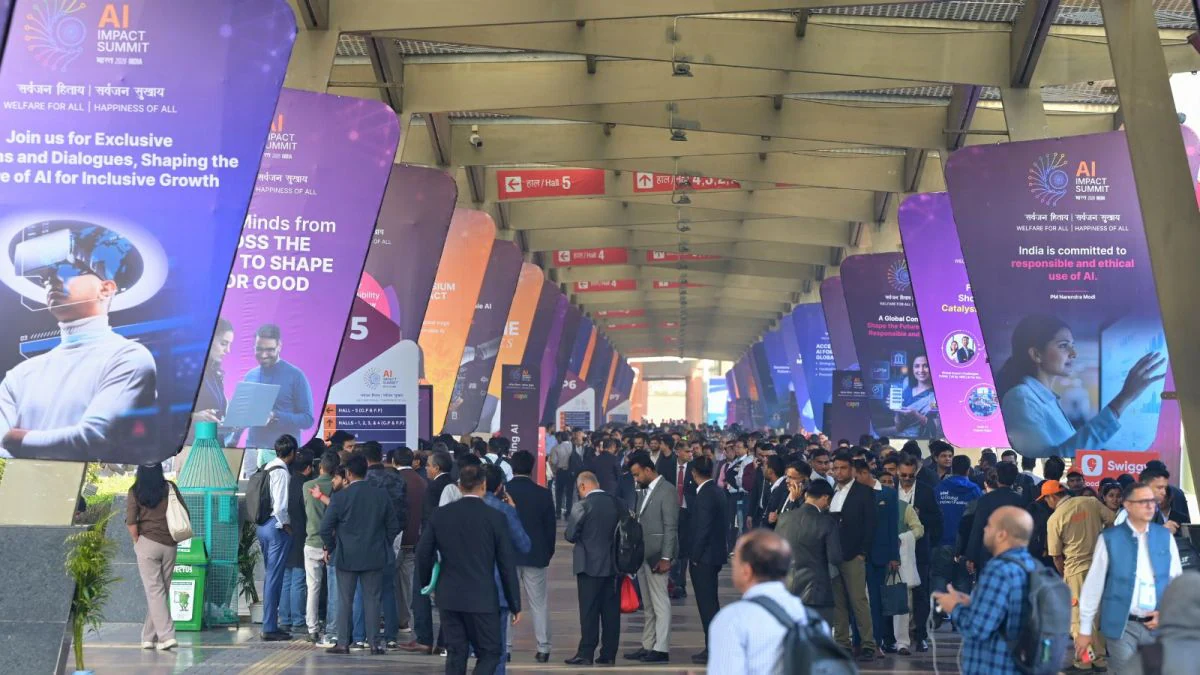
India has taken a bold step onto the global technology stage by hosting the AI Impact Summit 2026 in New Delhi from February 16–20 at the iconic Bharat Mandapam. The summit is drawing delegates from over 30 countries, including ministers, policymakers, innovators, and representatives from international organisations.
For India, this is more than just an event. It is a statement that the Global South is ready to shape the future of artificial intelligence, not just consume it.
Why the AI Impact Summit 2026 Matters Globally
A Historic Global South AI Gathering
The AI Impact Summit is being described as the first major international AI summit hosted in the Global South. Anchored around India’s three guiding principles—people, planet, and progress the event reflects a cooperative and inclusive approach to technology development.
The presence of global leaders, including the U.K. delegation led by David Lammy and AI Minister Kanishka Narayan, highlights the summit’s diplomatic and strategic importance.
Day one access has been restricted for official delegations, while the AI expo opens to the public from February 17, encouraging wider participation.
India and the U.K. as Natural Tech Partners
According to the U.K.’s Department for Science, Innovation and Technology, India and Britain are “natural tech partners.” Indian IT giants such as Infosys, Tata Consultancy Services, and Wipro have significantly expanded operations across the U.K.
British firms generate more than £47.5 billion in revenue from business activities in India, underlining the strong economic ties between the two countries.
The summit aims to deepen this partnership in AI research, governance, and commercial innovation.
How AI Can Supercharge Growth and Jobs
AI as an Engine of Economic Renewal
The U.K. delegation has emphasized that artificial intelligence can unlock economic growth, create high-quality jobs, and modernise public services.
David Lammy described the summit as a critical moment to ensure AI’s benefits are unlocked responsibly, with robust safety standards built in from the start.
Kanishka Narayan called AI “the defining technology of our generation,” stressing that its benefits should not be limited to a privileged few.
For India, this message resonates strongly. With one of the world’s youngest populations, AI-driven industries could generate employment in data science, robotics, cybersecurity, AI ethics, and advanced manufacturing.
Practical Examples of AI in Everyday Life
Artificial intelligence is already transforming sectors across India.
In healthcare, AI tools help doctors detect diseases like cancer through faster image analysis. In education, AI-powered platforms personalise learning for students based on strengths and weaknesses.
Municipal bodies can use AI to process citizen grievances within minutes instead of days. Businesses can automate routine tasks, enabling workers to focus on creative and strategic roles.
The promise is clear: AI can reduce waiting times, improve efficiency, and create new opportunities.
AI for Development: A Global Responsibility
AI4D Programme and Inclusive Innovation
The U.K. is expected to announce new initiatives under its £100 million AI for Development (AI4D) programme during the summit.
One initiative includes an African Language Hub, enabling AI systems to function in 40 African languages. Another initiative is the Asian AI4D Observatory to promote responsible AI governance across South and Southeast Asia.
The AI4D Compute Hub at the University of Cape Town will provide computing power for African innovators.
These initiatives reflect a broader understanding that AI must not widen global inequality.
Building Trust Through a Common Framework
Trust is central to AI adoption. Discussions at the summit are expected to focus on building a common regulatory framework that balances innovation with safety.
India’s approach stresses ethical AI development that protects citizens’ data while encouraging entrepreneurship.
Without trust, AI adoption will slow down. With trust, it can accelerate inclusive growth.
AI in Education: Tool, Not Shortcut
Preparing India’s Youth for AI
India’s Minister of State for Electronics and IT has stressed that AI should not be treated as a shortcut in education.
Students must learn computational thinking and understand how AI systems work. Using AI to complete homework without understanding concepts can harm critical thinking.
AI should be integrated into school curricula and higher education not just as a subject, but as a foundational skill.
Teachers as Enablers of Responsible AI Use
Teachers must guide students on how to use AI responsibly.
For example, AI tools can help draft essays or solve coding problems, but students must verify outputs and understand underlying principles.
AI is a powerful assistant, not a replacement for curiosity and learning.
India’s Strategic Position in the AI Era
From IT Services to AI Leadership
India has long been a global IT powerhouse. The AI Impact Summit signals a shift from outsourcing services to leading innovation.
With investments in next-generation telecom for rural communities, genomic medicine research, and advanced battery technology, India is positioning itself at the forefront of emerging technologies.
Bengaluru, often called India’s Silicon Valley, is expected to play a key role as U.K. ministers visit to explore collaborative projects.
A Message to the World
The AI Impact Summit 2026 sends a powerful message: India is not just participating in the AI revolution it is helping shape it.
Hosting such a high-profile summit reinforces India’s status as a leading emerging economy and a responsible global partner in technology governance.
For Indian entrepreneurs, students, and policymakers, the summit offers inspiration and opportunity.
The discussions in New Delhi this week may influence global AI policy for years to come.
As artificial intelligence continues to evolve, the real challenge will not be technological capability but ensuring that AI benefits everyone from doctors and teachers to farmers and small business owners.
If guided responsibly, AI could become a force that drives prosperity, sustainability, and social progress across India and beyond.
Related posts:
 BSSC Extends Inter Level Recruitment 2025 Registration Deadline Again
 Banking Connect Boosts Real-Time Monitoring and Transforms India’s Bill Payments
 India Introduces New Mandatory SIM Rule for Messaging Apps Nationwide
 NASA Artemis II Mission 2026: Humanity’s Moon-Fly Opportunity
 J&K age-relaxation row delays JKPSC exam amid political blame game
 Apple iOS 26.2 Update Brings Alarms, Lock Screen Changes
 KVS Recruitment 2025 Notification Released for 2499 Teaching Vacancies
 Google Dark Web Report Shutdown 2026: What Users Need Know
 China’s Superconducting Maglev Train Smashes Speed Record At 700 Kmph
 China Proposes AI Safety Rules for Human-Like Interaction and Ethics